
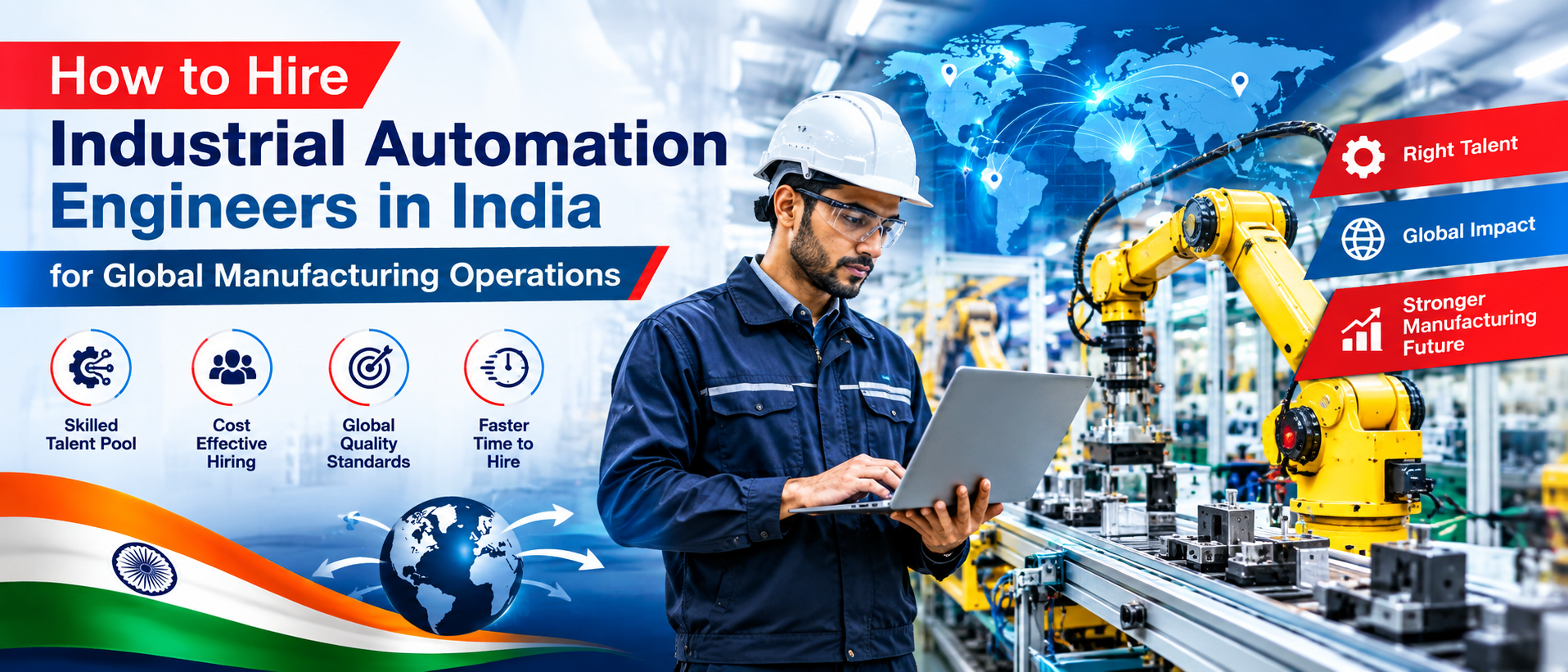
Why Global Manufacturers Are Looking to India for Automation Talent


Industrial automation is becoming an increasingly important part of modern manufacturing. Companies are investing in automated production lines, robotics, programmable logic controllers, supervisory control systems, industrial networks, machine vision and digital manufacturing technologies to improve productivity and operational consistency.
As manufacturing operations become more technologically advanced, finding engineers with the right combination of technical knowledge, industrial experience and practical problem-solving skills can become challenging.
India has a large engineering talent pool, making it an important sourcing market for companies seeking specialized technical professionals. For organizations expanding manufacturing operations across Europe and other international markets, structured recruitment can help identify candidates whose experience matches specific production environments.
Industrial Automation Engineers in India can support a broad range of manufacturing requirements, including control systems, PLC programming, SCADA, robotics, instrumentation, industrial communication and production-line automation.
For international employers, the objective should not simply be to recruit engineers with technical qualifications. The recruitment process should identify professionals who can work safely, communicate effectively, adapt to international working environments and support the specific automation technologies used by the employer.
Industrial Automation Engineers in India: Understanding the Talent Pool
India’s engineering ecosystem includes professionals from electrical, electronics, instrumentation, mechanical, mechatronics and automation backgrounds.
Depending on the manufacturing environment, employers may need engineers with experience in:
- PLC programming
- SCADA systems
- HMI development
- Industrial robotics
- Motion control
- Industrial networking
- Instrumentation
- Variable frequency drives
- Servo systems
- Control panels
- Machine vision
- Sensors and actuators
- Manufacturing execution systems
- Preventive and corrective maintenance
- Production-line commissioning
- Troubleshooting and fault diagnosis
A successful international recruitment strategy begins by identifying the exact technical requirements before advertising the position.
For example, a manufacturer using Siemens PLCs may require candidates with Siemens TIA Portal experience, while another facility may primarily use Allen-Bradley systems. Similarly, robotics experience may need to match specific platforms such as ABB, FANUC, KUKA or Yaskawa.
Therefore, employers should define the technology stack before beginning recruitment.
Hire Automation Engineers India: Building a Structured Recruitment Strategy
Companies looking to hire automation engineers India should create a recruitment process that evaluates both technical and professional capabilities.
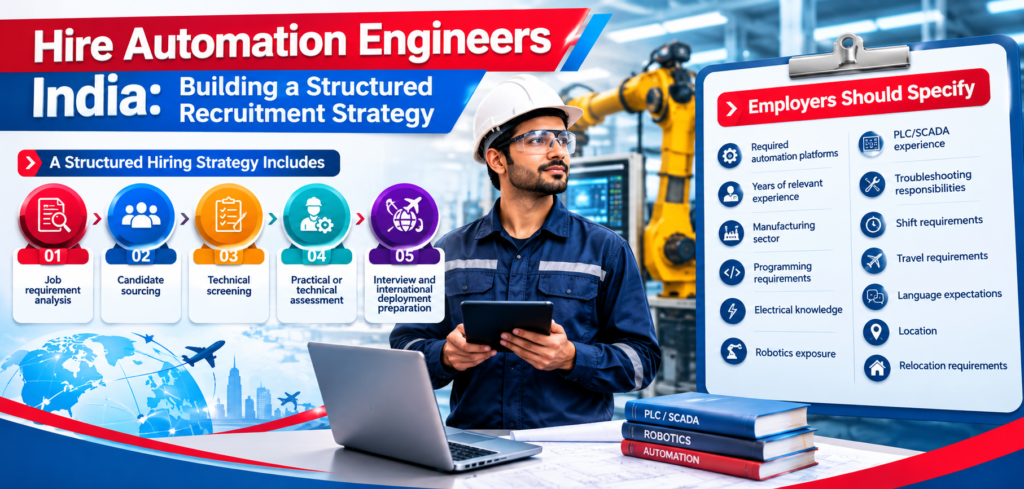
A structured hiring strategy can include five major stages:
- Job requirement analysis
- Candidate sourcing
- Technical screening
- Practical or technical assessment
- Interview and international deployment preparation
The first step is particularly important. A job description that simply states “automation engineer required” may attract a large number of candidates but may not identify the right technical profile.
Instead, employers should specify:
- Required automation platforms
- Years of relevant experience
- Manufacturing sector
- Programming requirements
- Electrical knowledge
- Robotics exposure
- PLC/SCADA experience
- Troubleshooting responsibilities
- Shift requirements
- Travel requirements
- Language expectations
- Location
- Relocation requirements
This creates a clearer recruitment funnel and helps international employers evaluate candidates more efficiently.
Industrial Automation Recruitment India: How International Employers Can Source Talent
Industrial automation recruitment India can be conducted through multiple channels, including specialized recruitment agencies, professional networks, engineering communities, technical institutes and digital recruitment platforms.
For international employers, working with an experienced recruitment partner can simplify candidate sourcing and initial screening.
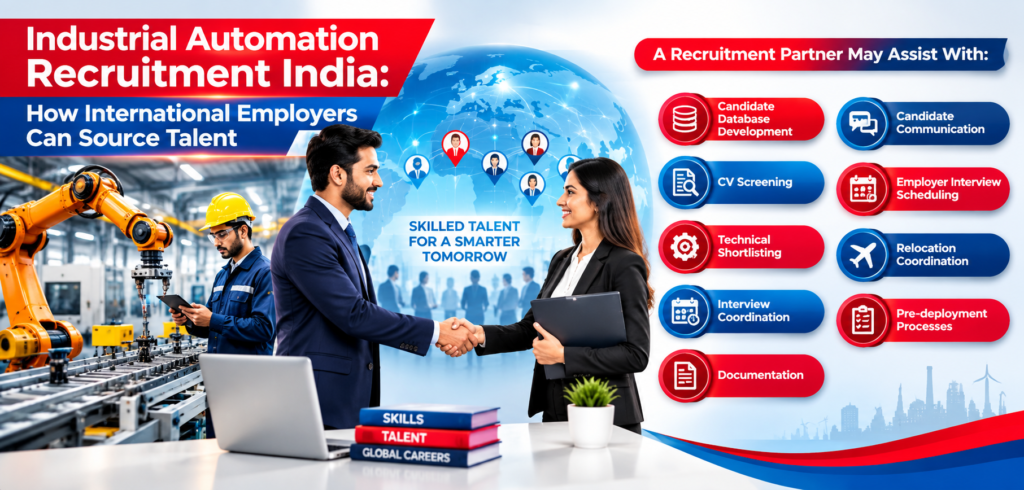
A recruitment partner may assist with:
- Candidate database development
- CV screening
- Technical shortlisting
- Interview coordination
- Documentation
- Candidate communication
- Employer interview scheduling
- Relocation coordination
- Pre-deployment processes
However, employers should clearly define responsibilities between the recruitment partner and the hiring company.
Technical decision-making should remain aligned with the employer’s actual production requirements.
Automation Engineers for Global Manufacturing: Skills Employers Should Evaluate
When recruiting automation engineers for global manufacturing, employers should evaluate more than academic qualifications.
Relevant technical capabilities may include PLC programming, SCADA configuration, HMI development, industrial communication and robotics integration.
Employers should also assess practical troubleshooting ability.
For example, an engineer may understand PLC programming theoretically but have limited experience diagnosing faults on an operating production line.
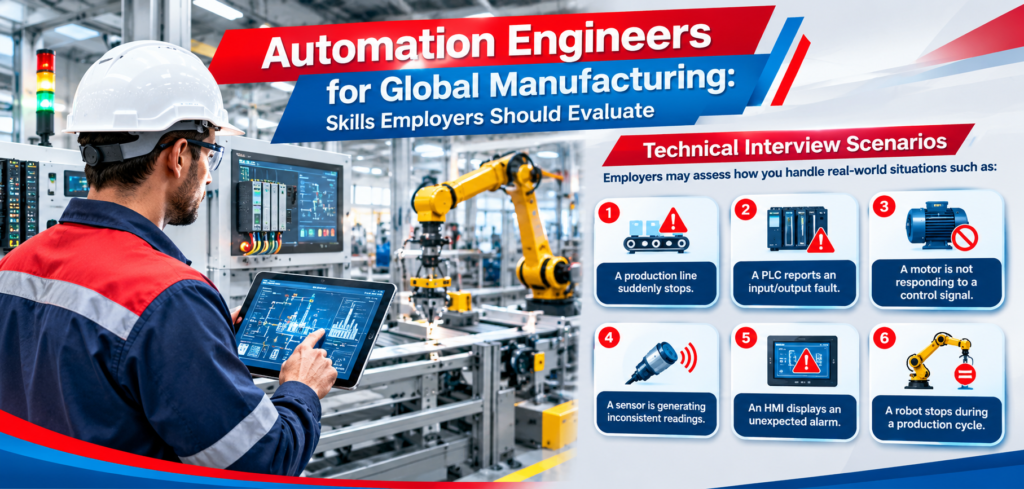
Technical interviews can therefore include practical scenarios such as:
- A production line suddenly stops.
- A PLC reports an input/output fault.
- A motor is not responding to a control signal.
- A sensor is generating inconsistent readings.
- An HMI displays an unexpected alarm.
- A robot stops during a production cycle.
Candidates can be asked to explain their troubleshooting methodology.
This approach provides employers with better insight into how candidates approach real industrial problems.
Manufacturing Automation Engineers: Experience That Matters
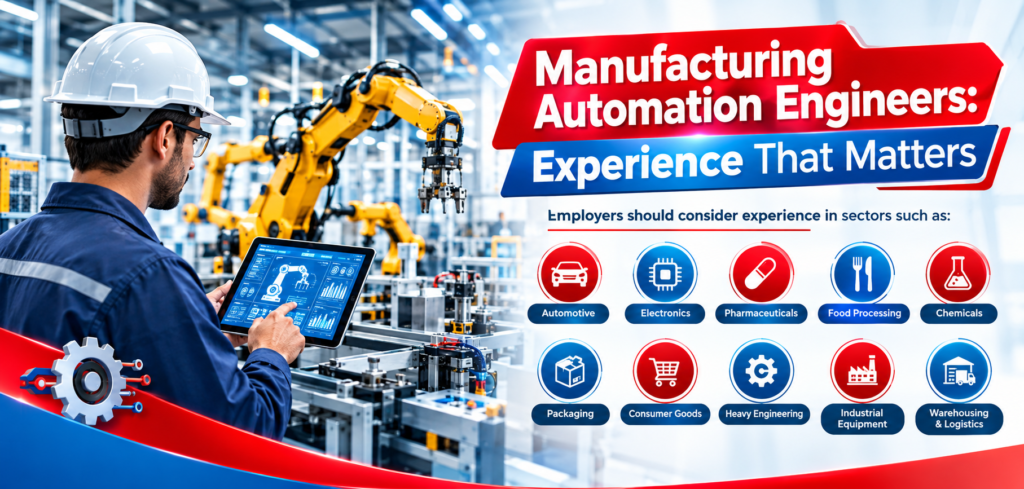
Manufacturing automation engineers work closely with production systems, which means industrial experience can be particularly valuable.
Employers should consider experience in sectors such as:
- Automotive
- Electronics
- Pharmaceuticals
- Food processing
- Chemicals
- Packaging
- Consumer goods
- Heavy engineering
- Industrial equipment
- Warehousing and logistics
The relevance of previous experience is often more important than simply counting total years of employment.
For example, an engineer with four years of automotive automation experience may be highly relevant to an automotive manufacturer, while a candidate with eight years of unrelated engineering experience may require more training.
Recruiters should therefore assess the candidate’s actual project history.
PLC SCADA Engineers India: Finding Candidates With Control-System Expertise
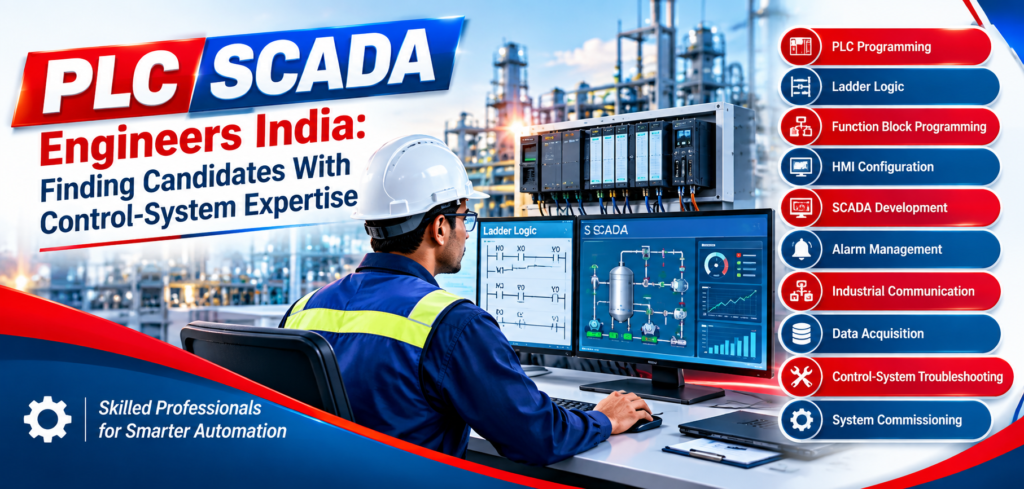
PLC SCADA engineers India are particularly relevant for manufacturing facilities that depend on programmable control systems and centralized monitoring.
Recruiters should identify candidates with experience in the PLC and SCADA platforms relevant to the employer.
Potential areas of assessment include:
- PLC programming
- Ladder logic
- Function block programming
- HMI configuration
- SCADA development
- Alarm management
- Industrial communication
- Data acquisition
- Control-system troubleshooting
- System commissioning
Candidates should also be able to explain projects they personally worked on rather than simply listing software names on their CV.
A useful interview question is:
“Describe an automation project you personally commissioned and explain the most difficult technical problem you encountered.”
The answer can reveal practical experience, ownership and troubleshooting ability.
Robotics Engineers India: Recruiting for Advanced Production Systems
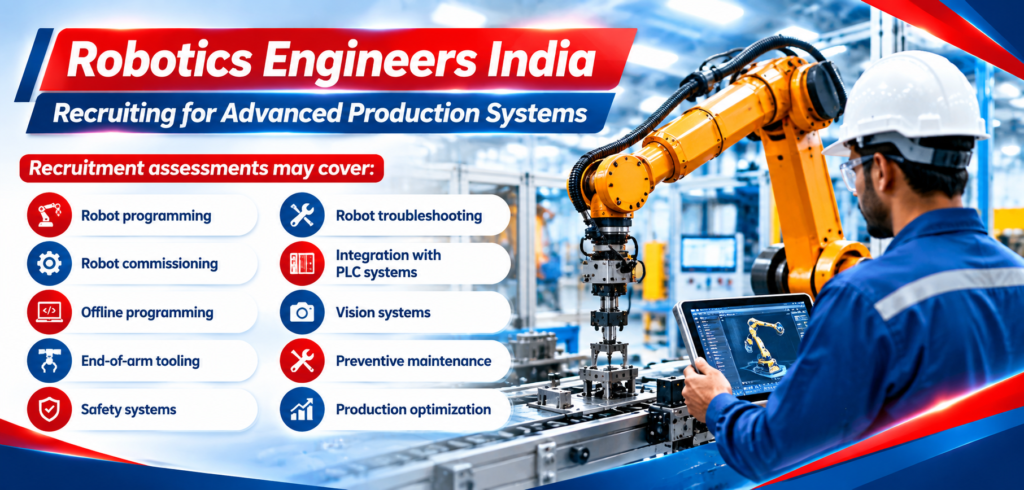
The demand for automation increasingly includes industrial robotics.
Robotics engineers India can support manufacturing operations involving robotic welding, assembly, material handling, palletizing, machine tending and other automated processes.
Employers should identify the robot platforms and applications used at their facilities.
Recruitment assessments may cover:
- Robot programming
- Robot commissioning
- Offline programming
- End-of-arm tooling
- Safety systems
- Robot troubleshooting
- Integration with PLC systems
- Vision systems
- Preventive maintenance
- Production optimization
Candidates who have worked on complete robotic cells may offer experience across multiple parts of the automation process.
Automation Talent for Europe: Preparing Engineers for International Manufacturing

Automation talent for Europe needs to meet both technical and workplace requirements.
European manufacturing operations can involve sophisticated production systems, strict safety procedures and detailed documentation requirements.
International employers should therefore assess:
- Technical competence
- Industrial safety awareness
- Documentation skills
- Communication
- Teamwork
- Adaptability
- Problem-solving
- Willingness to relocate
- Ability to work with multicultural teams
Employers should also clearly explain employment conditions, workplace expectations, location and relocation requirements during the recruitment process.
Transparent communication helps candidates make informed decisions about international opportunities.
Hire Engineers for Germany Manufacturing: Key Recruitment Considerations
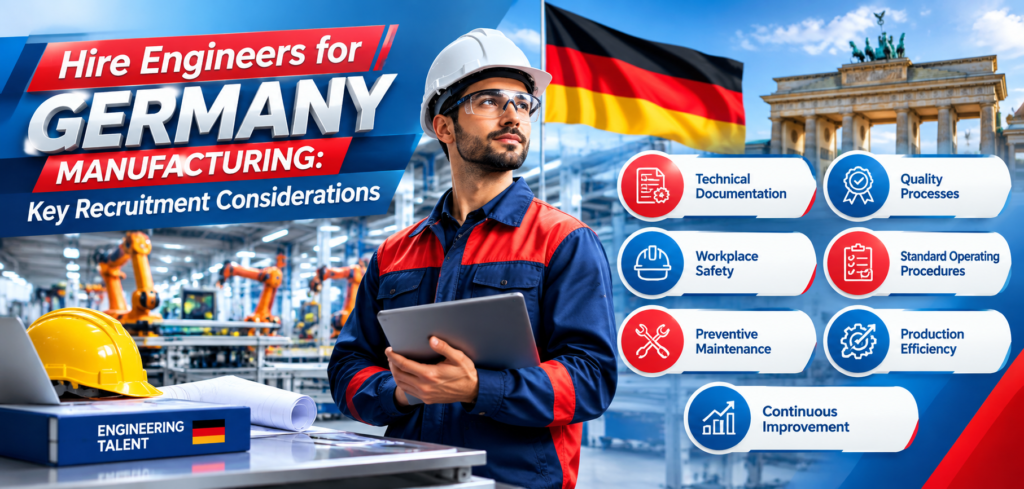
Companies seeking to hire engineers for Germany manufacturing should define their technical and workplace requirements before sourcing candidates.
Manufacturing employers may seek professionals experienced in automation systems, robotics, electrical controls, industrial networking and production-line integration.
German manufacturing environments may also place strong emphasis on:
- Technical documentation
- Quality processes
- Workplace safety
- Standard operating procedures
- Preventive maintenance
- Production efficiency
- Continuous improvement
Candidates should be evaluated against the employer’s specific requirements rather than being selected solely because they have experience with a particular technology.
Language requirements should also be clearly communicated where relevant to the position.
Automation Engineers for Netherlands: Building an International Engineering Workforce
Organizations looking for automation engineers for Netherlands can consider Indian engineering talent for specialized manufacturing requirements where the candidate’s skills match the employer’s needs.
Potential profiles include:
- Automation engineers
- Controls engineers
- PLC programmers
- Robotics engineers
- Electrical automation engineers
- Commissioning engineers
- Maintenance automation specialists
Recruitment should focus on matching technical experience with the actual production environment.
Employers should also explain relocation, work location, working hours and other employment conditions during the recruitment process.
Industrial Engineers for Poland: Supporting Manufacturing Expansion
Companies recruiting industrial engineers for Poland may require professionals who understand automation, production systems, process optimization and industrial engineering principles.
Depending on the position, relevant experience may include:
- Production-line optimization
- Lean manufacturing
- Process improvement
- Automation integration
- Production planning
- Quality improvement
- Industrial engineering
- Equipment efficiency
A well-defined job description helps recruitment teams identify candidates with the right combination of engineering and manufacturing experience.
Automation Recruitment for Czech Republic: Identifying Specialized Technical Talent
Automation recruitment for Czech Republic can focus on candidates with experience in industrial control systems, robotics, PLC programming and production automation.
Manufacturers should identify the technologies used in their facilities and use those requirements during candidate screening.
Technical assessments can include practical scenarios related to:
- PLC troubleshooting
- Machine downtime
- Robot faults
- Electrical control systems
- Sensor failures
- Production-line communication
- Preventive maintenance
This provides employers with a clearer understanding of candidates’ practical capabilities.
Automation Engineers for Italy: Matching Skills With Manufacturing Needs
Manufacturing companies seeking automation engineers for Italy can develop targeted recruitment campaigns based on their production technologies.
Candidate screening can consider experience in:
- Industrial automation
- PLC programming
- Robotics
- SCADA
- Electrical controls
- Machine integration
- Commissioning
- Production maintenance
Recruiters should also verify employment history and project experience to ensure that candidates’ CV claims correspond with their actual responsibilities.
Manufacturing Engineers for France: Recruiting for Modern Production Environments
Companies searching for manufacturing engineers for France may require professionals who combine engineering knowledge with practical production experience.
Depending on the organization, relevant capabilities may include automation, production engineering, process improvement and equipment integration.
A strong recruitment process should evaluate candidates based on the actual requirements of the position, including technical systems, manufacturing sector and project responsibilities.
International employers should also provide clear information about the role and relocation process.
Industrial Automation Hiring Europe: Creating a Scalable Recruitment Model
Industrial automation hiring Europe can become more efficient when employers use a standardized recruitment framework.
A scalable model can include:
Step 1: Define the Technical Profile
Identify the exact PLC, SCADA, robotics and industrial automation technologies required.
Step 2: Define the Experience Level
Specify whether the position requires junior, mid-level or senior engineering experience.
Step 3: Build the Candidate Pipeline
Use specialized recruitment channels to identify relevant Indian engineering professionals.
Step 4: Conduct Technical Screening
Shortlist candidates according to their actual project experience.
Step 5: Employer Interview
Allow the international employer to conduct the final technical and behavioral assessment.
Step 6: Documentation and Relocation
Once selected, candidates can proceed through the applicable documentation, employment and relocation processes.
This structure can help reduce unnecessary screening and create a more consistent international recruitment process.
Global Manufacturing Recruitment: Why Technical Matching Matters
Global manufacturing recruitment requires a different approach from conventional recruitment because technical requirements can vary significantly between factories.
A candidate who is suitable for one manufacturing plant may not necessarily be suitable for another.
For this reason, employers should evaluate:
- Technology compatibility
- Sector experience
- Project history
- Technical qualifications
- Troubleshooting capability
- Safety awareness
- Communication
- International mobility
Recruitment agencies and employers should maintain clear communication throughout the process.
Indian Engineering Manpower: A Resource for International Employers
Indian engineering manpower can provide international manufacturers with access to professionals across multiple engineering disciplines.
The country’s engineering ecosystem includes professionals specializing in automation, electrical engineering, electronics, mechanical engineering, instrumentation, robotics and industrial systems.
For international companies, the value of an overseas recruitment strategy depends on effective candidate matching.
Instead of focusing only on candidate volume, recruitment teams should prioritize:
Relevant skills + relevant experience + technical assessment + employer validation.
This approach can improve the quality of international hiring processes.
Skilled Automation Workforce India: Building Long-Term Manufacturing Capability
A skilled automation workforce India can support international companies seeking specialized engineering talent.
However, employers should consider long-term workforce requirements rather than hiring only for immediate vacancies.
For example, a manufacturer expanding its production capacity may need multiple categories of professionals:
- Automation engineers
- PLC programmers
- Robotics engineers
- Electrical engineers
- Maintenance engineers
- Controls engineers
- Commissioning engineers
Developing a structured talent pipeline can make future recruitment more efficient.
European Manufacturing Operations: Preparing Indian Engineers for International Roles
European manufacturing operations may involve different workplace procedures, documentation standards and organizational structures.
Candidates should receive clear information about the working environment before accepting an international assignment.
Recruitment teams can help candidates understand:
- Job responsibilities
- Workplace expectations
- Location
- Working schedule
- Relocation requirements
- Documentation
- Employer interview process
- Pre-departure requirements
Employers should also communicate technical expectations clearly.
The objective is to create alignment between the candidate and the employer before deployment.
International Engineering Recruitment: A Step-by-Step Hiring Process
International engineering recruitment becomes more manageable when organizations use a clearly defined process.
1. Workforce Planning
Determine the number and type of engineers required.
2. Technical Job Description
Define technologies, responsibilities and experience requirements.
3. Candidate Sourcing
Search for qualified engineering professionals through specialized recruitment channels.
4. CV Screening
Review qualifications, industrial experience and project history.
5. Technical Evaluation
Conduct technical interviews or assessments.
6. Employer Interview
Allow the hiring organization to make the final candidate assessment.
7. Selection and Documentation
Complete applicable employment and documentation procedures.
8. Relocation Preparation
Provide candidates with relevant information about their international assignment.
9. Joining and Onboarding
Support the transition into the employer’s manufacturing environment.
How Employers Can Improve Industrial Automation Recruitment From India
International manufacturers can improve recruitment outcomes by avoiding overly broad job descriptions.
Instead, recruitment requirements should answer specific questions:
- Which PLC platform is required?
- Is SCADA experience mandatory?
- Which robotics platform is used?
- What manufacturing sector experience is preferred?
- Is commissioning experience required?
- How much industrial experience is necessary?
- Is international travel involved?
- Is relocation required?
- Are language skills necessary?
The more precisely these requirements are defined, the easier it becomes to identify relevant candidates.
Building a Global Automation Workforce Through India
The increasing use of automation is creating demand for engineers who can manage sophisticated manufacturing technologies, troubleshoot production systems and support continuous improvement.
India offers a broad engineering talent pool that can be considered by international manufacturers looking to build specialized teams.
From Industrial Automation Engineers in India and PLC SCADA engineers India to robotics engineers India, employers can develop targeted recruitment strategies around their specific technical requirements.
For companies expanding across Germany, the Netherlands, Poland, the Czech Republic, Italy, France and other European markets, structured sourcing and technical evaluation can help create a more focused recruitment process.
The key is not simply to find more candidates. It is to identify engineers whose technical experience, manufacturing background and professional capabilities align with the employer’s actual requirements.
With effective industrial automation recruitment India, transparent communication and employer-led technical assessment, organizations can build a stronger pipeline for global manufacturing recruitment and international engineering requirements.
Leave a Reply