
A Golden Opportunity to Work in Japan’s Food Service Industry

Imagine working in one of the most advanced, disciplined, and culturally rich countries in the world—Japan. Now imagine doing that with a stable income, a long-term visa, and a government-authorised recruitment process backing you up. That’s exactly what H.R. International is offering with its urgent recruitment for food service industry jobs in Tokyo. These opportunities are not just jobs; they are life-changing career pathways designed for individuals who want global exposure, professional growth, and financial stability.
Japan’s food service industry is booming like never before. From traditional ramen shops tucked away in narrow streets to high-end international restaurants in Tokyo’s bustling districts, the demand for skilled kitchen staff and front-of-house professionals is soaring. Due to an aging population and labor shortages, Japan has opened its doors to foreign workers under the Specified Skilled Worker (SSW) visa program, creating a golden chance for eligible candidates.
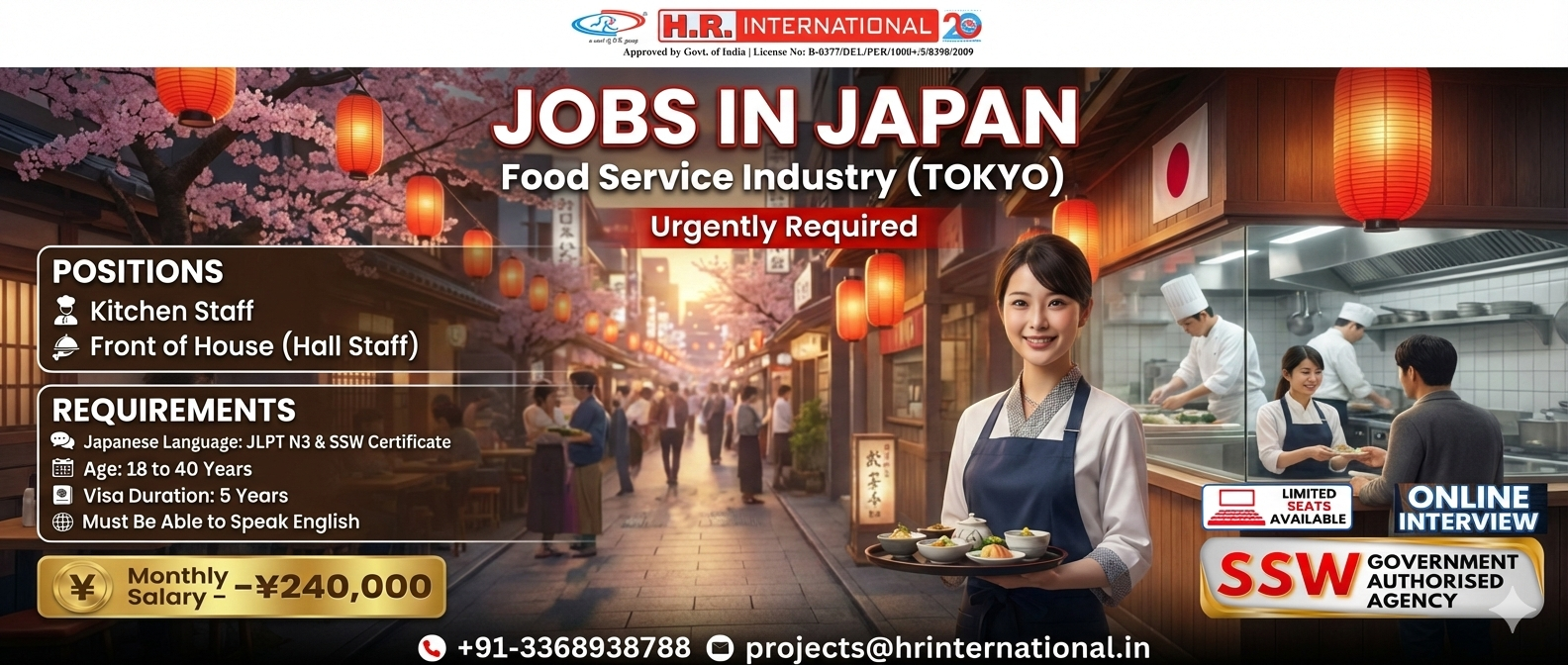
This opportunity comes with a monthly salary of ¥240,000, a 5-year visa duration, and the chance to work legally in Japan under a government-authorised agency. The process includes online interviews, making it accessible even if you’re applying from overseas. However, seats are limited, and competition is high, which means timing is everything.
If you meet the eligibility criteria—JLPT N3 level Japanese, SSW certification, English communication skills, and are between 18 to 40 years of age—this could be the opportunity you’ve been waiting for. Let’s break down everything you need to know, step by step, so you can make an informed and confident decision about your future in Japan.
Japan’s Food Service Industry: A Global Employment Hub
Japan’s food service industry is more than just restaurants and cafes—it’s a massive ecosystem that reflects the country’s dedication to quality, precision, and customer satisfaction. Tokyo alone hosts tens of thousands of dining establishments, serving locals, tourists, and business travelers from around the world. This constant demand for food services has created a significant need for skilled and semi-skilled workers, especially in roles like kitchen staff and hall staff.
What makes Japan unique is its commitment to consistency and excellence. Whether it’s a small sushi bar or a large restaurant chain, every establishment follows strict hygiene standards, structured workflows, and a deep respect for customer service. For foreign workers, this environment offers something invaluable: structured learning and professional discipline. You’re not just earning money; you’re building habits and skills that are respected globally.
Tokyo, in particular, is the beating heart of this industry. As the capital city, it experiences constant foot traffic, international events, and a vibrant nightlife. Restaurants operate long hours, and many struggle to find enough local workers willing to take on demanding schedules. This gap is where foreign workers step in, supported by the SSW visa system.
For job seekers, this means stability. The food service industry is recession-resistant—people always need to eat. Even during economic downturns, restaurants adapt rather than shut down completely. That’s why working in this sector in Japan is considered a safe and reliable career choice, especially for those seeking overseas employment.
Why Tokyo Is the Heart of Hospitality Jobs
Tokyo isn’t just a city; it’s a universe of opportunities. From Shibuya and Shinjuku to Ginza and Akihabara, every area has its own food culture and customer base. This diversity creates a constant demand for workers who can adapt, learn, and deliver consistent service.
One of the biggest advantages of working in Tokyo is exposure. You’ll interact with people from different cultures, learn international service standards, and gain experience that looks impressive on any global resume. Employers in Tokyo are also known for providing structured training, even for entry-level roles. This means you don’t need years of experience—just the right attitude and basic skills.
Another key factor is income stability. While Tokyo has a higher cost of living compared to rural areas, it also offers higher salaries and better infrastructure. With a ¥240,000 monthly salary, careful budgeting can still allow you to save money, especially if accommodation and transport options are well-managed.
Tokyo’s public transportation system is world-famous for its efficiency. This makes commuting easy and affordable, reducing daily stress. Combine that with access to healthcare, safety, and a clean environment, and you begin to see why Tokyo is such an attractive destination for foreign workers in the hospitality sector.
About H.R. International – A Government Authorised SSW Agency
When it comes to overseas employment, trust is everything. H.R. International stands out because it is a government-authorised agency operating under the SSW framework. This authorization is not just a label—it’s a guarantee that the recruitment process follows legal, ethical, and transparent standards.
Many job seekers fall into traps set by fake agents or unverified recruiters. H.R. International eliminates that risk by offering verified job placements, proper documentation support, and clear communication throughout the process. From application to online interview and visa processing, candidates are guided step by step.
Another major advantage of working with a government-authorised agency is compliance. This means your employment contract, salary structure, working hours, and visa conditions align with Japanese labor laws. You’re protected, supported, and informed at every stage.
H.R. International also understands the emotional side of overseas employment. Moving to another country is a big decision, and candidates often have concerns about language, culture, and job security. By providing accurate information and consistent support, the agency helps reduce uncertainty and builds confidence.
Understanding the SSW Visa for Japan
The Specified Skilled Worker (SSW) visa was introduced by the Japanese government to address labor shortages in key industries, including food service. This visa allows foreign nationals to work legally in Japan for up to five years, making it one of the most attractive work visa options currently available.
Unlike temporary or seasonal visas, the SSW visa offers stability. You can live, work, and earn in Japan without constantly worrying about short-term renewals. For many workers, this long duration opens doors to better financial planning, skill development, and even future opportunities within Japan or other countries.
The SSW visa also ensures fair treatment. Employers hiring under this program must meet strict criteria, including fair wages and proper working conditions. This protects workers from exploitation and ensures a professional working environment.
For the food service industry, the SSW visa is a game-changer. It allows restaurants to hire motivated foreign workers who are willing to learn, adapt, and contribute long-term. For workers, it’s a chance to build a solid career foundation in one of the world’s most respected economies.
Job Positions Available in Tokyo’s Food Service Sector
The current openings through H.R. International focus on two key roles: Kitchen Staff and Front of House (Hall Staff). Both positions are essential to restaurant operations and offer hands-on experience in Japan’s hospitality industry.
Kitchen Staff Roles and Responsibilities
Kitchen staff are the backbone of any food establishment. In Japan, this role goes beyond basic cooking. You’ll be involved in food preparation, ingredient handling, cleaning, and maintaining strict hygiene standards. Precision and consistency are highly valued, and even simple tasks are performed with care and attention.
Working as kitchen staff also helps you understand Japanese food culture from the inside. You’ll learn how kitchens are organized, how teamwork functions under pressure, and how efficiency is maintained during peak hours. Over time, this experience can lead to more responsibilities and better positions.
Front of House (Hall Staff) Roles and Responsibilities
Hall staff are the face of the restaurant. This role involves greeting customers, taking orders, serving food, and ensuring a pleasant dining experience. Communication skills are crucial, which is why Japanese language proficiency (JLPT N3) and basic English skills are required.
In Japan, customer service is treated as an art. As hall staff, you’ll learn how to anticipate customer needs, handle requests politely, and maintain professionalism at all times. These skills are transferable and highly valued in hospitality industries worldwide.
Salary and Benefits: What ¥240,000 Monthly Means for You
At first glance, a monthly salary of ¥240,000 might just look like a number. But when you break it down in the context of Japan’s food service industry—especially in Tokyo—it represents stability, dignity, and opportunity. For many international workers, this salary is a strong starting point that allows them to live comfortably while gaining valuable overseas work experience.
Tokyo is known for its higher cost of living, but it is also known for efficiency. Expenses like transportation are well-organized and affordable thanks to Japan’s world-class public transit system. Many food service workers spend significantly less on commuting compared to other global cities. Accommodation costs can vary, but shared housing or employer-assisted arrangements help keep expenses manageable.
Beyond the base salary, the real value lies in consistency and legality. Your income is protected under Japanese labor law, meaning timely payment, regulated working hours, and a structured work environment. Overtime, if applicable, is usually compensated according to legal standards. This predictability allows workers to budget, save, and even send money back home without constant stress.
Another overlooked benefit is lifestyle quality. Japan offers clean cities, low crime rates, excellent healthcare, and a respectful work culture. When you combine a stable income with these factors, the overall quality of life becomes a major advantage. Over time, as you gain experience and adapt to the work culture, opportunities for better roles and higher earnings often follow.
Eligibility Criteria Explained Clearly
Understanding eligibility is crucial because Japan’s SSW program is structured and strict—but fair. The requirements are designed to ensure that workers can integrate smoothly into the workplace and society.
Age Requirement: 18 to 40 Years
The age range of 18 to 40 years is ideal for physically active roles in the food service industry. Restaurants often require workers who can handle long hours on their feet, multitask during peak times, and adapt quickly to fast-paced environments. This age bracket also aligns with Japan’s long-term workforce planning under the SSW visa.
Japanese Language Requirement: JLPT N3
The JLPT N3 level ensures you can understand everyday Japanese used at work. This includes following instructions, reading basic notices, and communicating with coworkers and customers. You don’t need to be fluent like a native speaker, but you should be comfortable enough to function independently in a restaurant setting.
SSW Certificate Requirement
The SSW certificate proves that you have the basic skills and knowledge required for the food service industry. It reassures employers that you understand industry standards and can contribute effectively from day one. This certification is a cornerstone of the SSW visa process.
English Language Skills
While Japanese is essential, basic English communication skills are also required. Many restaurants in Tokyo serve international customers, and English helps bridge communication gaps. Even simple conversational ability can make a big difference in customer service roles.
Japanese Language Skills: Why JLPT N3 Matters
Language is more than just words—it’s connection, confidence, and competence. In Japan’s food service industry, JLPT N3 is not just a requirement; it’s a survival tool. It allows you to understand instructions from supervisors, coordinate with coworkers, and respond appropriately to customers.
Imagine a busy dinner rush. Orders are coming in fast, instructions are being shouted across the kitchen, and timing is everything. In such moments, language clarity prevents mistakes and reduces stress. JLPT N3 ensures you can keep up with this pace.
Outside of work, language skills enhance your daily life. From shopping at local stores to asking for directions or visiting a doctor, Japanese proficiency gives you independence. It also helps you integrate into society, build friendships, and truly experience life in Japan rather than feeling like an outsider.
Many workers find that once they start working in Japan, their language skills improve rapidly. Daily exposure, repetition, and real-life usage accelerate learning. What starts as basic communication often grows into confidence and fluency over time.
Online Interview Process: Step-by-Step Guide
One of the most convenient aspects of this opportunity is the online interview process. You don’t need to travel or spend extra money just to attend an interview. Everything is handled digitally, making the process efficient and accessible.
The interview typically focuses on three areas: your motivation, your basic skills, and your communication ability. Interviewers want to know why you want to work in Japan, whether you understand the nature of food service work, and if you can communicate at the required level in Japanese and English.
Preparation is key. Practice basic Japanese phrases related to food service. Be honest about your experience and show willingness to learn. Japanese employers value attitude as much as skill—sometimes even more.
Dress professionally, choose a quiet environment, and ensure your internet connection is stable. These small details reflect your seriousness and professionalism. Remember, the interview is not just about testing you—it’s about seeing if you’re a good fit for a long-term role.
Limited Seats Available: Why Early Application Is Critical
This is not an open-ended opportunity. Limited seats mean exactly that—once positions are filled, applications close. Japan’s food service industry has high demand, and government-authorised agencies like H.R. International receive applications from many candidates.
Delaying your application could mean missing out entirely. Early applicants often have a better chance of securing interviews and choosing from available roles. It also gives you more time to prepare documents, language skills, and mental readiness for relocation.
Think of it like boarding a train—once it leaves the station, you can’t catch it by standing still. Acting early shows initiative and commitment, qualities that employers appreciate.
Life in Tokyo as a Food Service Worker
Living in Tokyo is an experience unlike any other. The city blends tradition and modernity seamlessly. As a food service worker, you’ll be part of the daily rhythm that keeps this massive city running.
Work culture in Japan is disciplined but respectful. Punctuality, cleanliness, and teamwork are taken seriously. At first, this structure may feel strict, but many workers grow to appreciate the clarity and fairness it brings.
Outside of work, Tokyo offers endless possibilities. From affordable local meals to cultural festivals, parks, and shopping districts, there’s always something to explore. Even simple pleasures—like walking through a quiet neighborhood or visiting a convenience store—feel unique in Japan.
Transportation is efficient, safe, and reliable. Trains run on time, and stations are well-connected. This makes commuting stress-free and allows you to explore the city easily, even on your days off.
Career Growth Opportunities in Japan’s Hospitality Industry
Starting as kitchen staff or hall staff doesn’t mean staying there forever. Japan’s hospitality industry values experience and loyalty. Workers who show dedication, improve their language skills, and maintain a positive attitude often find opportunities for growth.
You may take on supervisory roles, specialize in certain tasks, or move to better establishments. The skills you gain—discipline, teamwork, customer service—are transferable globally. Even if you eventually choose to work in another country, experience in Japan carries strong weight.
For many, the five-year SSW period becomes a foundation for long-term career planning. It’s not just about earning—it’s about building a future.
Challenges You Should Be Prepared For
No overseas job is without challenges. Cultural differences, language barriers, and homesickness are common experiences. Japanese work culture can be demanding, and expectations are high.
However, these challenges also lead to personal growth. Adapting to a new culture builds resilience, confidence, and independence. Most workers find that initial difficulties fade as they settle into routines and form connections.
Being mentally prepared and open-minded makes a huge difference. The rewards—professional growth, financial stability, and global exposure—often outweigh the challenges.
How to Apply Through H.R. International
Applying through H.R. International is straightforward. As a government-authorised agency, they guide you through documentation, interview preparation, and visa processing.
For inquiries and applications:
Contact Number: +91-8368938788
Email: projects@hrinternational.in
Make sure your documents are ready, including language certificates and identification. Clear communication and timely responses help speed up the process.
Why This Opportunity Can Change Your Life
This is more than a job—it’s a doorway to international experience, structured career growth, and personal transformation. Working in Japan teaches discipline, respect, and professionalism that stay with you for life.
Financially, a stable income in a strong economy provides security. Professionally, international exposure boosts your profile. Personally, living in Japan broadens your worldview.
Opportunities like this don’t come often—and when they do, they demand action.
Take the First Step Toward Your Japan Career
The H.R. International food service jobs in Tokyo offer a rare combination of legality, stability, and growth. With a ¥240,000 monthly salary, 5-year SSW visa, and government-authorised recruitment, this opportunity stands out in today’s overseas job market.
If you meet the requirements and are ready for a new chapter, now is the time to act. Japan is waiting—and your future could begin with one decision.
FAQs
- Is prior experience required for these food service jobs?
Basic experience helps, but attitude, certification, and language skills are more important. - Can I save money with a ¥240,000 salary in Tokyo?
Yes, with smart budgeting and shared accommodation, savings are possible. - Is the SSW visa extendable?
The SSW visa allows work in Japan for up to five years. - Are online interviews mandatory?
Yes, the recruitment process includes online interviews for convenience. - Is this recruitment process legal and safe?
Yes, H.R. International is a government-authorised SSW agency.
Leave a Reply