
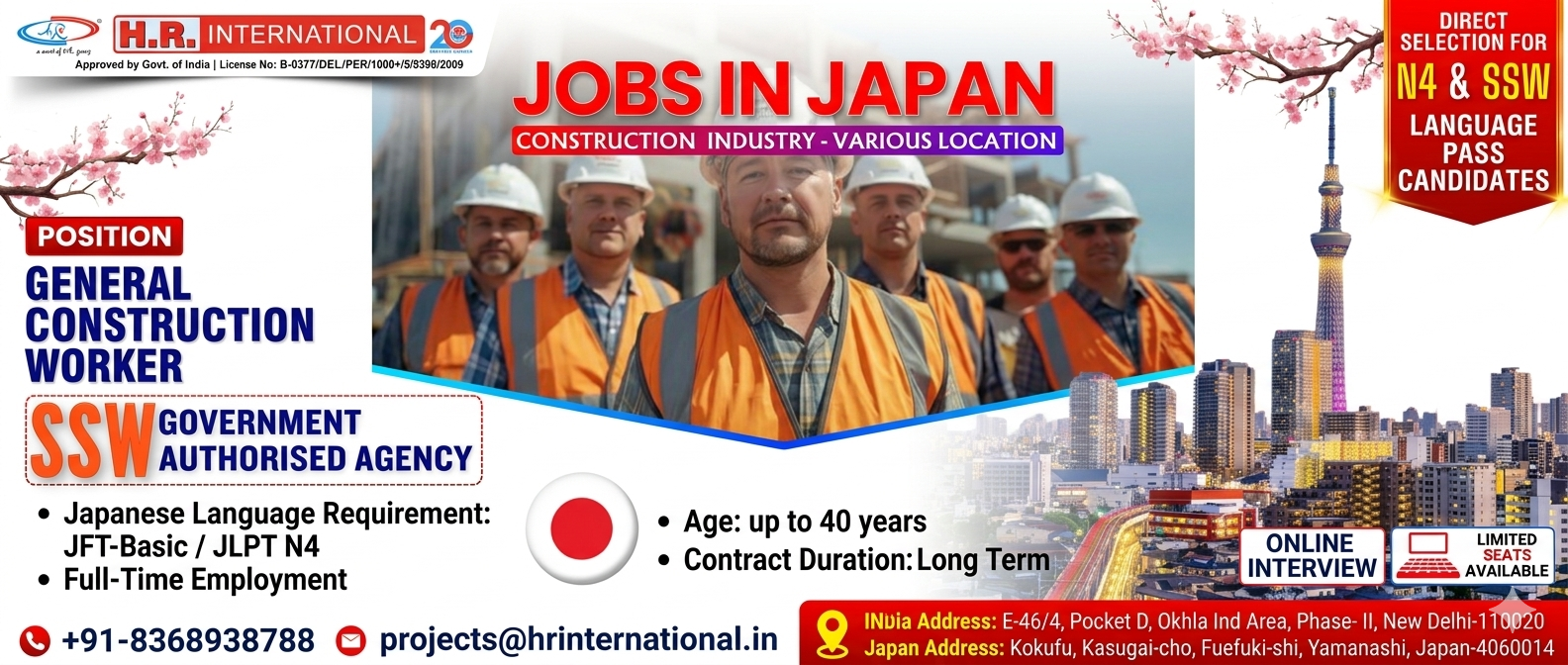
Understanding Direct Selection for Japan Jobs

What is Direct Selection in Overseas Recruitment
Direct selection is one of the most efficient and transparent hiring processes for candidates aiming to work abroad, especially in countries like Japan where structured recruitment is taken very seriously. Unlike traditional recruitment channels that involve multiple intermediaries, direct selection allows candidates to connect with employers or authorized agencies without unnecessary delays or hidden complications. This streamlined approach ensures that applicants are evaluated purely on their qualifications, skills, and readiness to work, rather than on connections or lengthy bureaucratic processes.
When it comes to Japan, direct selection becomes even more significant because the country maintains strict immigration and labor policies. Employers prefer candidates who meet specific criteria, especially in language proficiency and technical capability. That’s where programs like the Specified Skilled Worker (SSW) visa category come into play. Candidates who have passed JLPT N4 or JFT-Basic are already ahead in the game, as they meet the fundamental language requirement needed to adapt to Japanese work culture.
Imagine skipping the confusion and going straight to the source—that’s exactly what direct selection offers. Candidates can attend online interviews, present their abilities directly, and receive quicker responses compared to conventional hiring routes. It also reduces the risk of fraud, as authorized agencies like H.R. International ensure compliance with government standards. For job seekers in India, this model is becoming increasingly attractive, especially for industries like construction where Japan has a growing demand.
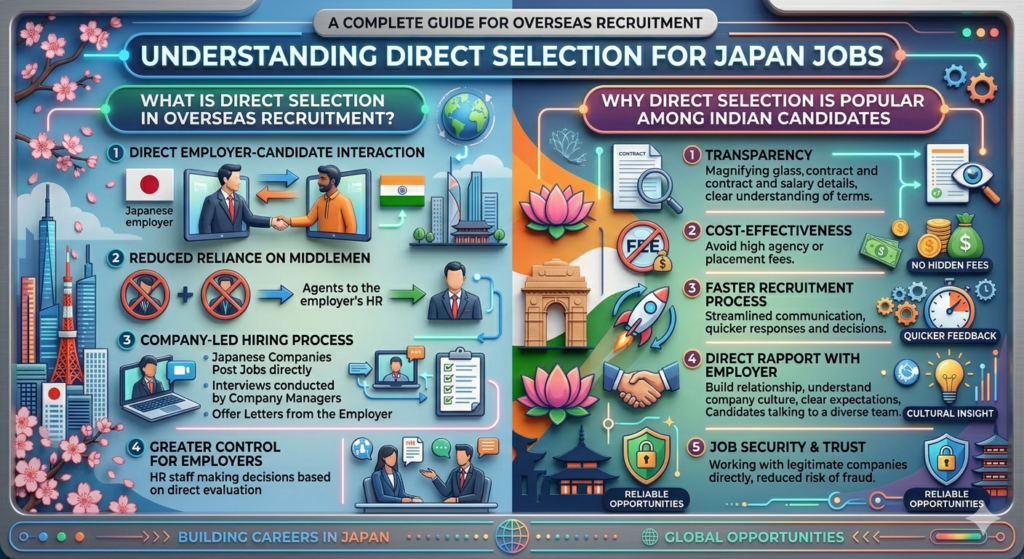
Why Direct Selection is Popular Among Indian Candidates
Indian candidates are increasingly gravitating toward direct selection opportunities for Japan, and the reasons are quite practical. First, there’s clarity. When a recruitment process is direct, candidates know exactly what is expected—from language requirements to job roles and salary structures. There’s no ambiguity, which often plagues indirect hiring methods.
Another major factor is speed. Traditional overseas recruitment can take months, sometimes even longer, due to multiple approval layers. Direct selection, particularly with online interviews, significantly reduces this timeline. Candidates can apply, get shortlisted, and attend interviews from the comfort of their homes. This convenience is especially valuable for working individuals who cannot afford to take extended time off just to attend physical interviews.
Cost-effectiveness also plays a big role. With fewer intermediaries involved, candidates often face lower processing fees. Authorized agencies like H.R. International ensure transparency in charges, which builds trust among applicants. In addition, candidates feel more secure knowing that they are dealing with a government-authorised agency, reducing the chances of scams or misleading job offers.
There’s also a psychological advantage. Direct interaction with recruiters or employers gives candidates confidence and a better understanding of their future workplace. They can ask questions, clarify doubts, and assess whether the job aligns with their career goals. In a competitive job market, this kind of clarity is invaluable.
For those who already hold JLPT N4 or JFT-Basic certification, direct selection is almost like a fast-track entry into Japan’s workforce. It recognizes their effort in learning the language and opens doors to stable, long-term employment opportunities in industries that truly need their skills.
Overview of H.R. International Recruitment Opportunity
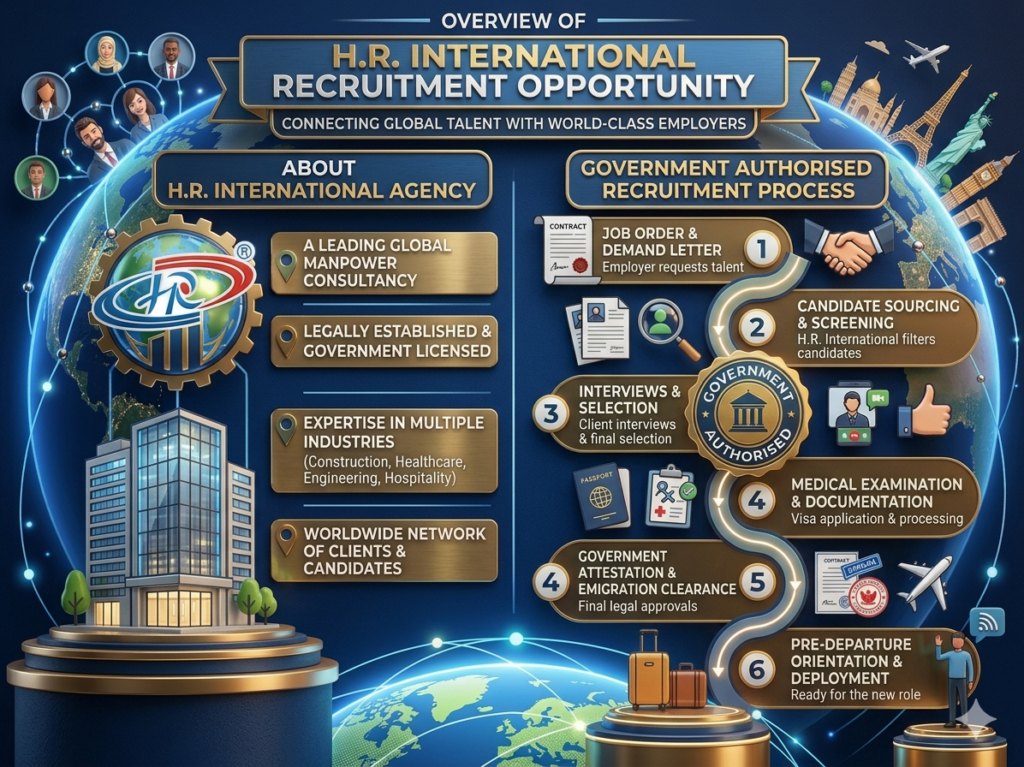
About H.R. International Agency
H.R. International has established itself as a prominent name in overseas recruitment, particularly for countries like Japan where compliance and credibility are non-negotiable. Based in New Delhi, the agency has years of experience connecting skilled Indian workers with global employers. What sets H.R. International apart is its commitment to transparency, ethical recruitment practices, and candidate support throughout the hiring journey.
The agency operates from its office located at E-46/4, Pocket D, Okhla Industrial Area, Phase-II, New Delhi-110020, making it accessible for candidates across India. Over the years, it has built strong relationships with international companies, especially in Japan’s construction sector. These partnerships allow the agency to provide genuine job opportunities that align with government regulations and industry standards.
One of the standout features of H.R. International is its focus on direct selection processes. By eliminating unnecessary intermediaries, the agency ensures that candidates get a fair chance to present themselves directly to employers. This not only speeds up the recruitment process but also enhances trust between all parties involved.
Candidates also benefit from the agency’s guidance on documentation, interview preparation, and visa procedures. Moving to a country like Japan can feel overwhelming, especially for first-time international workers. H.R. International simplifies this journey by providing step-by-step assistance, ensuring that candidates are well-prepared at every stage.
Another important aspect is their specialization in sectors with high demand, such as construction. Japan’s aging population and ongoing infrastructure projects have created a significant need for foreign workers. H.R. International taps into this demand, offering roles like General Construction Worker under the SSW category, which are both stable and rewarding.
Government Authorised Recruitment Process
Working with a government-authorised agency is crucial when applying for overseas jobs, and this is where H.R. International provides a significant advantage. Authorization ensures that the agency adheres to strict guidelines set by both Indian and Japanese authorities, protecting candidates from fraudulent practices and ensuring fair treatment.
In the context of Japan, the recruitment process must align with immigration policies, labor laws, and industry standards. Authorized agencies act as a bridge between employers and candidates, ensuring that all legal requirements are met. This includes verifying job offers, ensuring proper contracts, and facilitating visa processing under categories like Specified Skilled Worker (SSW).
The process typically begins with candidate screening, where applicants are evaluated based on their qualifications, language proficiency, and physical fitness. Once shortlisted, candidates are invited for online interviews, allowing employers to assess their suitability. This step is particularly important for roles in construction, where practical skills and communication abilities are essential.
Transparency is a key element here. Candidates are informed about job roles, salary packages, working conditions, and contract duration upfront. This eliminates surprises and helps applicants make informed decisions. Additionally, being part of a government-authorised process ensures that candidates receive proper documentation, including legally binding employment contracts.
Another benefit is post-selection support. Authorized agencies often assist with pre-departure training, cultural orientation, and travel arrangements. This holistic approach ensures that candidates are not just placed in jobs but are also prepared to succeed in a new environment.
For anyone considering a career in Japan, choosing a government-authorised recruitment channel is not just a preference—it’s a necessity. It provides peace of mind, legal security, and a clear pathway to achieving professional goals in one of the world’s most disciplined and opportunity-rich job markets.
Jobs in Japan Construction Industry
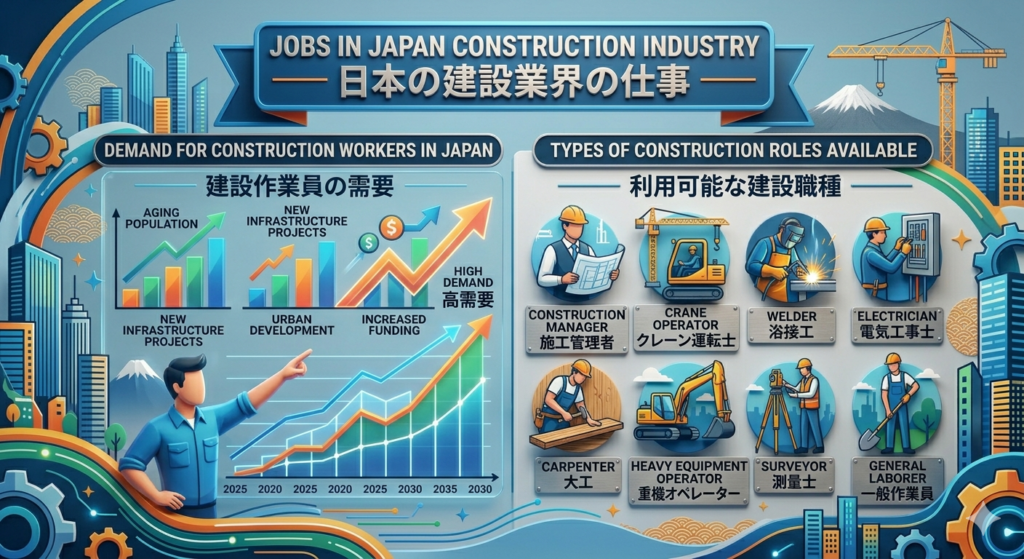
Demand for Construction Workers in Japan
Japan’s construction industry is experiencing a significant labor shortage, and this has opened doors for foreign workers, especially those qualified under the SSW (Specified Skilled Worker) category. The country is in the middle of continuous infrastructure development, ranging from urban redevelopment projects to disaster-resistant buildings and transportation networks. At the same time, Japan’s aging population has reduced the availability of local workers, creating an urgent need for skilled and semi-skilled labor from abroad.
For candidates who have passed JLPT N4 or JFT-Basic, this demand translates into a real opportunity. These certifications demonstrate that a candidate has basic Japanese communication skills, which is essential for working safely and efficiently on construction sites. Employers in Japan prioritize workers who can understand instructions, follow safety protocols, and communicate with team members, even at a basic level.
Recent industry insights suggest that Japan needs hundreds of thousands of additional construction workers to meet its infrastructure goals. Events like urban expansion, maintenance of aging buildings, and preparations for natural disasters have only increased the urgency. This means that opportunities are not limited to a single city but are spread across various locations in Japan, giving candidates flexibility in terms of work environment and exposure.
Another factor driving demand is the government’s proactive approach. By introducing the SSW visa program, Japan has made it easier for foreign workers to legally enter and work in industries facing labor shortages. This program ensures fair wages, proper working conditions, and long-term employment prospects, making it an attractive option for Indian candidates.
From a career perspective, working in Japan’s construction industry is more than just a job—it’s an opportunity to gain international experience, learn advanced techniques, and build a stable future. The structured work culture, emphasis on safety, and use of modern technology make it a valuable learning environment for anyone willing to step out of their comfort zone.
Types of Construction Roles Available
The term “General Construction Worker” may sound broad, but in reality, it encompasses a wide range of responsibilities and specialized tasks. In Japan, construction projects are highly organized, and each worker plays a specific role within a larger system. This means that even within a general category, there are opportunities to learn and grow in different areas.
Some of the common roles included under this category involve basic site preparation, material handling, assisting skilled workers, and maintaining tools and equipment. Workers may also be involved in tasks like scaffolding, concrete mixing, and site cleanup. These roles are essential for ensuring that construction projects run smoothly and efficiently.
What makes Japan unique is its attention to detail and safety. Workers are trained to follow strict guidelines, use protective equipment, and adhere to precise instructions. This not only ensures safety but also improves the overall quality of work. For candidates coming from India, this can be a valuable experience that enhances their skill set and makes them more competitive in the global job market.
There are also opportunities to specialize over time. For example, a worker who starts with basic tasks may eventually gain experience in areas like carpentry, welding, or machinery operation. This progression is often supported by on-the-job training and guidance from experienced supervisors.
Another interesting aspect is the diversity of projects. Workers may find themselves involved in residential construction, commercial buildings, roadwork, or even large-scale infrastructure projects. Each type of project offers a different set of challenges and learning opportunities, keeping the work dynamic and engaging.
For candidates selected through direct selection for N4 & SSW language pass candidates, this variety ensures that the job is not monotonous. Instead, it becomes a journey of continuous learning and professional growth, supported by a structured system that values discipline and efficiency.
Position Details – General Construction Worker (SSW)
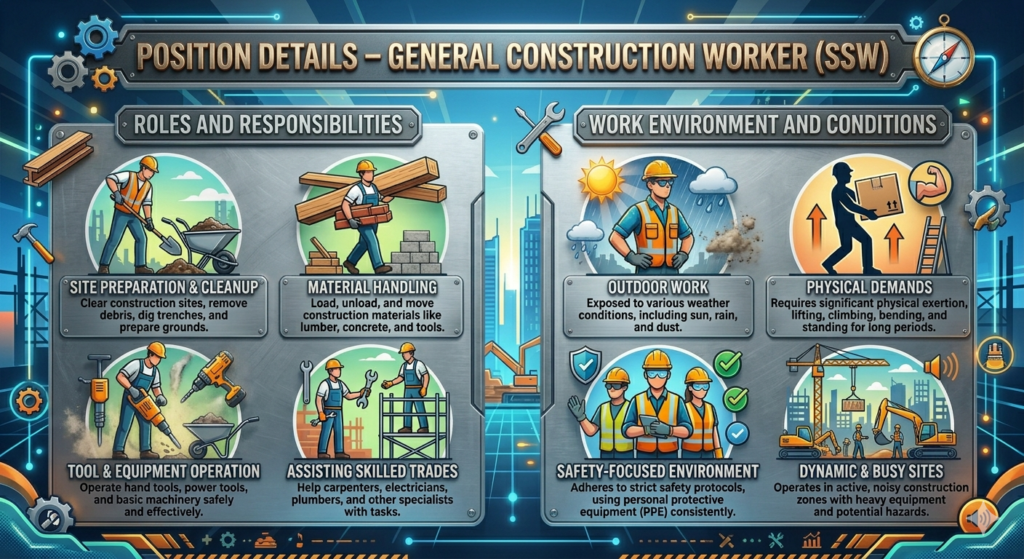
Roles and Responsibilities
The role of a General Construction Worker under the SSW category is both physically demanding and highly rewarding. It involves a mix of manual labor, teamwork, and adherence to strict safety standards. Workers are expected to perform a variety of tasks that contribute to the successful completion of construction projects.
Daily responsibilities typically include preparing construction sites, loading and unloading materials, and assisting skilled tradespeople such as electricians, carpenters, and masons. Workers may also be involved in assembling temporary structures like scaffolding, mixing concrete, and operating basic machinery. While these tasks may seem straightforward, they require precision, coordination, and a strong work ethic.
One of the key aspects of this role is teamwork. Construction projects in Japan are highly collaborative, with each worker contributing to a shared goal. Communication, even at a basic level, is essential for ensuring that tasks are completed safely and efficiently. This is why the Japanese language requirement (JLPT N4 or JFT-Basic) is so important—it enables workers to understand instructions and interact with colleagues.
Safety is another critical responsibility. Workers must follow strict guidelines, wear protective gear, and report any hazards immediately. Japan’s construction industry is known for its emphasis on safety, and this culture is ingrained in every aspect of the job.
In addition to physical tasks, workers are also expected to maintain cleanliness and organization on the site. This includes proper disposal of waste, storage of tools, and ensuring that work areas are free from hazards. These practices not only improve efficiency but also reflect the disciplined work culture that Japan is known for.
Overall, the role offers a balanced mix of physical activity, skill development, and teamwork. For candidates willing to put in the effort, it provides a stable and fulfilling career path in an international setting.
Work Environment and Conditions
Working in Japan’s construction industry comes with its own set of challenges and rewards. The work environment is structured, disciplined, and focused on efficiency. Workers are expected to follow schedules strictly, adhere to safety protocols, and maintain a high level of professionalism at all times.
The physical nature of the job means that workers should be prepared for long hours of standing, lifting, and working in various weather conditions. However, this is balanced by the availability of proper safety equipment, regular breaks, and a supportive work environment. Employers in Japan are known for their commitment to worker welfare, ensuring that conditions are safe and compliant with labor laws.
One of the standout features of working in Japan is the emphasis on cleanliness and organization. Construction sites are kept tidy, tools are व्यवस्थित, and processes are streamlined to minimize errors. This not only improves productivity but also creates a more pleasant work environment.
Another important aspect is cultural adaptation. Workers are expected to respect Japanese customs, follow rules, and maintain discipline. While this may require some adjustment initially, it ultimately helps in building a strong work ethic and professional attitude.
Accommodation and transportation are often arranged or supported by employers, making it easier for foreign workers to settle in. In many cases, workers live in shared housing, which also provides an opportunity to connect with colleagues and build a support network.
Despite the challenges, the experience of working in Japan is highly rewarding. It offers exposure to advanced construction techniques, a chance to learn new skills, and the opportunity to earn a stable income. For candidates selected through direct selection for N4 & SSW language pass candidates, it’s a chance to build a future in one of the world’s most developed economies.
Japanese Language Requirement for SSW Jobs
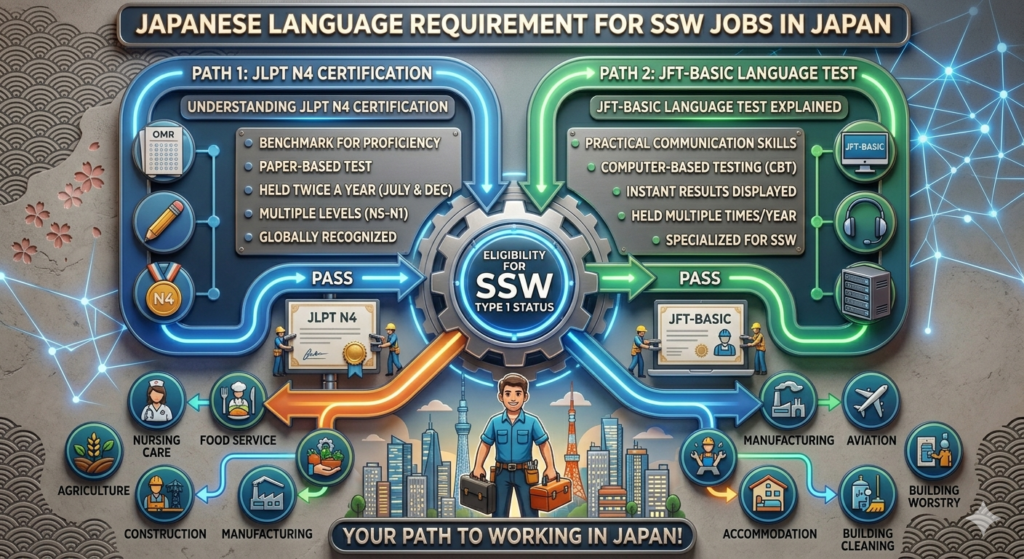
Understanding JLPT N4 Certification
If you’re aiming for direct selection for N4 & SSW language pass candidates, then understanding the value of JLPT N4 certification is absolutely essential. Think of JLPT N4 as your entry ticket into Japan’s professional world—it doesn’t make you fluent, but it proves you can survive, communicate, and function in everyday situations. And in a work environment like construction, that’s exactly what employers are looking for.
JLPT N4 focuses on basic Japanese comprehension. Candidates are expected to understand simple conversations, read basic sentences, and grasp commonly used vocabulary. You’re not expected to deliver speeches or write essays, but you should be able to follow instructions like “bring tools,” “wear safety gear,” or “move materials to a specific area.” These small but crucial interactions can make a big difference in a construction setting where timing and coordination matter.
From an employer’s perspective, hiring someone with JLPT N4 certification reduces risk. It ensures that the worker can adapt quickly, understand safety protocols, and communicate with team members without constant supervision. This is particularly important in Japan, where efficiency and precision are deeply embedded in work culture.
For candidates, achieving JLPT N4 also builds confidence. It shows that you’ve invested time and effort into learning the language, which reflects your commitment to working in Japan. Many candidates describe it as a turning point—the moment when working abroad stops being a dream and starts becoming a realistic goal.
Another interesting aspect is how JLPT N4 opens doors beyond just getting a job. Once you’re in Japan, improving your language skills can lead to better roles, higher salaries, and more responsibilities. It’s like starting at level one in a game, but with clear pathways to level up.
In the context of jobs in Japan construction industry, JLPT N4 is not just a requirement—it’s a foundation. It sets the stage for everything else, from workplace communication to cultural integration, making it one of the most important qualifications for aspiring candidates.
JFT-Basic Language Test Explained
While JLPT N4 is widely known, the JFT-Basic (Japan Foundation Test for Basic Japanese) is another equally important pathway for candidates seeking SSW jobs in Japan. In fact, many candidates find JFT-Basic to be more practical because it focuses specifically on real-life communication rather than academic language skills.
The JFT-Basic test is designed to evaluate whether a candidate can handle everyday situations in Japan. This includes understanding instructions, engaging in simple conversations, and responding appropriately in common scenarios. For construction workers, this is incredibly relevant because the job requires quick understanding and clear communication rather than complex language usage.
One of the biggest advantages of JFT-Basic is its accessibility. The test is conducted multiple times a year, and results are often available quickly. This makes it an attractive option for candidates who want to fast-track their application process. In the context of direct selection, having a JFT-Basic certification can significantly improve your chances of getting shortlisted.
The test itself covers listening and reading skills, focusing on practical situations like workplace communication, daily life interactions, and basic instructions. It’s less about memorizing grammar rules and more about understanding how language is used in real-world contexts.
Employers in Japan recognize JFT-Basic as a valid proof of language ability, especially for SSW positions. It assures them that the candidate can adapt to the work environment and interact effectively with colleagues. This is particularly important in industries like construction, where miscommunication can lead to delays or even safety risks.
For candidates who may find JLPT challenging, JFT-Basic offers a more approachable alternative. It’s like choosing a practical driving test over a theoretical exam—you’re proving that you can actually function in real situations.
Ultimately, whether you choose JLPT N4 or JFT-Basic, the goal remains the same: to demonstrate your readiness to work in Japan. Both certifications are valuable, and having either one makes you eligible for general construction worker SSW roles, bringing you one step closer to a stable and rewarding career abroad.
Eligibility Criteria for Candidates
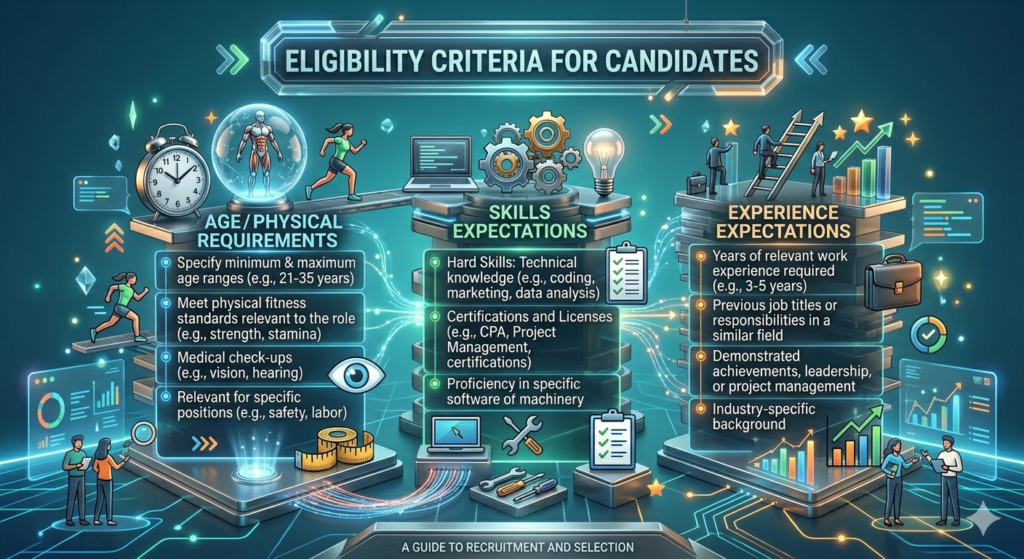
Age Limit and Physical Requirements
When applying for direct selection for N4 & SSW language pass candidates, meeting the eligibility criteria is just as important as having the right qualifications. One of the primary requirements for this opportunity is the age limit, which is up to 40 years. This range is carefully defined to ensure that candidates are physically capable of handling the demands of construction work while also being adaptable to a new environment.
Construction work is physically intensive—it involves lifting, carrying, bending, and working for extended hours. Because of this, employers prioritize candidates who are in good health and have the stamina to perform daily tasks efficiently. It’s not about being a bodybuilder; it’s about having the endurance to stay productive throughout the workday.
Medical fitness is often a part of the selection process. Candidates may be required to undergo health checks to ensure they are free from conditions that could affect their performance or safety. This is not just for the employer’s benefit but also for the worker’s well-being. Japan has strict safety standards, and ensuring that workers are physically fit is a key part of maintaining those standards.
Another aspect to consider is adaptability. Moving to a new country comes with challenges—different climate, food, and lifestyle. Candidates within the specified age range are generally more flexible and open to adapting to these changes. This makes it easier for them to settle into their new roles and perform effectively.
From a practical standpoint, the age limit also aligns with long-term employment goals. Since the contract duration is long-term, employers prefer candidates who can contribute consistently over an extended period. This creates a win-win situation where workers gain job stability, and employers benefit from experienced and reliable staff.
Meeting the age and physical requirements is not just about ticking a box—it’s about ensuring that you’re ready for the journey ahead. It sets the foundation for a successful career in Japan’s construction industry.
Skills and Experience Expectations
While the role of a general construction worker (SSW) is considered entry-level in some respects, having basic skills and experience can significantly boost your chances during direct selection. Employers are not just looking for labor—they are looking for individuals who can contribute effectively from day one.
Basic construction knowledge, such as handling tools, understanding site operations, or assisting skilled workers, is highly valued. Even if you haven’t worked in Japan before, experience in similar roles in India can make a strong impression. It shows that you’re familiar with the nature of the work and can adapt quickly.
Soft skills also play a crucial role. Punctuality, discipline, and the ability to follow instructions are highly regarded in Japan. These qualities often matter as much as technical skills because they reflect your attitude toward work. In a culture that values precision and teamwork, being reliable and cooperative can set you apart from other candidates.
Language skills, as mentioned earlier, are a key requirement. Having JLPT N4 or JFT-Basic certification is not optional—it’s essential. It ensures that you can communicate effectively, understand instructions, and integrate into the workplace.
Employers may also look for candidates who are willing to learn and grow. The construction industry in Japan offers opportunities to develop new skills, and showing a willingness to improve can make a positive impression during interviews.
Ultimately, the goal is to find candidates who are not just qualified but also motivated. The combination of basic skills, language proficiency, and a strong work ethic creates a profile that employers find highly attractive.
For those who meet these expectations, the opportunity to work in jobs in Japan construction industry becomes much more accessible, paving the way for a stable and rewarding career.
Employment Terms and Benefits
Salary Expectations and Perks
When exploring direct selection for N4 & SSW language pass candidates, one of the first questions that naturally comes to mind is: “What will I earn, and is it worth it?” The answer, in most cases, is yes—especially when you consider the combination of salary, benefits, and long-term stability offered by jobs in Japan construction industry.
While exact salaries can vary depending on location, company, and experience, general construction workers under the SSW visa category typically earn a competitive monthly income compared to similar roles in India. On average, workers can expect a salary ranging between ¥180,000 to ¥250,000 per month (approximately ₹1,00,000 to ₹1,50,000+). This figure may increase with overtime, which is quite common in construction projects.
Overtime pay is another significant advantage. Japanese labor laws ensure that any extra hours worked are compensated fairly, often at a higher rate than regular hours. This means that motivated workers can increase their earnings substantially by taking on additional shifts.
Apart from salary, there are several perks that make these jobs attractive. Many employers provide subsidized accommodation, which reduces living expenses significantly. Transportation support, work uniforms, and safety equipment are also commonly provided, ensuring that workers can focus on their tasks without worrying about additional costs.
Health insurance and social security benefits are mandatory in Japan, and foreign workers under the SSW program are included. This ensures access to medical care and financial protection in case of emergencies. It’s a level of security that many workers find reassuring, especially when living abroad.
Another often overlooked benefit is the opportunity to save. Due to structured expenses and disciplined work culture, many workers are able to send a substantial portion of their earnings back home. Over time, this can lead to significant financial growth, helping families achieve goals like education, housing, or business investments.
In essence, the financial package is not just about the monthly paycheck—it’s about the overall value. When you combine salary, benefits, and savings potential, general construction worker SSW roles in Japan become a highly rewarding opportunity.
Contract Duration and Career Growth
One of the most appealing aspects of direct selection for N4 & SSW language pass candidates is the long-term contract duration. Unlike short-term or seasonal jobs, SSW roles are designed to provide stability and continuity, allowing workers to build a secure future.
Typically, SSW contracts are issued for a specific period but can be renewed based on performance and employer requirements. This means that workers who demonstrate dedication, discipline, and skill can continue working in Japan for several years. It’s not just a temporary job—it’s a career pathway.
Career growth is another major advantage. While many candidates start as general construction workers, the experience gained on Japanese worksites can open doors to more specialized roles. Over time, workers can develop expertise in areas like machinery operation, welding, carpentry, or site supervision.
Language skills also play a crucial role in career advancement. As workers improve their Japanese proficiency beyond JLPT N4 or JFT-Basic, they become eligible for higher responsibilities and better-paying roles. It’s like climbing a ladder—each step brings new opportunities.
Employers in Japan value loyalty and hard work. Workers who consistently perform well are often given additional responsibilities, training opportunities, and even leadership roles within their teams. This creates a sense of progression that goes beyond just earning a salary.
Another long-term benefit is the international exposure. Working in Japan adds significant value to your professional profile. It demonstrates adaptability, discipline, and global experience—qualities that are highly regarded in today’s job market.
For many candidates, this journey doesn’t just improve their financial situation; it transforms their entire career trajectory. It’s a chance to move from local opportunities to a global stage, all starting with a single step through direct selection.
Application and Interview Process
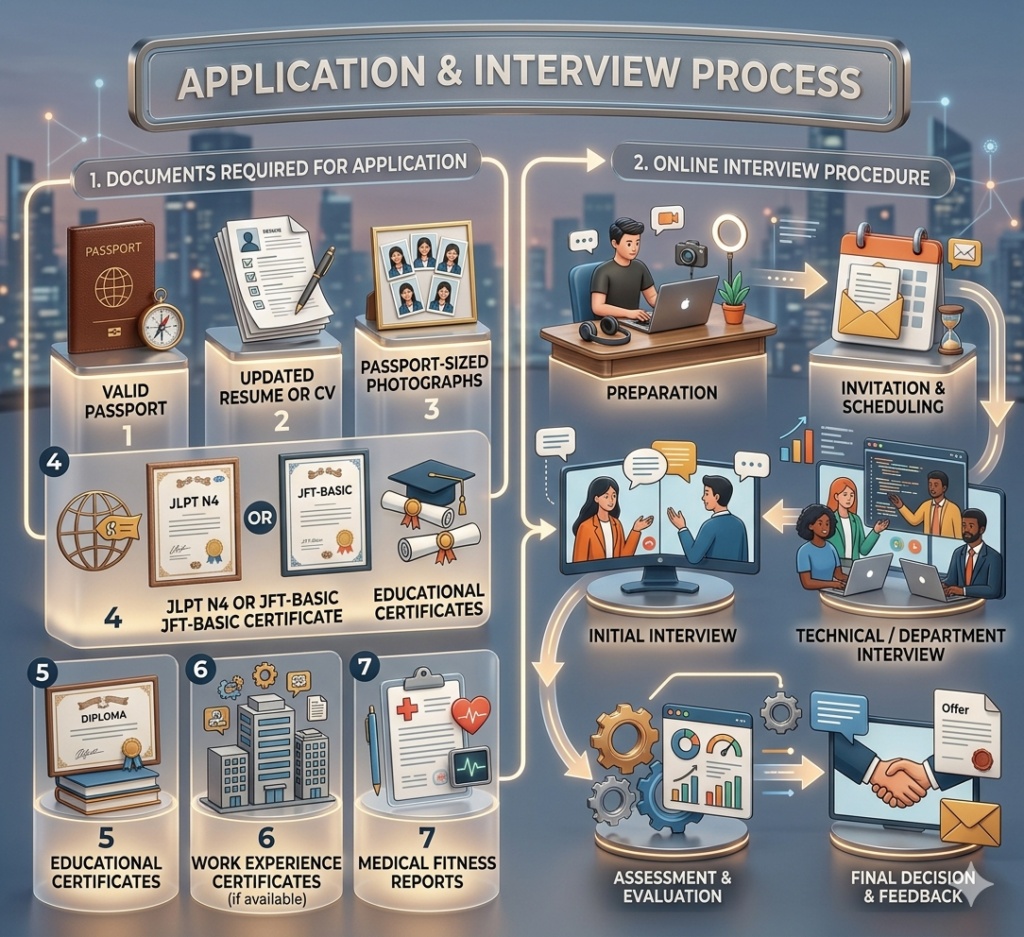
Online Interview Procedure
The online interview process is one of the most convenient aspects of applying for jobs in Japan construction industry through direct selection. Gone are the days when candidates had to travel long distances just to attend an interview. Now, everything can be done from the comfort of your home, making the process faster and more accessible.
Once your application is shortlisted by H.R. International, you will be invited to participate in an online interview. This is usually conducted via video conferencing platforms, where representatives from the hiring company assess your suitability for the role.
The interview typically focuses on a few key areas: your basic construction knowledge, physical readiness, and Japanese language ability (JLPT N4 or JFT-Basic). Don’t expect overly complicated questions—employers are more interested in your attitude, willingness to work, and ability to understand instructions.
Preparation is crucial. Candidates should ensure they have a stable internet connection, a quiet environment, and all necessary documents ready. Practicing basic Japanese phrases can also make a strong impression, showing that you are confident and prepared.
During the interview, honesty and clarity go a long way. Employers appreciate candidates who are straightforward about their experience and eager to learn. Even if you don’t have extensive experience, showing a positive attitude can make a big difference.
Another important aspect is punctuality. Logging in on time and being ready demonstrates professionalism—a quality highly valued in Japan. Think of the interview as your first step into Japanese work culture, where discipline and respect are key.
The online format also allows employers to conduct interviews efficiently, which means faster results for candidates. In many cases, selections are made quickly, allowing successful applicants to move on to the next stages without unnecessary delays.
Documents Required for Application
Applying for direct selection for N4 & SSW language pass candidates involves submitting a set of essential documents. These documents help employers verify your identity, qualifications, and eligibility for the role.
Some of the key documents include:
- Valid passport
- Updated resume or CV
- Passport-sized photographs
- JLPT N4 or JFT-Basic certificate
- Educational certificates
- Work experience certificates (if available)
- Medical fitness reports
Each document plays a specific role in the evaluation process. For example, your language certificate proves that you meet the communication requirements, while your resume provides insight into your skills and experience.
Accuracy is extremely important. Any discrepancies or missing information can delay the process or even lead to rejection. Candidates are advised to double-check all documents before submission and ensure that they are clear and legible.
In some cases, additional documents may be requested depending on the employer’s requirements. Being prepared for this ensures a smooth application process.
H.R. International often assists candidates in organizing and verifying their documents, reducing the chances of errors. This support can be particularly helpful for first-time applicants who may not be familiar with international recruitment procedures.
Overall, the documentation process is straightforward but requires attention to detail. It’s a crucial step that bridges the gap between application and selection, bringing you closer to your goal of working in Japan.
Contact Details and Office Locations
India Office Details
For candidates interested in applying, reaching out to the official recruitment agency is a critical step. H.R. International’s India office is conveniently located at:
E-46/4, Pocket D, Okhla Industrial Area, Phase-II, New Delhi-110020
This central location makes it accessible for candidates from across the country. Whether you need assistance with your application, documentation, or interview preparation, the office serves as a reliable point of contact.
Candidates can also connect via phone at +91-8368938788 or email at projects@hrinternational.in. These communication channels ensure that queries are addressed promptly, providing clarity and guidance throughout the process.
Having a physical office adds a layer of trust and credibility. It assures candidates that they are dealing with a legitimate, government-authorised agency, reducing concerns about fraud or misinformation.
Japan Office Details
H.R. International also maintains a presence in Japan, further strengthening its ability to connect candidates with employers. The Japan office is located at:
Kokufu, Kasugai-cho, Fuefuki-shi, Yamanashi, Japan 4060014
This local presence allows the agency to coordinate directly with employers, ensuring smooth communication and efficient placement of candidates. It also helps in addressing any issues that may arise after candidates arrive in Japan.
Having offices in both India and Japan creates a seamless bridge between the two countries, making the recruitment process more efficient and reliable.
Limited Seats and Why You Should Apply Now
The phrase “limited seats available” is not just a marketing tactic—it reflects the reality of direct selection for N4 & SSW language pass candidates. Employers have specific requirements and a fixed number of positions to fill, which means opportunities can close quickly once the desired number of candidates is selected.
Timing plays a crucial role here. Candidates who apply early have a better chance of securing a spot, attending interviews, and completing the process without rushing. Waiting too long can result in missed opportunities, especially in high-demand sectors like construction.
Another factor to consider is competition. As awareness about jobs in Japan construction industry grows, more candidates are applying for these roles. Having the required qualifications, such as JLPT N4 or JFT-Basic, gives you an advantage—but acting quickly ensures you stay ahead of the competition.
Applying now also gives you more time to prepare. From improving your language skills to organizing documents and practicing for interviews, early action sets you up for success.
Think of it like catching a train—if you’re on time, you have a smooth journey; if you’re late, you miss the opportunity altogether. The same applies here.
For those who meet the criteria and are serious about building a career in Japan, this is the moment to take action. The combination of direct selection, government-authorised recruitment, and long-term employment makes this opportunity too valuable to ignore.
Conclusion
The opportunity for direct selection for N4 & SSW language pass candidates in the jobs in Japan construction industry represents a powerful gateway to international career growth. With the support of a government-authorised agency like H.R. International, candidates gain access to a transparent, efficient, and reliable recruitment process that prioritizes their skills and potential.
From understanding the role of a general construction worker (SSW) to meeting language requirements like JLPT N4 or JFT-Basic, every step in this journey is designed to prepare candidates for success. The combination of competitive salaries, long-term contracts, and career growth opportunities makes this more than just a job—it’s a life-changing experience.
With online interviews, clear eligibility criteria, and strong support systems in place, the process has never been more accessible. Add to that the urgency of limited seats, and it becomes clear that this is an opportunity worth acting on immediately.
FAQs
1. What is the minimum language requirement for SSW jobs in Japan?
Candidates must have JLPT N4 or JFT-Basic certification, which proves basic Japanese communication skills required for workplace interaction.
2. What is the age limit for applying?
The maximum age limit is up to 40 years, ensuring candidates are physically fit for construction work.
3. Is the recruitment process genuine and safe?
Yes, it is conducted by a government-authorised agency (H.R. International), ensuring transparency and legal compliance.
4. Are interviews conducted offline or online?
The selection process includes online interviews, making it convenient for candidates across India.
5. How can I apply for this opportunity?
You can contact H.R. International via phone at +91-8368938788 or email at projects@hrinternational.in for application details.
Leave a Reply