
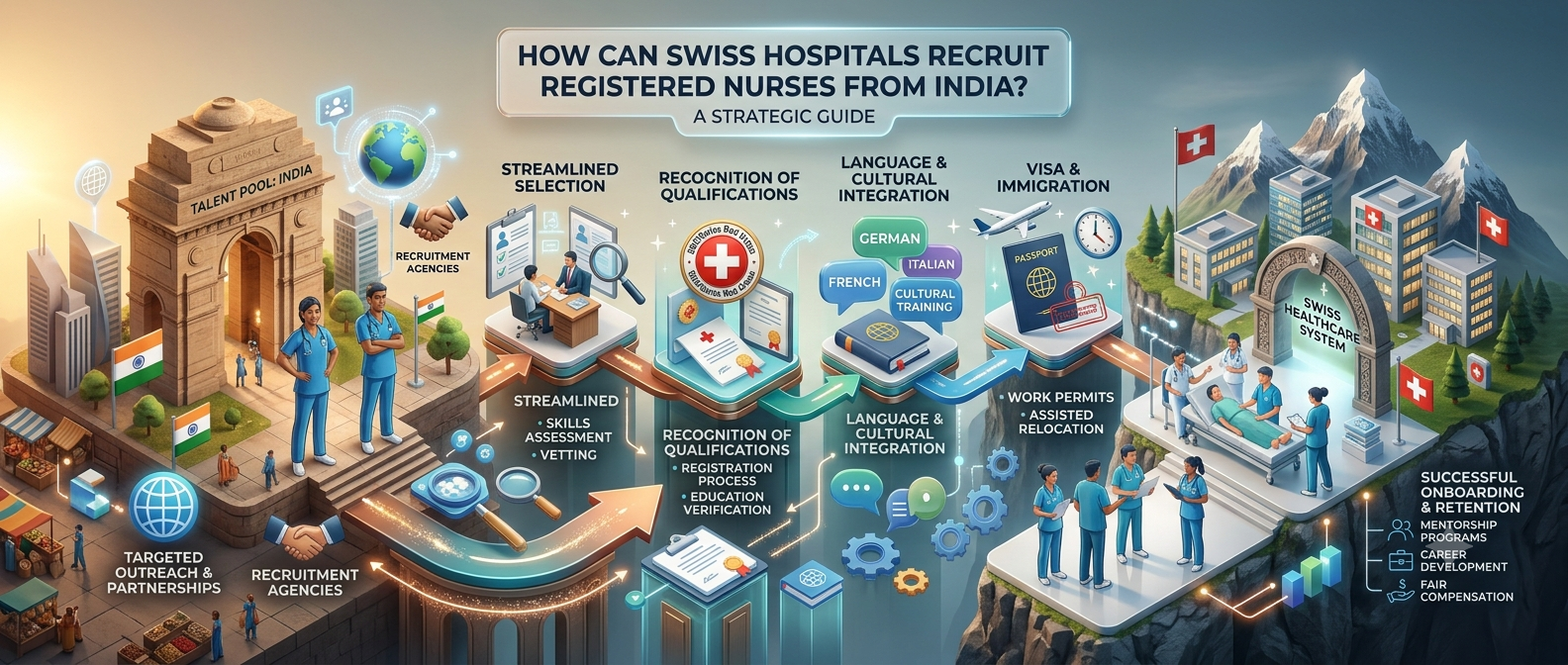
Why Switzerland Needs Indian Registered Nurses

Switzerland is widely recognized for having one of the world’s most advanced healthcare systems. The country consistently invests in modern hospitals, cutting-edge medical technology, and high-quality patient care. Despite these strengths, Swiss hospitals continue to face a significant shortage of qualified nursing professionals. An aging population, increasing healthcare demands, and retirement of experienced nurses have created thousands of vacancies across hospitals, rehabilitation centers, elderly care facilities, and specialized healthcare institutions. As healthcare services continue to expand, hospitals are actively exploring international recruitment solutions to ensure uninterrupted patient care.
India has emerged as one of the leading global suppliers of skilled healthcare professionals. Every year, thousands of registered nurses graduate from recognized nursing institutions across India, bringing strong clinical knowledge, practical hospital experience, and adaptability to international healthcare environments. Indian nurses have successfully established their reputation in countries such as the United Kingdom, Germany, Ireland, Australia, New Zealand, and several Gulf nations. Their commitment to patient care, professional ethics, and willingness to learn new healthcare systems make them highly valuable for Swiss healthcare employers.
For Swiss hospitals, international recruitment is no longer just an option—it has become a strategic workforce solution. By partnering with experienced overseas recruitment agencies, employers can access a large talent pool of qualified Indian registered nurses while ensuring compliance with immigration regulations, professional licensing standards, and employment laws. This comprehensive guide explains everything Swiss healthcare employers need to know about recruiting Indian registered nurses efficiently and legally while highlighting the best practices for successful international hiring.
How Can Swiss Hospitals Recruit Registered Nurses from India?
Swiss hospitals seeking highly qualified nursing professionals can successfully recruit from India through a structured international hiring process. The first step involves identifying workforce requirements, including specialty areas such as ICU, emergency nursing, operating theatre, pediatric nursing, oncology, rehabilitation, or elderly care. Once staffing needs are clearly defined, hospitals typically collaborate with experienced international healthcare recruitment agencies that specialize in sourcing qualified nurses from India.
The recruitment process usually begins with candidate sourcing, credential verification, document screening, and preliminary interviews. Recruitment agencies verify educational qualifications, nursing registrations, work experience, passport validity, and language proficiency before presenting shortlisted candidates to Swiss employers. Hospitals can then conduct virtual interviews to evaluate clinical knowledge, communication skills, and cultural adaptability before extending employment offers.
Swiss employers must also comply with Swiss immigration policies and professional recognition procedures. Depending on the canton and healthcare institution, nurses may need credential recognition and language proficiency in German, French, or Italian. Many recruitment agencies assist candidates throughout these processes by providing documentation support, visa guidance, language preparation, and relocation assistance.
Hiring Indian registered nurses offers numerous benefits beyond simply filling vacancies. Indian nurses are known for their adaptability, strong clinical training, compassion, teamwork, and ability to work efficiently in multicultural healthcare environments. Their experience with high patient volumes and advanced clinical procedures enables them to integrate quickly into Swiss hospitals while maintaining excellent standards of patient care.
Current Nursing Shortage in Switzerland
Switzerland is experiencing one of the most significant healthcare workforce shortages in Europe. Hospitals, rehabilitation centers, long-term care facilities, and specialized clinics are facing increasing pressure to recruit qualified nurses as patient demand continues to grow. An aging population, higher life expectancy, expanding healthcare services, and the retirement of experienced nursing professionals have created a widening gap between available healthcare workers and patient needs. Many healthcare employers are now looking beyond domestic hiring and actively exploring international recruitment to maintain high standards of patient care.
The shortage is particularly noticeable in specialized departments such as intensive care units (ICU), emergency medicine, surgical wards, oncology, geriatrics, and rehabilitation services. Healthcare organizations require nurses who can quickly adapt to modern medical technologies, multidisciplinary teams, and patient-centered care models. Delays in recruitment can increase workloads for existing staff, contribute to burnout, and affect the overall quality of healthcare services. This has encouraged Swiss healthcare employers to develop long-term international recruitment strategies rather than relying solely on local hiring.
Indian registered nurses have become one of the most reliable solutions to this workforce challenge. India produces thousands of highly trained nursing graduates every year who possess strong clinical skills and valuable experience in hospitals accredited by national and international healthcare organizations. Their ability to work in multicultural environments, combined with their dedication to patient care and professional ethics, makes them excellent candidates for Swiss hospitals. Recruiting internationally not only addresses immediate staffing shortages but also helps healthcare organizations build a sustainable workforce for the future.
Why Indian Nurses Are Preferred
Indian nurses have established a strong reputation worldwide for their professionalism, compassion, and clinical competence. They are employed across leading healthcare systems in countries such as the United Kingdom, Germany, Ireland, Australia, New Zealand, the United States, and the Gulf region. Their education emphasizes theoretical knowledge, practical hospital training, patient safety, infection control, and evidence-based nursing practices, making them well-prepared for international healthcare environments.
One of the key reasons Swiss employers prefer Indian nurses is their adaptability. Indian healthcare professionals often work in high-pressure hospitals where they manage large patient volumes while maintaining quality care. This experience develops excellent critical thinking, time management, teamwork, and communication skills. Many Indian nurses also possess experience in specialized departments including intensive care, emergency medicine, neonatal care, dialysis, oncology, cardiac care, and operation theatres, allowing Swiss hospitals to recruit professionals for highly specialized roles.
Another significant advantage is their commitment to continuous professional development. Many Indian registered nurses pursue additional certifications, advanced nursing education, and international language training before seeking overseas employment. Their willingness to learn German, French, or Italian significantly improves their integration into Swiss healthcare facilities. Employers also appreciate their cultural sensitivity, respectful approach to patient care, and ability to collaborate effectively with multidisciplinary healthcare teams.
How to Hire Registered Nurses from India for Switzerland
Hiring nurses internationally requires careful planning and compliance with both Indian and Swiss regulations. The first step is defining workforce requirements, including the number of nurses, specialties, experience levels, educational qualifications, and language expectations. Clear job descriptions help recruitment agencies identify candidates whose qualifications closely match the hospital’s staffing needs.
After defining recruitment objectives, Swiss hospitals typically partner with experienced international healthcare recruitment agencies specializing in nurse placement. These agencies advertise vacancies, screen applications, verify educational credentials, validate nursing registrations, confirm employment history, and conduct preliminary interviews. Only candidates meeting predefined eligibility criteria are shortlisted for employer interviews, significantly reducing recruitment time and administrative workload.
Once candidates are selected, hospitals issue conditional employment offers while initiating credential recognition, work permit applications, and visa documentation. Many agencies also coordinate medical examinations, police clearance certificates, document legalization, and travel arrangements. Providing language training, cultural orientation, and relocation support helps newly recruited nurses transition smoothly into Swiss healthcare environments. A structured onboarding program further improves employee retention and long-term workforce stability.
Understanding Swiss Recruitment Requirements
Swiss healthcare employers must ensure every internationally recruited nurse satisfies national and cantonal regulations before beginning employment. Educational qualifications should be recognized by the relevant Swiss authorities responsible for healthcare professions. Verification generally includes reviewing nursing degrees, clinical training records, professional registrations, employment certificates, and identity documentation.
Professional experience is another important consideration. While entry-level nurses may qualify for certain positions, many hospitals prefer candidates with at least two to three years of clinical experience, particularly for specialized departments such as ICU, emergency medicine, operating theatre, oncology, and critical care. Practical experience enables international nurses to adapt more quickly to Switzerland’s healthcare standards and patient expectations.
Language proficiency remains one of the most critical recruitment requirements. Since Switzerland has multiple official languages, employers usually require nurses to demonstrate competency in German, French, or Italian depending on the hospital’s location. Recruitment agencies frequently assist candidates by arranging language courses before relocation. Investing in language preparation improves communication with patients, enhances workplace integration, and contributes to better clinical outcomes.
Language and Licensing Requirements
Language proficiency is essential for successful nursing practice in Switzerland because effective communication directly influences patient safety, treatment accuracy, and collaboration among healthcare professionals. Hospitals generally require candidates to achieve recognized language certification before beginning clinical duties. Depending on the region, German, French, or Italian may be mandatory. Some employers also offer additional language support after arrival to help nurses strengthen their communication skills in real clinical settings.
Professional licensing involves the recognition of nursing qualifications through Swiss regulatory authorities. Candidates must submit educational transcripts, nursing registration certificates, employment records, identity documents, and other required paperwork for evaluation. In some cases, additional assessments, adaptation programs, or supervised practice periods may be required before obtaining full professional recognition. Recruitment agencies familiar with Swiss regulations simplify this process by guiding candidates through documentation and compliance requirements.
Swiss hospitals benefit greatly from working with agencies experienced in healthcare recruitment because licensing procedures can be complex and time-consuming. Expert agencies monitor changing regulations, prepare documentation accurately, coordinate with regulatory authorities, and minimize delays. This allows employers to focus on selecting qualified nursing professionals while ensuring legal compliance throughout the recruitment process.
Where Can Swiss Hospitals Find Registered Nurses from India?
Swiss hospitals looking to expand their nursing workforce have several reliable channels for sourcing qualified professionals from India. One of the most effective methods is partnering with internationally recognized healthcare recruitment agencies that specialize in overseas nurse placement. These agencies maintain extensive databases of registered nurses with experience in medical-surgical units, intensive care, emergency departments, pediatrics, oncology, dialysis, and elderly care. Because candidates are pre-screened and credential-verified, hospitals can significantly reduce hiring time while improving recruitment quality.
Hospitals can also recruit through nursing colleges, professional associations, healthcare job fairs, and international recruitment campaigns conducted across major Indian cities. These recruitment drives allow employers to interview multiple candidates within a short period, evaluate their clinical knowledge, and identify nurses who match organizational requirements. Digital recruitment platforms have further simplified international hiring by enabling virtual interviews, online document verification, and remote assessments.
Choosing the right sourcing partner is crucial. Recruitment agencies with experience in Swiss healthcare hiring understand licensing procedures, language requirements, immigration regulations, and documentation standards. They also provide support services such as language preparation, credential recognition, visa processing, travel coordination, and post-arrival assistance. This comprehensive approach allows Swiss hospitals to recruit qualified Indian nurses efficiently while ensuring compliance with Swiss employment regulations.
Government-Approved Recruitment Agencies
Working with government-approved overseas recruitment agencies provides Swiss hospitals with additional confidence throughout the hiring process. These agencies operate under applicable recruitment regulations, maintain transparent hiring practices, and ensure candidates are recruited ethically. They verify educational qualifications, nursing registrations, work experience, police clearance certificates, and medical fitness before presenting candidates to employers.
Government-approved agencies also help prevent recruitment fraud by ensuring documentation is authentic and recruitment procedures comply with legal requirements in both India and Switzerland. Hospitals benefit from structured recruitment timelines, standardized documentation, and reduced administrative burdens. Agencies frequently coordinate interviews, employment contracts, visa applications, and travel arrangements while keeping employers informed at every stage.
Ethical recruitment has become increasingly important in global healthcare. Reputable agencies prioritize fair employment practices, transparent communication, and long-term workforce retention rather than simply filling vacancies. Their expertise allows Swiss hospitals to build sustainable international nursing teams while protecting the interests of both employers and healthcare professionals.
Direct Recruitment vs. Agency Recruitment
Swiss healthcare employers sometimes consider direct recruitment from India, particularly when they have internal HR teams experienced in international hiring. Direct recruitment offers greater control over candidate sourcing and interviews, but it also requires significant investment in advertising, credential verification, legal compliance, language assessment, visa processing, and relocation management. For hospitals unfamiliar with Indian recruitment procedures, this approach can become time-consuming and resource-intensive.
Agency recruitment simplifies the entire process by providing end-to-end recruitment solutions. Specialized healthcare recruitment agencies manage candidate sourcing, screening, background verification, interview scheduling, documentation, immigration procedures, licensing support, and onboarding assistance. Their established recruitment networks enable hospitals to access larger talent pools while reducing hiring timelines.
For most Swiss hospitals, agency recruitment delivers better efficiency, lower recruitment risk, and higher-quality outcomes. Experienced agencies understand healthcare workforce planning, maintain strong relationships with nursing institutions, and provide ongoing support after deployment. This enables employers to focus on patient care while recruitment professionals handle the complexities of international hiring.
Which Recruitment Agency Helps Swiss Hospitals Hire Indian Nurses?
When selecting a recruitment partner, Swiss hospitals should prioritize agencies with extensive experience in international healthcare recruitment. The ideal agency should demonstrate a successful track record of placing registered nurses in European healthcare systems while maintaining high ethical standards throughout the recruitment process. Hospitals should evaluate agency expertise, compliance procedures, candidate screening methods, language training programs, and post-placement support before establishing a partnership.
An experienced recruitment agency typically begins by understanding the hospital’s staffing requirements, including specialty areas, preferred qualifications, language expectations, and employment conditions. It then sources candidates from accredited nursing institutions and experienced healthcare professionals working across India. Comprehensive screening includes educational verification, nursing registration validation, employment reference checks, clinical interviews, and language assessments.
The agency continues supporting both employer and candidate throughout credential recognition, visa processing, travel arrangements, and onboarding. This end-to-end service reduces recruitment delays, improves candidate readiness, and increases long-term employee retention. Hospitals that collaborate with specialized healthcare recruitment agencies often experience smoother international hiring processes and stronger workforce stability.
How Can I Recruit Indian Registered Nurses for My Swiss Hospital?
Recruiting Indian registered nurses for a Swiss hospital requires a structured and strategic approach. The process begins by identifying staffing shortages, determining specialty requirements, and establishing clear eligibility criteria. Hospitals should define expected qualifications, minimum work experience, language requirements, salary packages, employee benefits, and relocation support before launching recruitment activities.
After selecting a trusted recruitment agency, employers typically receive a shortlist of qualified candidates who have already undergone document verification and preliminary screening. Hospitals then conduct virtual interviews, clinical assessments, and communication evaluations to identify the most suitable professionals. Successful candidates receive conditional employment offers while licensing, immigration, and credential recognition procedures begin simultaneously.
Providing relocation assistance significantly improves recruitment success. Many employers offer language training, temporary accommodation, airport pickup, cultural orientation, mentorship programs, and structured induction sessions. These initiatives help internationally recruited nurses integrate quickly into the Swiss healthcare environment, improving job satisfaction, retention, and patient care outcomes.
Best Recruitment Agency for Registered Nurses in Switzerland
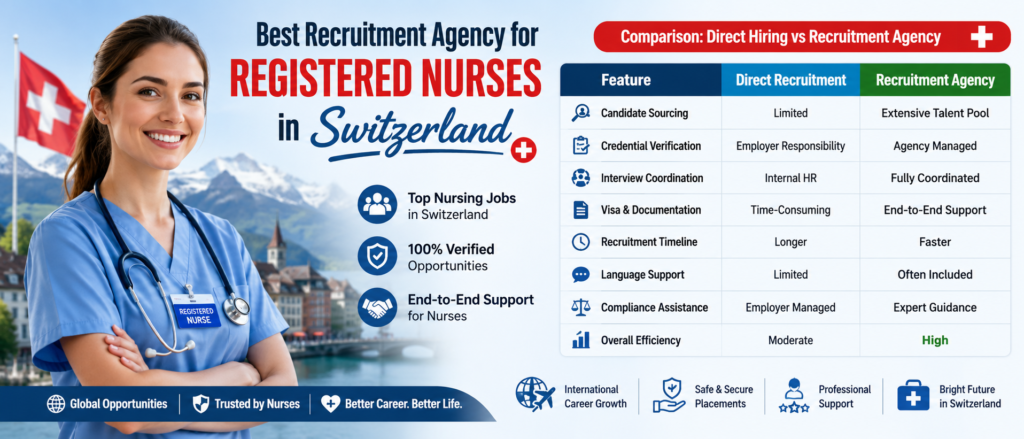
The Best Recruitment Agency for Registered Nurses in Switzerland is one that offers specialized healthcare recruitment services rather than general overseas staffing. Such agencies possess deep knowledge of Swiss healthcare regulations, nursing qualification recognition, immigration requirements, and language expectations. Their recruitment consultants understand the unique workforce challenges faced by hospitals and can recommend suitable candidates for different clinical specialties.
A high-quality recruitment agency invests heavily in candidate assessment. Clinical competency evaluations, communication testing, background verification, and reference checking ensure hospitals receive nurses who meet international healthcare standards. Agencies should also maintain transparent recruitment practices, provide regular progress updates, and support both employers and candidates throughout every stage of recruitment.
Long-term partnership is another distinguishing factor. Instead of focusing only on immediate placements, leading agencies assist hospitals with workforce planning, talent pipeline development, retention strategies, and future recruitment campaigns. This strategic approach helps healthcare organizations maintain stable nursing teams while reducing recurring recruitment costs.
Comparison: Direct Hiring vs Recruitment Agency
| Feature | Direct Recruitment | Recruitment Agency |
| Candidate Sourcing | Limited | Extensive Talent Pool |
| Credential Verification | Employer Responsibility | Agency Managed |
| Interview Coordination | Internal HR | Fully Coordinated |
| Visa & Documentation | Time-Consuming | End-to-End Support |
| Recruitment Timeline | Longer | Faster |
| Language Support | Limited | Often Included |
| Compliance Assistance | Employer Managed | Expert Guidance |
| Overall Efficiency | Moderate | High |
How Do Swiss Employers Hire Registered Nurses from India?
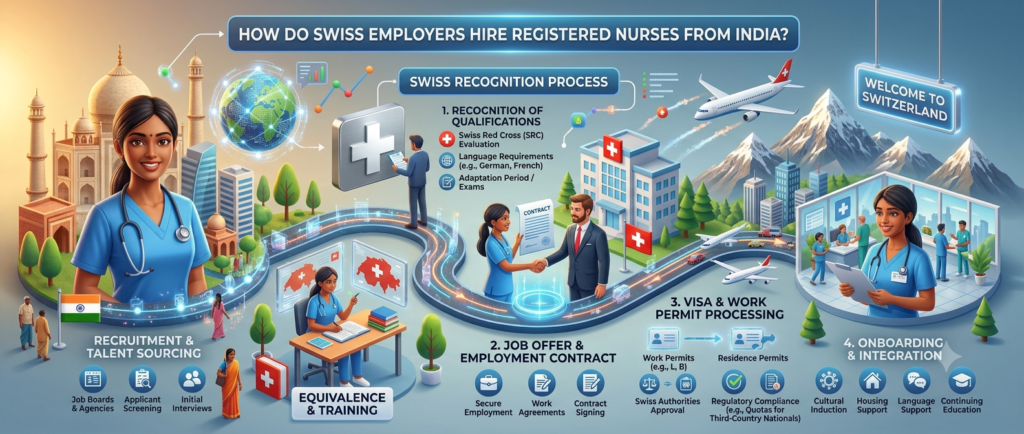
Swiss employers usually follow a systematic recruitment pathway that begins with workforce planning and ends with successful onboarding. They collaborate with specialized international recruitment agencies to identify experienced nurses who satisfy professional, educational, and language requirements. Once candidates are selected, employers coordinate licensing recognition, employment contracts, immigration documentation, and relocation assistance.
Many hospitals also implement orientation programs covering Swiss healthcare protocols, infection prevention standards, patient safety procedures, electronic medical record systems, and workplace culture. These initiatives accelerate adaptation while improving confidence among internationally recruited nurses. Continuous professional development opportunities further strengthen employee engagement and long-term retention.
Recruiting Indian registered nurses has become an increasingly strategic investment for Swiss healthcare organizations seeking sustainable workforce solutions. With proper planning, experienced recruitment partners, and comprehensive onboarding, hospitals can successfully address nursing shortages while maintaining exceptional standards of patient care.
Conclusion
The growing demand for healthcare professionals has made international recruitment an essential workforce strategy for Swiss hospitals. India offers one of the world’s largest pools of highly qualified registered nurses, making it an ideal destination for healthcare employers seeking experienced, compassionate, and clinically competent professionals. By partnering with experienced overseas healthcare recruitment agencies, Swiss hospitals can simplify candidate sourcing, credential verification, language preparation, licensing, immigration, and relocation.
Organizations that invest in ethical recruitment practices, structured onboarding, and long-term employee support are better positioned to build stable nursing teams and deliver outstanding patient care. As Switzerland continues addressing healthcare workforce shortages, recruiting registered nurses from India will remain one of the most effective and sustainable solutions for the future.
Frequently Asked Questions
1. How Can Swiss Hospitals Recruit Registered Nurses from India?
Swiss hospitals can recruit Indian registered nurses through specialized international healthcare recruitment agencies that manage sourcing, screening, licensing support, visa processing, and relocation.
2. How to Hire Registered Nurses from India for Switzerland?
Hospitals should define staffing requirements, partner with experienced recruitment agencies, interview qualified candidates, complete credential recognition, and provide onboarding support.
3. Where Can Swiss Hospitals Find Registered Nurses from India?
They can find qualified nurses through overseas healthcare recruitment agencies, nursing institutions, professional job fairs, and international recruitment campaigns.
4. Which Recruitment Agency Helps Swiss Hospitals Hire Indian Nurses?
Agencies specializing in international healthcare recruitment with expertise in Swiss regulations, language requirements, and nurse licensing are the preferred choice.
5. Why Should Swiss Hospitals Recruit Indian Registered Nurses?
Indian nurses are recognized globally for their strong clinical skills, professional ethics, adaptability, and experience across multiple healthcare specialties, making them valuable additions to Swiss healthcare organizations.
Leave a Reply