

Germany has a strong and diverse economy, with employers across healthcare, engineering, manufacturing, construction, logistics, hospitality, IT, automotive, and other industries seeking qualified workers. For companies facing difficulties filling positions locally, international recruitment can provide access to a wider talent pool.
Overseas recruitment for German companies requires more than simply finding candidates in another country. Employers need to consider workforce requirements, candidate qualifications, recruitment processes, documentation, employment conditions, immigration procedures, professional recognition where applicable, language skills, and long-term workforce integration.
India can be an important sourcing market for German employers looking for qualified professionals and skilled workers. With a large workforce and established education and technical-training systems, Indian candidates may be considered for suitable international employment opportunities depending on the occupation and applicable German requirements.
This guide explains important considerations for German companies planning international recruitment and looking for reliable recruitment partners.
Why Overseas Recruitment for German Companies Is Becoming Important
Recruiting internationally allows employers to expand their search beyond the domestic labor market. Instead of limiting recruitment to candidates already living in Germany, companies can identify suitable candidates in countries with relevant talent pools.
Overseas recruitment for German companies can be particularly relevant when employers have persistent vacancies, require specialized skills, or need to recruit multiple employees within a defined timeframe.
International recruitment can also support companies that are expanding operations or experiencing workforce requirements across several locations.
However, overseas hiring should be approached as a structured business process. Employers should first identify the positions they need to fill, required qualifications, experience, language abilities, employment conditions, and expected joining timelines.
International Recruitment for Germany: What Employers Should Consider
International recruitment for Germany involves several stages. A typical process can include workforce planning, job description preparation, candidate sourcing, screening, interviews, document verification, employment arrangements, immigration-related procedures, and onboarding.
German employers should clearly define the requirements before approaching an overseas recruitment provider.
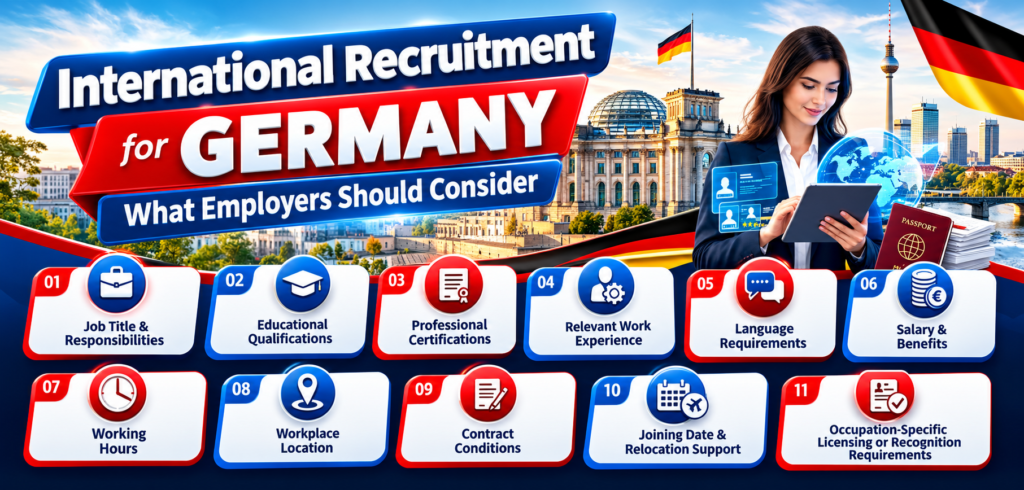
Important information can include:
- Job title and responsibilities
- Required educational qualifications
- Professional certifications
- Relevant work experience
- Language requirements
- Salary and benefits
- Working hours
- Workplace location
- Contract conditions
- Required joining date
- Accommodation or relocation support, where applicable
- Any occupation-specific licensing or recognition requirements
A clear recruitment brief helps an international recruitment partner identify candidates who are more closely aligned with the employer’s requirements.
Recruitment Agency for German Companies: How to Choose a Partner
A recruitment agency for German companies can support employers with candidate sourcing, preliminary screening, interview coordination, documentation, and recruitment administration.
When evaluating an international recruitment agency, German employers should look beyond the size of the candidate database. The quality of recruitment processes, transparency, communication, documentation practices, and understanding of international hiring requirements are also important.
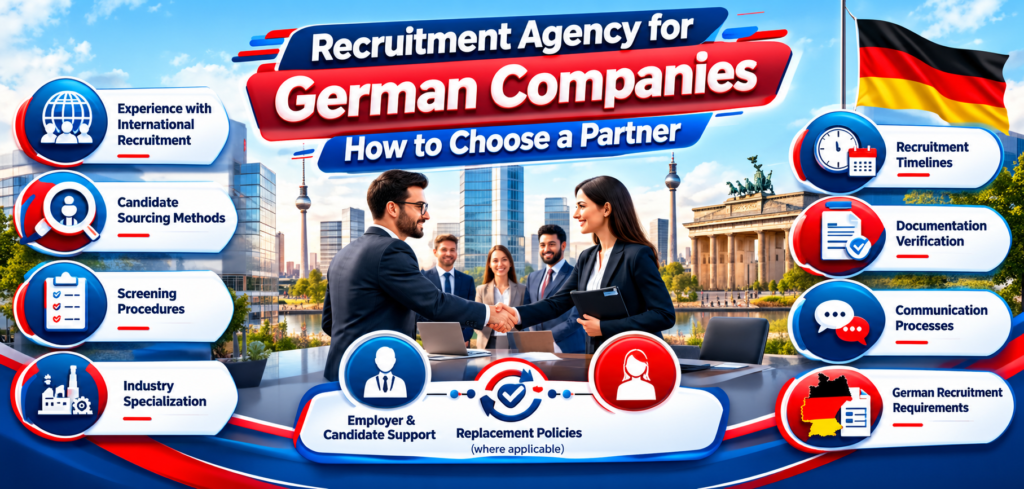
Employers can ask potential recruitment partners about:
- Experience with international recruitment
- Candidate sourcing methods
- Screening procedures
- Industry specialization
- Recruitment timelines
- Documentation verification
- Communication processes
- Employer and candidate support
- Replacement policies, where applicable
- Experience with German recruitment requirements
A recruitment partnership should be based on clearly defined responsibilities and transparent communication between the German employer and the overseas recruitment provider.
Hiring Workers from India for Germany: Key Considerations
Hiring workers from India for Germany can give employers access to a large international talent pool. India has professionals and skilled workers across sectors such as IT, engineering, healthcare, manufacturing, construction, hospitality, logistics, and other industries.
However, employers should evaluate candidates according to the specific requirements of the position rather than relying solely on job titles or years of experience.
For regulated professions, qualification recognition or professional authorization may be required. Employers should therefore determine the applicable requirements for the specific occupation before beginning large-scale recruitment.
For non-regulated positions, employers should still carefully verify educational credentials, professional experience, technical skills, and employment history.
Language requirements should also be established early. Depending on the position and workplace, German-language skills may be important, while some international roles may operate primarily in English.
German Employer Recruitment Agency: Supporting the Hiring Process
A German employer recruitment agency or international recruitment partner can help connect German businesses with candidates outside Germany.
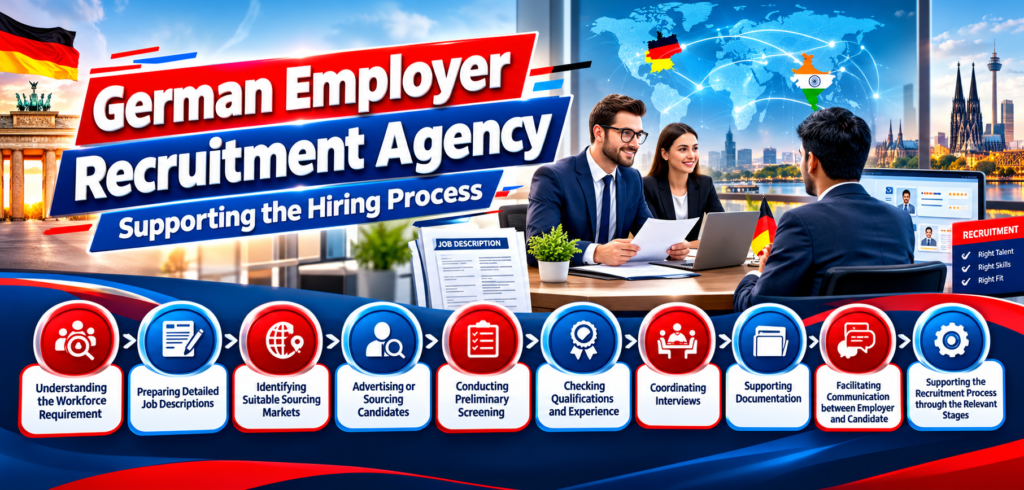
For an employer, the recruitment process may include several activities:
- Understanding the workforce requirement
- Preparing detailed job descriptions
- Identifying suitable sourcing markets
- Advertising or sourcing candidates
- Conducting preliminary screening
- Checking qualifications and experience
- Coordinating interviews
- Supporting documentation
- Facilitating communication between employer and candidate
- Supporting the recruitment process through the relevant stages
The exact responsibilities should be established between the employer and recruitment provider before recruitment begins.
Skilled Workers from India to Germany: Finding the Right Talent
Skilled workers from India to Germany may be sourced for different industries depending on employer requirements and applicable regulations.
Potential areas can include engineering, information technology, healthcare, manufacturing, automotive, construction, hospitality, logistics, and technical services.
Employers should create competency-based job descriptions that clearly explain what the candidate must be able to do.
For example, a technical position may require specific machinery experience, software knowledge, technical certifications, or industrial experience. A healthcare position may require particular qualifications, registration, recognition, language proficiency, and professional authorization.
The more specific the employer’s requirements, the easier it becomes for the recruitment partner to conduct targeted sourcing and screening.
Germany Overseas Staffing Solutions for Growing Businesses
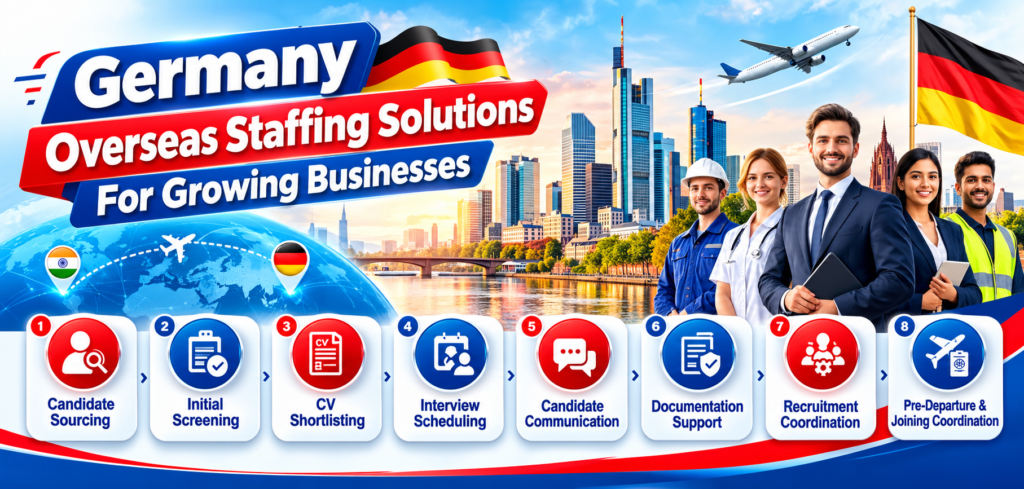
Germany overseas staffing solutions can be useful for organizations that need to recruit internationally on a continuing basis.
Instead of handling every stage independently, an employer can establish a recruitment workflow with an overseas staffing partner.
Such a partnership may cover:
- Candidate sourcing
- Initial screening
- CV shortlisting
- Interview scheduling
- Candidate communication
- Documentation support
- Recruitment coordination
- Pre-departure communication
- Joining coordination
Employers should decide which activities will be handled internally and which will be managed by the recruitment provider.
Bulk Recruitment for German Companies: Planning Large-Scale Hiring
Bulk recruitment for German companies requires considerably more planning than hiring one or two employees.
When an employer needs dozens or hundreds of workers, recruitment should be organized around a structured workforce plan.
The employer should provide information such as:
- Number of vacancies
- Job categories
- Required qualifications
- Experience requirements
- Work locations
- Salary and employment conditions
- Shift requirements
- Language expectations
- Target joining dates
- Interview process
- Documentation requirements
A recruitment partner can then create a sourcing strategy based on these requirements.
Bulk hiring also requires effective candidate communication. Applicants should receive accurate information about the employer, position, employment conditions, recruitment stages, and applicable requirements.
Indian Recruitment Agency for Germany: Building a Reliable Hiring Channel
An Indian recruitment agency for Germany can act as a sourcing and recruitment channel for German companies seeking candidates in India.
German employers should look for recruitment partners that use transparent candidate screening and communication practices.
The employer should receive clear information about shortlisted candidates, including their qualifications, relevant experience, language skills, and other requirements applicable to the position.
For international recruitment, documentation accuracy is especially important. Candidate information should be reviewed carefully before proceeding to later stages.
Germany Manpower Recruitment: From Requirement to Candidate Selection
Germany manpower recruitment should begin with a clearly defined employer requirement.
The process can be divided into several stages:
Stage 1: Workforce Requirement Analysis
The employer identifies the number and type of employees required.
Stage 2: Recruitment Strategy
The recruitment partner determines suitable sourcing channels and candidate markets.
Stage 3: Candidate Sourcing
Candidates are sourced through databases, professional networks, recruitment campaigns, referrals, and other appropriate channels.
Stage 4: Screening
Candidates are evaluated against the employer’s stated requirements.
Stage 5: Interviews
Shortlisted candidates participate in employer interviews or assessments.
Stage 6: Documentation
Relevant educational, professional, identity, and employment documents are collected and reviewed.
Stage 7: Employment and Immigration Process
The employer and candidate proceed according to the applicable German employment and immigration requirements.
Stage 8: Relocation and Onboarding
Where applicable, the candidate receives support with relocation, travel, workplace orientation, and joining procedures.
International Staffing Germany: Creating a Sustainable Workforce
International staffing Germany is not simply about filling vacancies. Employers should consider how international employees will become productive members of the organization.
Successful international staffing can involve:
- Clear job expectations
- Appropriate workplace orientation
- Language support
- Cultural awareness
- Accommodation guidance where applicable
- Workplace safety training
- Employee documentation
- Long-term communication
A structured onboarding program can help international employees understand workplace procedures, responsibilities, communication channels, and organizational expectations.
Recruitment Partner for German Employers: Questions to Ask Before Starting
A recruitment partner for German employers should be able to clearly explain its recruitment process.
Before signing an agreement, employers may want to ask:
How do you source candidates?
Understanding the sourcing method helps employers assess whether the recruitment provider can reach the required talent pool.
How do you screen candidates?
Ask whether qualifications, experience, language skills, and employment history are checked.
How do you handle bulk recruitment?
For large hiring projects, employers should understand the agency’s capacity and recruitment workflow.
How are interviews organized?
Clarify whether interviews are conducted online, in person, or through assessment centers.
Who handles candidate communication?
Clear communication responsibilities can prevent misunderstandings during international recruitment.
How is documentation managed?
Employers should understand what documentation the recruitment partner collects and how verification is handled.
Foreign Worker Recruitment Germany: Understanding Employer Responsibilities
Foreign worker recruitment Germany requires employers to understand the rules applicable to employing international workers.
Requirements can vary according to factors such as nationality, occupation, qualification, employment conditions, and immigration status.
Employers should therefore use official German sources and qualified professional advice where necessary rather than relying on generic information.
For regulated professions, additional recognition or authorization requirements may apply.
Employers should also ensure that job offers and employment conditions accurately reflect the actual position and comply with applicable German employment requirements.
India to Germany Recruitment: Building a Structured Process
India to Germany recruitment works most effectively when both sides establish a clear process from the beginning.
A German company can provide a detailed recruitment order to its Indian partner. The recruitment agency can then source candidates according to the agreed criteria.
The employer can review shortlisted profiles and conduct interviews before making hiring decisions.
This model allows the German employer to retain control over candidate selection while using the recruitment partner’s local sourcing capabilities.
For larger recruitment projects, employers may establish regular reporting systems covering candidate numbers, screening results, interview schedules, selected candidates, and recruitment progress.
German Companies Hiring International Workers: Common Challenges
German companies hiring international workers may encounter challenges that are less common in domestic recruitment.
These can include:
- Differences in qualification systems
- Language barriers
- Documentation requirements
- Professional recognition
- Immigration procedures
- Candidate relocation
- Travel arrangements
- Cultural differences
- Longer recruitment timelines
Planning for these factors early can make the recruitment process more organized.
Employers should also avoid promising candidates a specific outcome regarding immigration or professional recognition unless that outcome has been formally established through the appropriate process.
Overseas Manpower Solutions Germany: Scaling Recruitment
Overseas manpower solutions Germany can support companies that need international recruitment across multiple positions.
For example, a manufacturing company may require technicians, production workers, maintenance professionals, and engineers at the same time.
Instead of treating each vacancy as a completely separate project, an employer can create a workforce recruitment plan covering all required categories.
The recruitment partner can then organize sourcing campaigns around individual job categories while maintaining a centralized reporting system.
Skilled Manpower Recruitment India Germany: Matching Skills With Demand
Skilled manpower recruitment India Germany should focus on matching candidates with actual employer requirements.
A strong candidate profile should demonstrate relevant qualifications, practical experience, technical capabilities, and other skills required for the position.
Employers can improve recruitment outcomes by providing detailed job descriptions instead of generic requirements such as “experienced worker.”
For technical positions, employers can specify machinery, tools, software, certifications, production environments, or technical processes involved in the job.
Germany Workforce Recruitment Agency: What Employers Should Expect
A Germany workforce recruitment agency working internationally should provide an organized recruitment process and clear communication.
Employers should expect regular updates about recruitment activity and should have a defined point of contact for questions.
For bulk recruitment projects, reporting can include:
- Candidates sourced
- Candidates screened
- Candidates shortlisted
- Interviews scheduled
- Candidates selected
- Documentation status
- Recruitment stage
- Expected joining timelines
Such reporting gives employers better visibility into the recruitment pipeline.
International Hiring Solutions for Germany: A Long-Term Approach
International hiring solutions for Germany can become part of a company’s long-term workforce strategy.
Rather than turning to overseas recruitment only when vacancies become urgent, businesses can establish recruitment partnerships in advance.
A long-term approach can help employers develop candidate pipelines for recurring requirements and improve communication between the company and its recruitment partners.
Employers can also review recruitment performance over time by analyzing metrics such as candidate quality, interview-to-selection ratios, joining rates, recruitment timelines, and retention.
Recruitment Services for German Employers: Choosing the Right Model
Recruitment services for German employers can range from candidate sourcing to complete recruitment coordination.
The appropriate model depends on the company’s internal HR capabilities and workforce requirements.
Some employers may only require candidate sourcing, while others may need assistance with screening, interview coordination, documentation, and international recruitment administration.
Before beginning a project, employers should establish the scope of services, commercial terms, responsibilities, communication process, and expected recruitment timelines.
Building a Reliable International Recruitment Strategy
International hiring can give German businesses access to a broader talent pool, particularly when suitable candidates are difficult to find through domestic recruitment alone.
Overseas recruitment for German companies requires careful planning, transparent communication, appropriate candidate screening, and attention to the employment and immigration requirements applicable to each position.
For German businesses considering hiring workers from India for Germany, establishing a professional recruitment partnership can help organize candidate sourcing and recruitment activities in the Indian market.
Whether the requirement involves a small number of specialized professionals or bulk recruitment for German companies, the process should begin with clearly defined workforce requirements and realistic expectations.
A structured approach to international recruitment for Germany can help employers build an organized pipeline of international talent while maintaining appropriate standards for qualification, documentation, communication, and compliance.
German employers exploring international hiring should evaluate recruitment partners carefully and verify the requirements applicable to their specific occupations before proceeding with recruitment.
Leave a Reply