
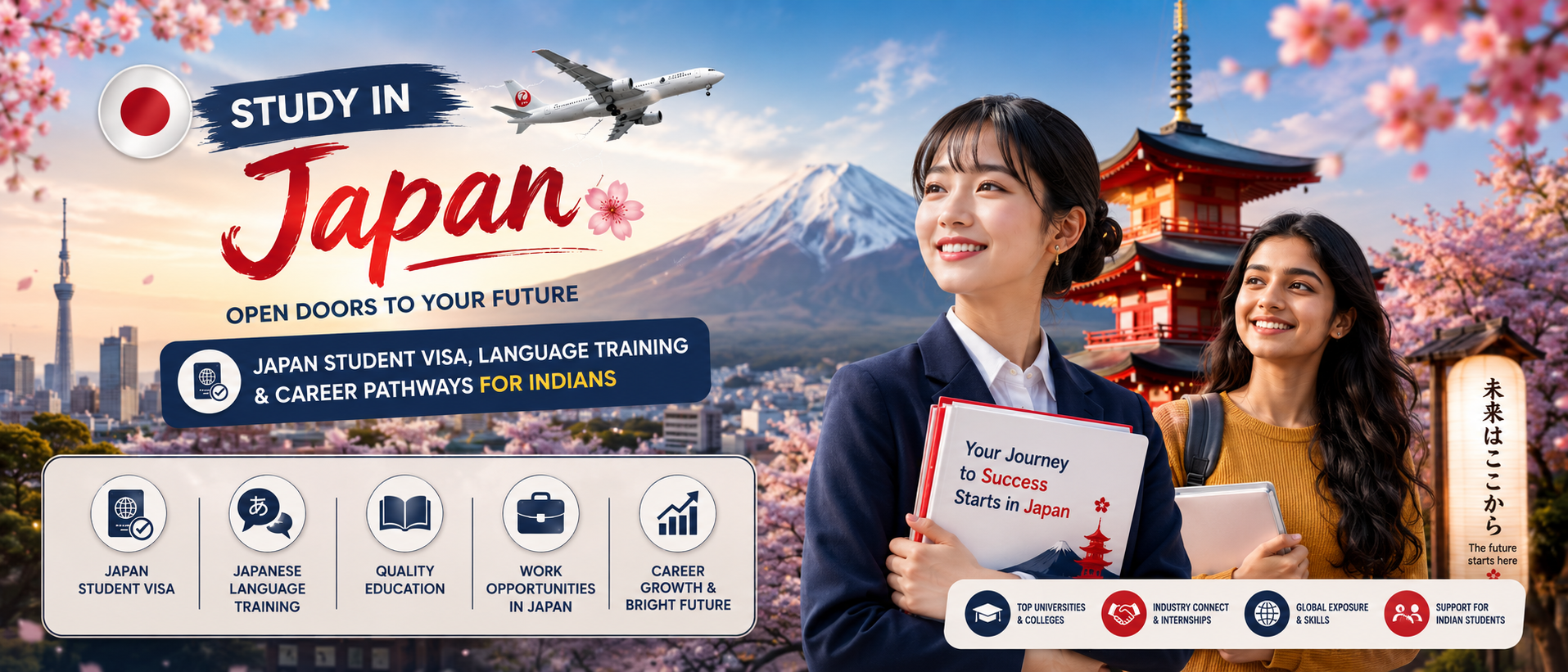
Study in Japan with Work Opportunities: A Complete Guide for Indian Students

For Indian students looking beyond conventional study destinations, Study in Japan can offer an interesting combination of education, cultural exposure, language development, and potential career opportunities. Japan is known for its advanced technology, disciplined working environment, strong education system, manufacturing expertise, and demand for international talent in several sectors. The opportunity is becoming increasingly visible: according to the Japan Student Services Organization (JASSO), 408,069 international students were studying in Japan as of May 1, 2025, representing a 21.2% increase from the previous year and the highest figure recorded in the survey.
For Indian students, however, moving to Japan should not be viewed simply as a way to find employment. The right approach is to think of education, Japanese-language ability, cultural adaptation, and career preparation as parts of one journey. A student visa is primarily intended for education, while full-time employment after graduation generally requires a change to an appropriate work-authorized status of residence. This distinction is important when evaluating advertisements or programs promising a combination of study and employment. A strong Japan language training program, realistic career planning, and proper immigration guidance can make the pathway much easier to understand.
Why Study in Japan Is Becoming a Popular Choice for Indian Students

Choosing a country for higher education is a major decision. Students consider tuition, living expenses, career prospects, safety, culture, language, and the possibility of remaining in the country after graduation. Japan stands out because it combines a sophisticated economy with globally recognized educational institutions and a distinctive culture that attracts students from around the world. The official Study in Japan platform highlights Japan’s diverse regions, educational institutions, scholarships, living information, employment guidance, and student experiences, making it easier for prospective students to research the destination before applying.
The recent international-student numbers also demonstrate the strength of Japan’s education market. In 2025, Japanese language institutes alone accounted for 140,174 international students, while professional training colleges had 106,829 students. Universities, graduate schools, junior colleges, and other institutions also hosted international learners. For an Indian student, this means Japan is no longer simply a destination associated with engineering or technology. Depending on eligibility and the institution, students can explore academic, professional, technical, language, and career-oriented pathways. The key is choosing a legitimate program whose educational content, fees, visa requirements, and career claims are clearly explained before making a financial commitment.
Japan’s Growing International Student Community
The growth in international student numbers is significant because it reflects Japan’s expanding role as an international education destination. The 2025 JASSO survey recorded 408,069 international students, an increase of more than 71,000 compared with the previous year. This creates an increasingly multicultural student environment in which learners can meet people from different countries while developing the communication skills required for life in Japan.
For Indian students, that international environment can also provide an opportunity to develop confidence outside the classroom. Studying in Japan means learning how to navigate public transportation, communicate in Japanese, follow workplace etiquette, manage personal finances, and understand local customs. These experiences can become valuable career assets when combined with formal qualifications and language proficiency. Rather than seeing Japan only as a place to earn money, students should see it as a place where education and professional development can reinforce each other.
Study in Japan with Work Opportunity: What Students Should Know
The phrase study in Japan with work opportunity is attractive, but it needs to be understood correctly. A student residence status is designed for education and does not automatically authorize employment. According to the official Study in Japan guidance, students can undertake part-time work only after obtaining the relevant permission for activities outside their permitted status.
Once permission is granted, international students can generally work up to 28 hours per week during academic periods, with different rules applying during long school holidays. The purpose of this work is to supplement educational and living expenses rather than replace the primary purpose of studying. Students must also ensure that employment does not interfere with their education and that the work complies with Japanese law.
This is why responsible programs should avoid presenting part-time work as guaranteed income. A student may find employment, but the availability, hourly wage, location, schedule, Japanese ability, and individual circumstances all influence actual earnings. A good Japan work permit program should therefore explain the difference between student status, permitted part-time work, and the separate immigration process required for full-time employment after graduation.
Understanding the Japan Student Visa
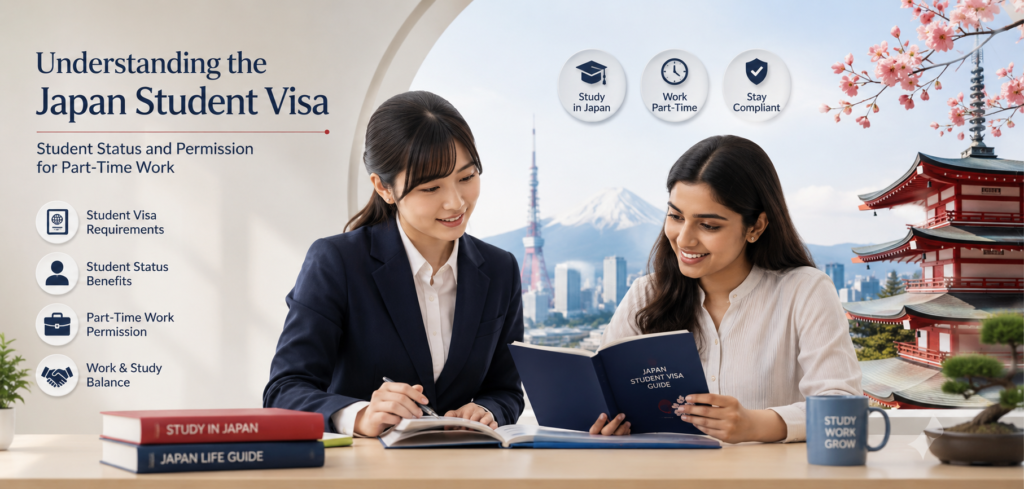
The Japan student visa is generally connected with the student’s admission to an educational institution and the appropriate status of residence. Students should prepare their educational documents, financial evidence, passport documentation, photographs, admission-related documents, and other materials required for their specific circumstances. Requirements can vary according to the institution and immigration process, so applicants should always verify current requirements through official channels and their educational institution.
The most important point is that receiving a student visa should not be confused with receiving a full-time work permit. Japan’s official guidance states that students intending to work full-time after completing their studies must change from Student status to a status that permits the intended employment. This makes early planning extremely valuable. Instead of waiting until graduation to think about employment, students can gradually improve Japanese proficiency, participate in internships where permitted, attend career events, develop professional skills, and research companies during their studies.
Student Status and Permission for Part-Time Work
The Student status itself does not authorize ordinary employment. Students who want to work part-time must obtain permission for activities outside their existing status. Once authorized, eligible students can normally work within the applicable weekly limit, provided they continue meeting the conditions of their student status.
This framework protects the educational purpose of the student pathway. Imagine your studies as the main road and part-time employment as a side road: the side road can help you reach certain financial and practical goals, but it should not take you away from the main destination. Students should therefore select jobs that fit their timetable and should never rely on exaggerated claims of guaranteed earnings.
Japan Language Training Program: Why Japanese Matters

Language is one of the biggest factors separating a comfortable experience in Japan from a difficult one. Even students enrolled in programs that include English-language instruction can benefit tremendously from learning Japanese. Everyday situations such as shopping, transportation, banking, accommodation, healthcare, workplace communication, and administrative procedures can become easier when students understand Japanese.
A structured Japan language training program can help students develop grammar, vocabulary, pronunciation, reading, listening, and conversational ability in stages. Professional instruction is particularly valuable because Japanese uses writing systems that are unfamiliar to most Indian learners. Students who begin preparing before departure may find it easier to adapt after arriving in Japan. Language training also demonstrates commitment to employers because it signals that the candidate is prepared to communicate and work within a Japanese environment.
Professional Japanese Language Training for Better Career Prospects
Professional Japanese language training should go beyond memorizing phrases for an examination. Students need practical communication skills that they can use in classrooms, interviews, workplaces, shops, transportation systems, and everyday conversations. A good trainer can also introduce Japanese workplace etiquette, greetings, formal communication, listening practice, and interview preparation.
Language ability can influence the range of opportunities available to international candidates. Certain jobs may require particular levels of Japanese proficiency, while others may place greater emphasis on technical qualifications or English skills. Students should therefore treat Japanese as a career skill rather than simply a visa requirement.
Japanese Language Course for Indian Students
A Japanese language course for Indian students can be designed to accommodate learners who are starting from zero. Many students may have never studied Japanese before, so a progressive curriculum can make the learning process less intimidating. Initial lessons typically focus on basic scripts, pronunciation, everyday vocabulary, sentence structures, and simple communication before moving toward more complex Japanese.
The learning journey also requires consistency. Japanese cannot realistically be mastered by attending occasional classes without practice. Students can improve faster by combining classroom instruction with listening exercises, reading, vocabulary revision, speaking practice, Japanese media, and mock tests. Whether the learner chooses an online or classroom format, regular exposure is the key.
N4 Japan Jobs and N5 Japan Jobs: Understanding the Pathway
Searches for N4 Japan jobs and N5 Japan jobs have become increasingly common among Indian candidates interested in Japanese employment pathways. However, candidates should understand that JLPT levels are language proficiency indicators and do not themselves guarantee employment. A candidate’s age, education, technical skills, experience, health requirements, employer selection, job category, immigration eligibility, and other factors can influence recruitment.
N5 represents an introductory level, while N4 indicates a stronger basic command of Japanese. Candidates should be cautious when interpreting phrases such as “N5 Japan jobs” as an automatic employment guarantee. Instead, language proficiency should be viewed as one component of a broader employability profile.
For candidates targeting skilled employment pathways, progressing beyond beginner Japanese can be particularly useful. The stronger the candidate’s communication ability, the easier it may become to understand workplace instructions, interact with colleagues, and adapt to Japanese professional culture.
Direct Selection for N4 Candidates
Programs advertising direct selection for N4 candidates may be attractive to applicants who have already invested time in Japanese-language preparation. N4-level candidates can potentially be positioned for opportunities where employers specify a corresponding language requirement, subject to the actual vacancy and eligibility criteria.
However, “direct selection” should never be interpreted as guaranteed employment or guaranteed visa approval. It generally means that eligible candidates may be considered directly through an employer selection process rather than following a longer preliminary training route. Candidates should ask for the employer’s name, job description, salary structure, working hours, location, contract terms, recruitment process, and immigration requirements before accepting an offer.
Direct Selection for N5 Candidates
Direct selection for N5 candidates can appeal to beginners who have achieved an entry-level Japanese qualification and want to explore opportunities in Japan. Nevertheless, candidates should carefully distinguish between language qualification and job eligibility. An N5 certificate demonstrates basic Japanese knowledge, but an employer may require stronger communication ability, technical skills, experience, or additional qualifications depending on the role.
For this reason, students who start at N5 should consider it the beginning rather than the finish line. Continuing toward N4 and higher levels can strengthen communication ability and potentially broaden future opportunities. A candidate who combines Japanese proficiency with a relevant vocational or academic qualification may present a much stronger profile than someone relying on language certification alone.
Japan Work Permit Program: Study First, Build Your Career Next
A Japan work permit program should be understood as a structured pathway rather than a single universal permit. Japan has different statuses of residence for different types of employment. The official Study in Japan website lists several employment-related statuses, including Engineer/Specialist in Humanities/International Services, Skilled Worker, Care Worker, and Specified Skilled Worker.
For example, Japan’s Specified Skilled Worker system covers sectors such as nursing care, building cleaning, construction, accommodation, agriculture, food and beverage manufacturing, food service, aviation, automobile maintenance, and other designated industries. This demonstrates why students and candidates need to identify the exact employment category rather than simply searching for a generic “work permit.”
Japan Work Opportunities for Indians

Japan work opportunities for Indians can exist across professional, technical, service, manufacturing, hospitality, care, construction, and other sectors, depending on the candidate’s qualifications and the applicable immigration category. Japan’s official employment guidance explains that international students can use career services, employment centers, internships, job fairs, seminars, company websites, and other resources when searching for employment.
For students, career preparation should begin well before graduation. Building a Japanese-style resume, practicing interviews, understanding workplace etiquette, researching companies, and improving language ability can all make the transition easier. Some international students may also qualify to continue job hunting in Japan after graduation by changing their status to Designated Activities under applicable conditions.
Industries Offering Potential Career Opportunities
Japan’s employment landscape includes a broad mix of industries. The official Specified Skilled Worker framework alone identifies multiple sectors experiencing recruitment needs, including construction, accommodation, agriculture, food manufacturing, food service, nursing care, aviation, and industrial fields.
For graduates with academic or professional qualifications, opportunities can also include engineering, programming, finance, human resources, marketing, translation, interpretation, research, product development, design, and other roles depending on their education and eligibility. The important lesson is simple: match your qualification, Japanese ability, and experience with the actual job category rather than choosing a pathway based only on salary advertisements.
Online Japan Batches for Flexible Learning
Online Japan batches can make Japanese-language preparation more accessible to students and working candidates. Online classes may suit learners who live far from training centers or have demanding schedules, while offline classes can provide face-to-face interaction, immediate correction, and classroom discipline. Offering both formats can allow students to choose a learning environment that fits their circumstances.
Regardless of format, the quality of instruction matters more than the delivery method. Students should look for structured lessons, qualified trainers, mock examinations, speaking practice, doubt-solving, progress tracking, and practical Japanese. A flexible batch becomes valuable when it produces measurable learning outcomes rather than simply providing access to recorded lectures.
How Students Can Prepare Before Going to Japan
Preparation should begin months before departure. Students can organize their academic documents, research institutions, understand visa requirements, begin Japanese language training, estimate living costs, learn about accommodation, and familiarize themselves with Japanese culture. Building a basic financial plan is particularly important because students should not assume that part-time income will cover every expense.
Language preparation should happen alongside academic preparation. Students can practice introductions, directions, shopping conversations, classroom communication, and common workplace expressions. They should also learn how to manage everyday responsibilities independently. These seemingly small skills can make a significant difference during the first few months in Japan.
Can Students Earn While Studying in Japan?
Yes, eligible international students may work part-time in Japan after receiving the required permission, but there are strict conditions. The official Study in Japan website states that part-time employment is generally limited to 28 hours per week, increasing to up to eight hours per day during designated long school holidays.
Students should also remember that their primary purpose remains education. The official guidance specifically advises students not to allow part-time employment to interfere with their studies. This is why responsible planning is essential. A student who works excessive hours and struggles academically could undermine the very pathway that brought them to Japan.
Can Students Earn INR 1 Lakh or More Per Month in Japan?
Marketing claims such as “earn minimum INR 1 lakh per month” should be treated as promotional estimates rather than universal guarantees. Actual income depends on the job, location, hours worked, wage rate, taxes, schedule, and legal work restrictions. Japan’s Ministry of Health, Labour and Welfare reports that the weighted national average regional minimum wage for fiscal 2025 was ¥1,121 per hour, but actual minimum wages vary by prefecture.
For illustration, 28 hours per week at ¥1,121 per hour would produce roughly ¥135,700 in a four-week month before deductions, assuming every permitted hour is available and worked. That does not mean every student will receive that amount, and it should not be confused with guaranteed earnings. Students should calculate income using the actual job offer, legal working hours, local wage rate, deductions, and living expenses rather than relying on a headline figure.
From Student to Full-Time Employee in Japan
One of the most attractive aspects of studying in Japan is the possibility of building a pathway toward a professional career. However, graduating does not automatically convert a Student status into a full-time employment status. Official guidance states that students intending to work full-time must change their status of residence to one that permits their intended employment.
The process depends on the job and the applicable immigration category. For example, the Engineer/Specialist in Humanities/International Services category covers roles such as engineering, programming, marketing, HR, finance, design, translation, interpretation, and other professional activities. This makes choosing an educational program strategically important. Your academic background and future job should form a logical connection wherever the relevant immigration category requires it.
Japan Career Opportunities After Graduation
Japan career opportunities can extend beyond the first job. Students who develop Japanese proficiency, professional qualifications, and workplace experience can potentially build long-term careers in Japan or use their international experience when returning to India or moving elsewhere. Japan’s official employment resources encourage international students to begin job hunting early, use career guidance, attend job fairs, seek internships, and communicate directly with companies.
The strongest candidates are usually those who prepare before graduation instead of waiting until the final semester. A combination of academic knowledge, Japanese language skills, communication ability, technical competence, and cultural understanding can make a candidate more competitive. Career development is a marathon rather than a lottery ticket: the more relevant skills you build, the more pathways you can potentially explore.
Important Things to Check Before Choosing a Japan Program
Before enrolling in any Study in Japan or Japan work-related program, candidates should investigate the details carefully. Ask whether the institution is legitimate, what qualification it awards, what the complete fee structure is, what the refund policy says, what language level is expected, what the visa pathway involves, and whether employment claims are supported by actual employer documentation.
Be especially careful with phrases such as “100% work permit success rate” or “guaranteed job.” Immigration decisions and employment selection depend on eligibility and official procedures, so no private training provider should be assumed to control government decisions. A credible provider should explain the process transparently, identify what is guaranteed and what is not, and encourage applicants to verify official information.
Why Japanese Language Skills Can Become a Career Advantage
Japanese language ability can become one of the most practical assets an Indian student develops during the Japan journey. It can help with classroom participation, workplace communication, interviews, networking, customer service, and everyday life. More importantly, language can transform a student from someone who merely lives in Japan into someone who can participate more confidently in Japanese society.
Students should therefore consider language training an investment in employability. Starting with N5 and progressing toward N4 can establish a foundation, while higher proficiency can open additional possibilities depending on the industry and employer. The right goal is not simply to pass an examination; it is to communicate effectively enough to understand instructions, express ideas, ask questions, solve problems, and build professional relationships.
Is Study in Japan Right for You?
Study in Japan can be an exciting pathway for Indian students who want international education combined with the possibility of developing Japanese language skills and exploring future career opportunities. Japan’s international student population reached a record 408,069 in 2025, demonstrating the country’s continued importance as an education destination. At the same time, students must understand that studying and working are governed by different immigration rules, and part-time employment requires the appropriate permission.
For students considering a Japan language training program, the smartest approach is to start early, build Japanese proficiency, understand the Japan student visa, research genuine institutions, prepare financially, and investigate employment pathways based on actual qualifications. N4 and N5 can be useful milestones, but neither level should be presented as an automatic guarantee of a job or work permit. With realistic expectations, proper preparation, professional language training, and a clear career plan, Japan can become more than a study destination—it can become a foundation for international career development.
Frequently Asked Questions About Study in Japan
1. Can Indian students study and work in Japan?
Yes, international students may undertake permitted part-time employment after obtaining the required permission. The general limit is 28 hours per week during academic periods, with up to eight hours per day during long school holidays under the applicable rules. Full-time employment after graduation requires changing to an appropriate work-authorized status.
2. Is N4 enough to get a job in Japan?
N4 can satisfy the language requirement for some opportunities, but it does not guarantee employment. Employers can consider education, technical skills, experience, interview performance, Japanese ability, and the requirements of the specific job. Candidates should verify the exact requirements of every vacancy.
3. Can N5 candidates get jobs in Japan?
Some recruitment pathways may consider candidates with beginner-level Japanese, depending on the job and employer. However, N5 should generally be viewed as a starting point. Improving toward N4 and higher levels can strengthen communication ability and potentially expand the range of opportunities.
4. Can students earn INR 1 lakh per month in Japan?
It is possible for some workers or students under particular circumstances to earn an equivalent amount, but it should not be treated as a guaranteed student income. Part-time working hours are legally restricted, and actual earnings depend on the hourly wage, number of permitted hours, job availability, location, and deductions. Japan’s 2025 weighted national average minimum wage was ¥1,121 per hour.
5. What is the best way to prepare for Study in Japan?
Start with a recognized educational pathway, understand the Japan student visa, begin Japanese-language training early, organize financial and academic documents, research living costs, and learn about post-study employment options. Candidates should also verify recruitment and visa claims through official sources rather than relying solely on promotional advertisements.
Leave a Reply