

Germany’s healthcare sector is facing a workforce challenge that cannot be solved by traditional hiring alone. Nursing remains one of the country’s major shortage areas, and current labour-market data continues to show strong demand for qualified nursing professionals. The Federal Employment Agency reported in 2026 that around 20% of employed nursing personnel in Germany had foreign citizenship in 2025, while the unemployment rate among qualified nursing professionals remained very low at 1.1%. For German hospitals, elderly-care facilities, rehabilitation centres and other healthcare providers, this creates a strong reason to develop reliable international recruitment channels. India is particularly relevant because it has a large pool of trained nursing professionals and Germany already has established government-supported recruitment cooperation involving Indian nurses from Kerala and Telangana. The opportunity, however, is not simply about finding candidates and sending CVs to Germany. Successful Indian nurses recruitment for Germany requires qualification screening, professional recognition, German language preparation, documentation, visa coordination, ethical recruitment and long-term integration. Employers that approach the process as a complete workforce strategy rather than a simple vacancy-filling exercise are more likely to attract suitable candidates and retain them.
Why Germany Is Looking to India for Qualified Nurses
Germany’s demand for nurses is closely connected with demographic change, rising healthcare needs and the difficulty of filling specialist positions through the domestic workforce alone. The Federal Employment Agency’s 2025 shortage analysis identified 157 occupations with shortages, with nursing and healthcare occupations among the areas showing particularly strong shortages. In 2025, Germany had approximately 1.76 million socially insured employees working in nursing occupations, yet the supply of qualified professionals remains difficult to match with demand. The same data shows that foreign workers are becoming increasingly important to maintaining healthcare capacity, with the number of foreign-national nursing employees rising significantly while the number of German-national employees declined. This is why German healthcare recruitment is moving beyond domestic advertising toward structured international sourcing. India can become an important recruitment market because German authorities already recognise cooperation with Indian healthcare professionals as part of international recruitment efforts. The official Make it in Germany portal lists India among the countries involved in the Triple Win programme, which places qualified nursing and care workers into German healthcare facilities. For employers, this means India is not simply an emerging recruitment market; it is already connected to recognised international nursing recruitment pathways.
The German Nursing Workforce Shortage
The scale of the challenge makes German nursing workforce shortage a strategic workforce issue rather than a temporary hiring problem. According to the Federal Employment Agency, Germany had around 31,000 registered nursing vacancies on average in 2025, while qualified nursing professionals continued to show very low unemployment. The agency also reported that the share of foreign nationals among nursing employees reached 20% in 2025. For employers, the message is clear: waiting for a large domestic pool of immediately available nurses may not be a sustainable recruitment strategy. International recruitment can expand the available talent pool, but only when employers build systems that account for professional recognition and integration. A German hospital might find an excellent Indian nurse with several years of clinical experience, but that candidate still needs to navigate Germany’s regulated-profession requirements. The recruitment strategy therefore needs to connect the employer, candidate, recognition authority, language provider and immigration process. When these components are managed together, international recruitment becomes much more predictable and can support workforce planning over several years rather than filling only one urgent vacancy.
Why Indian Nursing Professionals Are a Strong Recruitment Pool
India has a substantial healthcare education ecosystem and a large population of trained nursing professionals, making it an attractive source market for international recruitment. For German employers, the most important consideration should not simply be the number of available candidates but the quality and suitability of those candidates for the German healthcare environment. Indian nursing professionals can bring clinical experience, adaptability and experience working in demanding healthcare settings, but employers should assess each candidate individually rather than relying on nationality as a substitute for qualification screening. A strong recruitment programme should examine educational credentials, professional registration, clinical experience, specialty exposure, employment history, communication ability and motivation to work in Germany. The candidate’s willingness to learn German is equally important because nursing is a regulated profession and professional practice requires German language competence. Official German guidance states that nurses from third countries must undergo an individual recognition procedure, and professional practice generally requires German language skills at B2 level. Therefore, the best qualified nurses from India are not necessarily those with the longest CVs; they are candidates whose qualifications, clinical experience, language preparation and professional goals align with the German employer’s requirements.
Benefits of Recruiting Qualified Nurses from India
A well-designed international recruitment strategy can give German healthcare employers access to a broader talent pool while creating a repeatable hiring channel. Instead of treating every international candidate as a completely new project, employers can establish standard screening criteria and documentation checklists. This makes international nurse recruitment easier to scale. Another benefit is the ability to recruit according to specific clinical requirements. Depending on the employer, recruitment campaigns can target nurses with experience in hospitals, elderly care, rehabilitation, intensive care or other relevant environments, subject to the employer’s actual requirements and recognition pathway. The German government has also developed recognised recruitment initiatives involving India, including the Triple Win programme, which demonstrates that international recruitment from India can be structured around ethical and organised processes. For employers, the strongest model combines professional assessment with language preparation and realistic job information. Candidates should understand the workplace, duties, location, salary structure, working hours, accommodation arrangements and recognition pathway before accepting an offer. Transparency at this stage can reduce misunderstandings later and improve long-term retention.
Understanding Indian Nurses Recruitment for Germany
A successful Indian nurses recruitment for Germany campaign starts with defining the exact workforce requirement. German employers should determine how many nurses are required, which departments need staff, what clinical experience is preferred, whether the candidates need full recognition before joining, and what language level is required at each stage. Once these criteria are defined, recruiters can source candidates through professional networks, nursing institutions, recruitment agencies, job campaigns and recognised international recruitment channels. Screening should then verify the candidate’s nursing qualification, professional registration, experience and supporting documents. It is important to distinguish between candidates who are fully ready for professional practice in Germany and candidates who may still require recognition or an adaptation measure. Germany’s official guidance explains that third-country nurses undergo an individual recognition process, and if substantial differences are identified, compensation or adaptation measures may be required. This makes early document evaluation extremely valuable. Employers can avoid wasting time interviewing candidates whose qualification profile does not match the role and can instead build a pipeline of candidates who have a realistic pathway toward German professional recognition.
What German Employers Should Verify Before Hiring
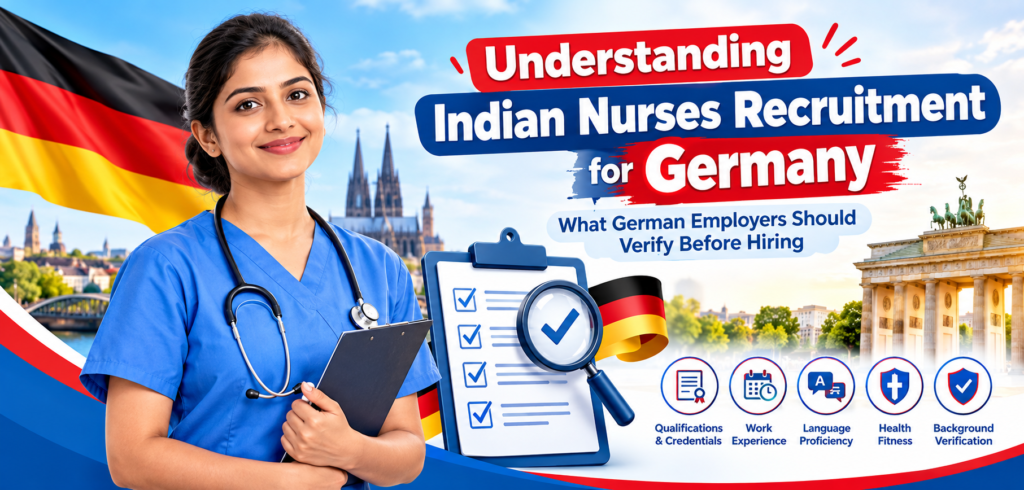
Before making an employment decision, employers should establish a candidate verification process covering both professional and immigration-related factors. The first step is confirming that the nursing qualification was genuinely completed and that the candidate has the relevant professional documentation. Employers should also review clinical experience, employment certificates and references where appropriate. The next stage is understanding where the candidate stands in the German recognition process. Because nursing is a regulated profession in Germany, full professional practice requires recognition of the foreign qualification and a professional licence. German employers should also consider the candidate’s German language level and whether additional language training will be required before or after arrival. A structured assessment can be organised into four areas: qualification, experience, language and documentation. This approach creates a transparent recruitment scorecard and allows employers to compare candidates fairly. It also makes communication with an overseas nurse recruitment agency much easier because the agency knows exactly what candidate profile the employer expects rather than sourcing broadly and hoping that suitable applicants appear.
Nurse Qualification Recognition Germany
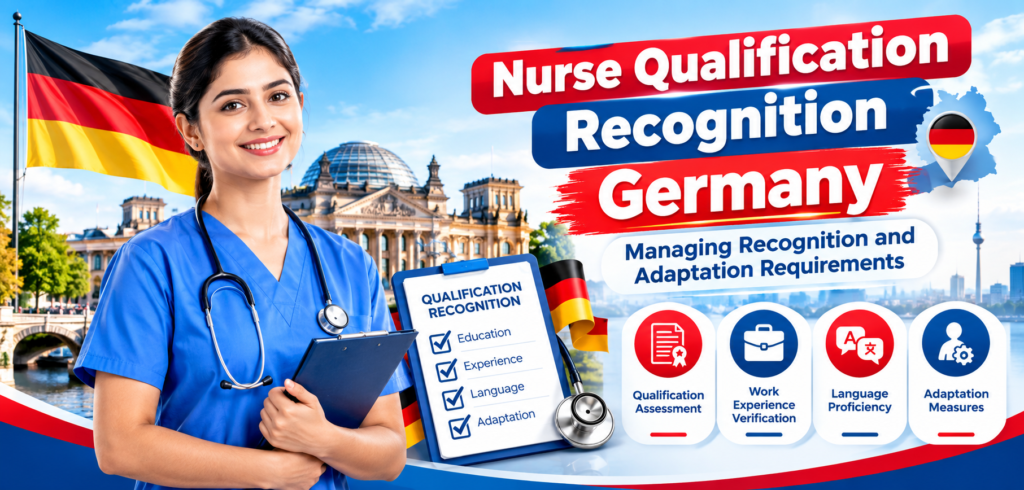
One of the most important stages of nurse qualification recognition Germany is the formal assessment of an international qualification against the relevant German reference occupation. Germany considers nursing a regulated profession, meaning foreign nurses cannot simply begin unrestricted professional practice based only on an overseas qualification. The competent authority assesses whether the foreign professional qualification is equivalent to the German nursing reference profession. Applications are submitted to the responsible recognition authority in the federal state where the employment is intended, and the recognition granted there is valid throughout Germany. If substantial differences are identified, the candidate may need an adaptation programme or another compensation measure before full recognition is awarded. The official recognition guidance indicates that the equivalence assessment generally takes around three to four months once all required documents have been submitted, although actual timelines can vary according to the case and authority. For employers, beginning this process early is essential because recognition should be treated as part of recruitment planning rather than as an administrative task left until the end.
Managing Recognition and Adaptation Requirements
Employers should build recognition management into the recruitment timeline from the moment a candidate is shortlisted. A professional recruitment partner can help collect documents, identify missing information and coordinate communication, but the final recognition decision belongs to the competent German authority. If a candidate receives partial recognition, the employer can explore the appropriate adaptation or qualification route rather than automatically rejecting the applicant. This creates a larger potential talent pool and allows German healthcare providers to recruit promising professionals who may need structured support before achieving full professional recognition. Germany also provides a recognition partnership pathway under which certain skilled workers can enter Germany and complete recognition-related steps alongside employment, subject to specific conditions. The official requirements include a suitable employer and, for the recognition partnership route, German language skills of at least A2 for the residence process; higher language proficiency may be required depending on the profession and qualification measures. Employers should therefore distinguish between immigration requirements and professional licensing requirements. This distinction prevents one of the most common international recruitment mistakes: assuming that obtaining a visa automatically means the candidate can immediately work as a fully licensed nurse.
German Language Requirements for Nurses
Language is not a secondary issue in healthcare recruitment; it is part of patient safety, teamwork and professional practice. The German language requirements for nurses need to be built into the recruitment plan from the beginning. Official German guidance states that nurses seeking professional recognition generally need German language skills at B2 level under the Common European Framework of Reference for Languages. This requirement makes language training a major component of India to Germany nurse recruitment. Employers should assess candidates’ current German level before making final recruitment decisions and establish a realistic training schedule. A candidate who has strong clinical skills but no German knowledge may still become an excellent employee, but the pathway will be longer than for a candidate who has already completed significant language preparation. Language training should also go beyond general conversational German. Nurses need terminology related to symptoms, medication, patient care, documentation, instructions, emergencies and communication with doctors and colleagues. The goal is not simply to pass a language examination; it is to develop communication confidence for a real clinical environment.
Why Language Preparation Should Start in India
Starting German language training in India can make the overall recruitment pathway more efficient because candidates can progress before travelling. Government-supported recruitment programmes already demonstrate the value of language preparation in the source country; the Triple Win programme, for example, includes German language support and nursing-related preparation for participating candidates. Private employers can apply a similar principle by partnering with credible training providers and linking language milestones to the recruitment timeline. A practical programme may begin with basic German and progressively move toward the level required for recognition and professional practice. Candidates should also receive cultural and workplace orientation so they understand communication styles, patient expectations and professional hierarchy. This is particularly useful because clinical competence and language competence are different skills. Someone may understand a medical procedure perfectly but still struggle to explain it to a German-speaking patient. Preparing both areas before arrival gives employers a stronger foundation for onboarding and reduces the pressure placed on the candidate during the first months in Germany.
International Nurse Recruitment: The Employer Process
A successful international nurse recruitment process can be divided into several connected stages: workforce planning, candidate sourcing, screening, interviews, document verification, recognition, language preparation, employment contracting, immigration processing, arrival support and integration. Employers should avoid treating these stages as isolated departments. For example, HR may select a candidate while another team handles recognition, and a third party handles immigration, creating communication gaps that delay the entire process. A better approach is to assign one recruitment coordinator or partner who maintains a clear timeline for every candidate. Digital tracking can help employers monitor language certificates, recognition status, document completion, visa progress and expected joining dates. The recruitment process should also include realistic information about the job. Candidates should know whether the role is in a hospital, nursing home, rehabilitation centre or another healthcare setting, what shifts are expected and what support is available. Clear expectations are especially important in overseas recruitment because relocation represents a major personal and professional decision. The objective should be a sustainable employment relationship rather than simply getting a candidate through the border.
Building a Structured Recruitment Pipeline
German employers can create a recruitment pipeline by maintaining candidate stages such as sourced, screened, interviewed, language preparation, recognition submitted, recognition completed, visa processing, travel ready and joined. This simple structure provides management with a clear view of the workforce pipeline. It also helps identify bottlenecks. If many candidates are stuck at language preparation, the employer may need additional training capacity; if documents are frequently incomplete, the screening process needs improvement. An experienced recruitment partner can provide additional support by coordinating candidate communication in India while the German employer focuses on interviews and workforce planning. This is where skilled healthcare manpower India becomes valuable as a strategic recruitment resource. Rather than launching a new campaign every time a vacancy appears, healthcare organisations can build relationships with reliable sourcing partners and maintain a qualified candidate pool. Over time, this can reduce recruitment pressure and create a more predictable flow of international nurses.
India to Germany Nurse Recruitment and Visa Processing
The immigration stage is another critical part of India to Germany nurse recruitment. The appropriate route depends on the candidate’s qualification status, recognition outcome, employment arrangement and individual circumstances. For fully recognised nursing professionals who meet the relevant requirements and have a suitable job, Germany provides skilled-worker immigration pathways. Where professional recognition is still incomplete, other routes may apply, including residence arrangements connected with recognition or adaptation measures. Official German guidance confirms that nurses from third countries may need a residence permit and that the route depends partly on the outcome of the recognition process. Employers should therefore avoid promising a fixed visa timeline before the candidate’s case has been properly assessed. Instead, the employer and recruitment partner should establish a document checklist, monitor each stage and communicate realistic expectations. Visa preparation should also be coordinated with recognition because these processes can affect one another. A complete international recruitment plan treats immigration as a managed project rather than a last-minute administrative requirement.
Understanding the Nursing Visa Germany Process
The phrase nursing visa Germany covers several possible immigration situations, so employers should focus on the candidate’s specific legal pathway instead of assuming that one visa category applies to everyone. A fully recognised nurse with the necessary professional permission and a qualifying job may be eligible for a skilled-worker residence route. A candidate whose qualification is only partially recognised may need to complete a qualification or adaptation process before obtaining full professional recognition. Germany also offers a recognition partnership route under defined conditions, including an agreement between the employer and worker and minimum German-language requirements for the residence pathway. The employer’s responsibility should include providing accurate employment information, supporting required documentation and maintaining communication during the process. Candidates should also be informed about accommodation, insurance, travel planning and arrival procedures. This creates a smoother transition from recruitment to employment. For a healthcare organisation, the real success metric is not simply visa approval; it is how quickly and effectively the nurse can become integrated into the workforce while meeting all professional and regulatory requirements.
Employer-Sponsored Nurses Germany
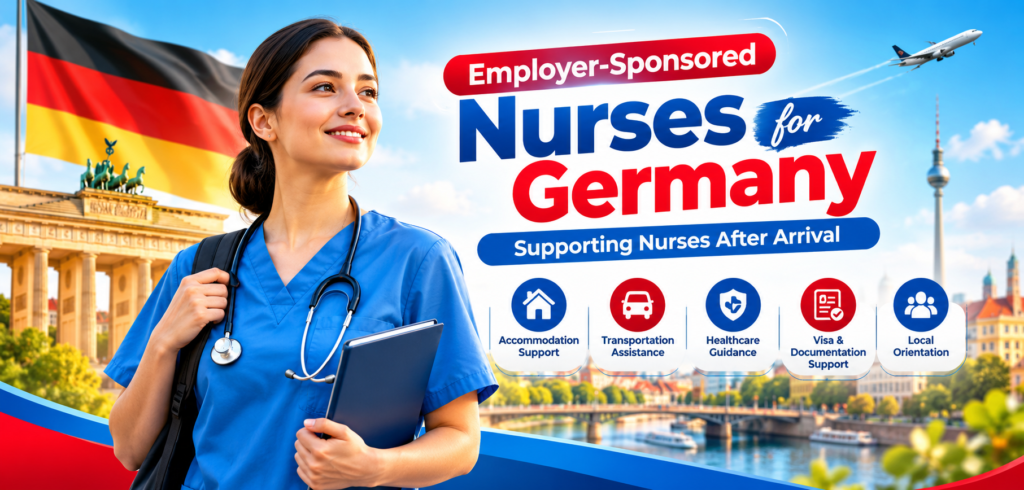
The concept of employer-sponsored nurses Germany is particularly attractive when employers want to build a committed international workforce rather than relying on candidates to navigate the entire relocation process alone. Employer involvement can include employment contracts, recognition support, language training, relocation assistance, accommodation guidance and onboarding. However, support must be clearly defined so that both employer and candidate understand their responsibilities. A good international recruitment package can make a healthcare organisation more attractive to qualified candidates, especially when competing employers are recruiting from the same international market. Employers should also ensure that recruitment and employment practices remain ethical and transparent. Germany’s official international recruitment framework emphasises fair recruitment standards, and government-supported projects involving nurses from India are designed around structured recruitment practices. The employer should provide accurate information about salary, working conditions and job responsibilities rather than presenting an idealised version of the position. Candidates who understand the reality of the job before relocation are more likely to adapt successfully.
Supporting Nurses After Arrival
Recruitment does not end when an Indian nurse lands in Germany. The first few months can determine whether an international employee remains with the organisation long term. Employers should consider practical onboarding support such as registration guidance, accommodation assistance, workplace orientation, introductions to colleagues and help understanding internal procedures. Cultural integration can also be valuable. A nurse may be clinically experienced but unfamiliar with German documentation systems, workplace communication patterns or patient expectations. A structured mentor or buddy system can provide a safe point of contact during the adjustment period. Employers can also schedule regular feedback meetings during the first three, six and twelve months. This helps identify issues before they become reasons for resignation. The objective of healthcare staffing solutions Germany should therefore be retention as well as recruitment. When international nurses feel supported, understand their career path and receive help with professional integration, employers can turn international hiring into a long-term workforce advantage rather than a cycle of repeated recruitment.
Choosing Healthcare Staffing Solutions Germany
Choosing suitable healthcare staffing solutions Germany requires employers to look beyond the number of CVs an agency can provide. A strong recruitment partner should understand nursing qualifications, German recognition requirements, language preparation, documentation, immigration procedures and ethical recruitment. The agency should also be capable of understanding the employer’s actual workforce needs. For example, a hospital looking for experienced nurses should not receive a large list of candidates who have only basic healthcare experience. Similarly, an elderly-care provider may need a different candidate profile from an acute-care hospital. The quality of matching matters more than the volume of applications. German employers should ask recruitment partners how candidates are screened, how documents are verified, how language readiness is assessed and what support is provided after arrival. They should also establish clear communication channels and measurable recruitment milestones. A transparent recruitment partner can function as an extension of the employer’s HR team, helping connect Indian candidates with German healthcare organisations while keeping the process organised.
Working With an Overseas Nurse Recruitment Agency
An experienced overseas nurse recruitment agency can simplify the international hiring process by coordinating activities across India and Germany. The agency can support candidate sourcing, initial screening, interview scheduling, documentation, language coordination, recognition assistance and relocation communication. However, employers should perform due diligence before selecting a recruitment partner. They should look for experience in healthcare recruitment rather than relying solely on claims of overseas placement. It is also useful to examine whether the agency provides clear information to candidates and follows ethical recruitment principles. Germany’s official guidance specifically highlights government-supported and recognised recruitment projects in international nursing recruitment, including the Triple Win initiative involving India. A private agency can complement such systems, but employers should ensure that every stage complies with applicable German and Indian requirements. The ideal partnership is based on transparency: the employer defines the job, the recruiter identifies suitable candidates, the candidate understands the pathway, and qualified professionals receive appropriate support throughout the process.
A Practical Recruitment Roadmap for German Employers

German healthcare employers seeking nurses from India can create a practical recruitment roadmap by starting with workforce demand and working backwards from the expected joining date. First, define the number and type of nurses required. Second, establish qualification and experience criteria. Third, select an appropriate Indian sourcing channel or recruitment partner. Fourth, conduct structured professional interviews and document verification. Fifth, begin recognition and language preparation as early as possible. Sixth, coordinate employment documentation and the appropriate immigration pathway. Finally, prepare an arrival and integration programme. This approach reduces uncertainty because each stage has a clear owner and measurable outcome. It also enables employers to identify delays early rather than discovering them when the expected joining date is approaching. The current German labour market makes this proactive approach particularly important. With nursing continuing to be identified as a shortage area and foreign workers playing an increasingly significant role, international recruitment is becoming a structural component of workforce planning. India can therefore be an important source market for German healthcare organisations that are prepared to invest in a professional recruitment process.
Creating a Long-Term International Recruitment Strategy
The strongest employers will not view Indian recruitment as a one-time response to a staffing crisis. They will build a long-term international nurse recruitment strategy with defined sourcing partners, language programmes, recognition workflows, immigration coordination and retention initiatives. Germany and India have already strengthened cooperation around the recruitment of Indian nursing professionals, with the German Federal Ministry of Health and India’s health authorities signing a memorandum of understanding in January 2026 aimed at establishing common recommendations and standards for recruiting qualified nurses. This development reinforces the importance of structured international recruitment. For German employers, the opportunity is significant, but success depends on preparation. The organisations that attract the best candidates will be those that communicate clearly, support recognition, invest in language training and offer genuine career development. International recruitment should not be treated as simply importing labour. Done properly, it is a partnership between employer and professional that creates benefits for the healthcare organisation, the nurse and ultimately the patients receiving care.
Conclusion
Germany’s nursing workforce challenge is creating a strong case for carefully managed international recruitment. The latest Federal Employment Agency data confirms that nursing remains a shortage area and that foreign professionals are already an important part of Germany’s healthcare workforce. India offers German healthcare employers access to a substantial pool of nursing professionals, while established cooperation between Germany and India demonstrates that this recruitment corridor has genuine institutional support. However, recruiting qualified nurses from India requires much more than finding candidates. Employers need to manage professional recognition, German language requirements, documentation, immigration, onboarding and retention as connected parts of one recruitment strategy. By working with a reliable recruitment partner and building a transparent, candidate-focused process, German hospitals, clinics and care providers can develop a sustainable pipeline of Indian nursing professionals. The future of German healthcare recruitment will increasingly depend on finding the right international talent—and equally importantly, creating the conditions that allow that talent to succeed.
Frequently Asked Questions
1. Why should German healthcare employers recruit nurses from India?
India provides access to a large pool of trained nursing professionals, and Germany already has established recruitment cooperation involving Indian nurses. Foreign-national nurses have become increasingly important to Germany’s healthcare workforce as domestic staffing shortages continue.
2. Do Indian nurses need qualification recognition in Germany?
Yes. Nursing is a regulated profession in Germany, so nurses from third countries generally need their foreign professional qualification assessed and recognised before they can practise as fully licensed nursing professionals.
3. What German language level is generally required for nurses?
For professional recognition and practice, German language proficiency at B2 level is generally required for nursing professionals. Specific immigration or recognition pathways can have different minimum requirements, so the candidate’s individual route should be assessed carefully.
4. Can German employers sponsor nurses from India?
German employers can employ international nursing professionals through applicable skilled-worker and recognition-related immigration pathways, provided the candidate and employer meet the relevant requirements. The appropriate route depends on factors such as qualification recognition, professional licensing and employment circumstances.
5. How can an overseas nurse recruitment agency help German employers?
A specialised agency can support candidate sourcing, professional screening, interview coordination, documentation, language preparation, recognition support, immigration coordination and relocation communication. The employer should still verify that its recruitment partner follows applicable legal and ethical recruitment standards.
Leave a Reply