

Why Indians Are Looking for Nursing Jobs in Germany

Rising Demand for Healthcare Professionals in Germany
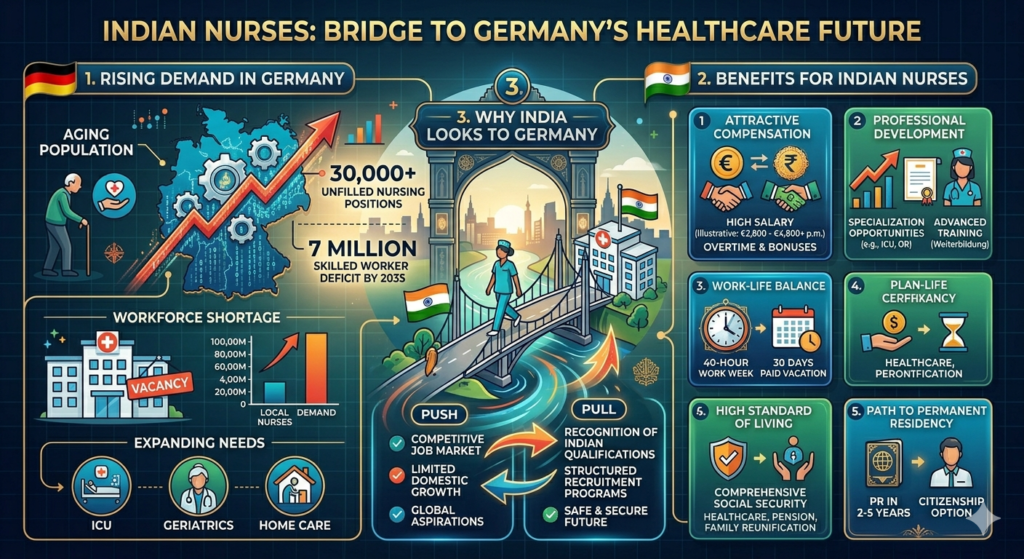
If you’ve been looking for nursing jobs in Germany, you’re definitely not alone. Over the past decade, Germany has quietly become one of the biggest global hubs for healthcare professionals, especially nurses. But what’s driving this demand? The answer is simple—Germany has an aging population. According to European health reports, nearly 22% of Germany’s population is over 65, and that number keeps growing every year. More elderly people means more hospitals, more care homes, and ultimately, a greater need for skilled nurses.
Now, here’s where it gets interesting for Indian professionals. Germany simply doesn’t have enough local nurses to meet this rising demand. That’s why the country has opened its doors wide to international talent, especially from countries like India where nursing education is strong and well-recognized. This gap has created a massive opportunity for those seeking nursing career opportunities in Germany.
Think about it like a puzzle missing pieces. Germany has the infrastructure, advanced hospitals, and high healthcare standards—but it needs skilled hands to keep everything running smoothly. That’s exactly where Indian nurses fit in. With proper training and the right qualifications, stepping into this system becomes not just possible, but highly rewarding.
The demand isn’t temporary either. Experts predict that Germany will need over 500,000 additional nurses by 2030. So if you’re planning long-term, this isn’t just a job—it’s a stable career path. That’s why more and more professionals are exploring the best way to get nursing jobs in Germany right now rather than waiting.
Benefits of Working in Germany as a Nurse from India
So why exactly should you consider making the move? What makes Germany stand out compared to other countries? When you decide to work in Germany as a nurse from India, you’re not just changing your workplace—you’re upgrading your entire lifestyle.
First, let’s talk about salary. The Germany nurse salary for Indians is significantly higher than what most nurses earn in India. On average, nurses in Germany can earn between €2,500 to €4,000 per month, depending on experience and qualifications. That’s not just a number—it translates to better living standards, savings, and financial stability.
But money isn’t everything, right? Germany also offers excellent working conditions. Hospitals are well-equipped, working hours are regulated, and employee rights are taken seriously. You won’t find yourself overworked without compensation, which is often a concern in many healthcare systems.
Another huge advantage is job security. Healthcare is a necessity, not a luxury. This means your role as a nurse will always be in demand. Combine that with Germany’s strong labor laws, and you’ve got a career that feels stable and secure.
And let’s not forget the exposure. Working in Germany gives you access to advanced medical technologies and international healthcare standards. It’s like upgrading your professional toolkit. Plus, you’ll gain global experience, which can open doors anywhere in the world later.
So when people talk about Indian nurses abroad Germany jobs, they’re not just referring to employment—they’re talking about a complete transformation in career and lifestyle.
Nursing Jobs in Germany for Indians – An Overview
Types of Nursing Career Opportunities in Germany
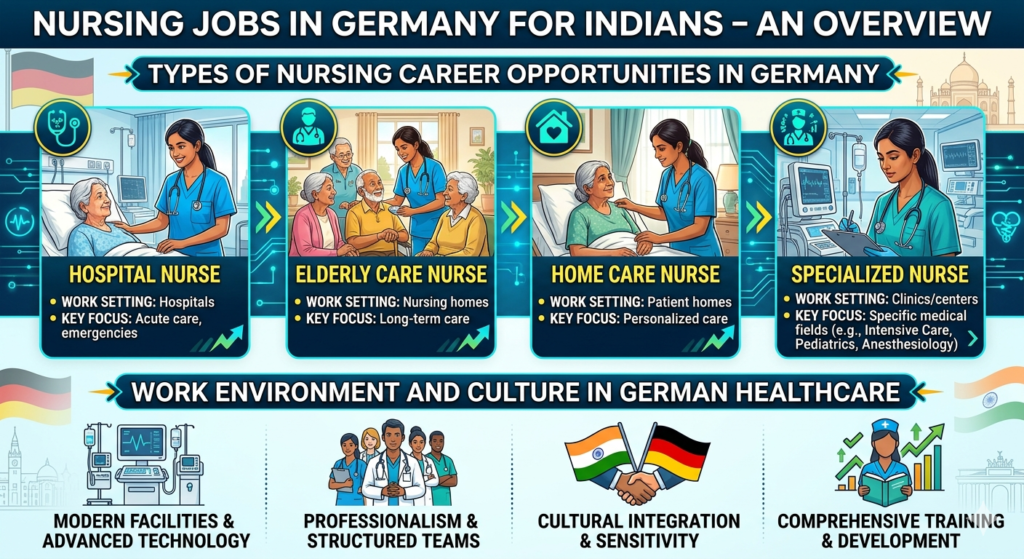
When exploring nursing jobs in Germany for Indians, it’s important to understand that the opportunities go far beyond just hospital roles. Germany’s healthcare system is diverse, and that means you have multiple career paths to choose from depending on your skills, interests, and long-term goals.
The most common roles include registered nurses in hospitals, where you’ll work in departments like emergency care, ICU, pediatrics, or surgery. These positions are ideal if you enjoy fast-paced environments and hands-on patient care. But that’s just one piece of the puzzle.
There are also opportunities in elderly care homes, which are incredibly important in Germany due to the aging population. These roles often focus on long-term patient relationships and holistic care, offering a different kind of professional satisfaction. Many Indian nurses actually find these roles more emotionally rewarding.
Home healthcare is another growing field. Imagine providing care to patients in their own homes—it’s more personal and allows you to build deeper connections. Then there are specialized roles like psychiatric nursing, rehabilitation care, and even administrative positions in healthcare facilities.
Here’s a quick comparison:
| Job Type | Work Setting | Key Focus |
| Hospital Nurse | Hospitals | Acute care, emergencies |
| Elderly Care Nurse | Nursing homes | Long-term care |
| Home Care Nurse | Patient homes | Personalized care |
| Specialized Nurse | Clinics/centers | Specific medical fields |
This variety means you’re not stuck in one role forever. You can switch paths, specialize further, or even move into leadership roles over time. That flexibility is one of the biggest advantages of pursuing nursing career opportunities in Germany.
Work Environment and Culture in German Healthcare
Let’s be honest—moving to a new country isn’t just about the job itself. It’s also about adapting to a completely different work culture. And when it comes to Germany, the work environment can feel quite different from what many Indian nurses are used to.
German healthcare facilities are known for their efficiency and structure. Everything runs like clockwork. Shifts are well-organized, responsibilities are clearly defined, and punctuality is taken very seriously. If you’re someone who appreciates order and clarity, you’ll probably enjoy this system.
Another key aspect is teamwork. Nurses in Germany work closely with doctors, therapists, and other healthcare professionals. Your opinion matters, and you’re encouraged to participate in patient care decisions. It’s not a hierarchical system where nurses are just following orders—you’re an active part of the healthcare team.
Communication is also direct and straightforward. Germans value honesty and clarity, so don’t expect too much small talk at work. It might feel a bit formal at first, but once you get used to it, you’ll realize it actually makes things more efficient.
Work-life balance is another major plus. Unlike in many countries where healthcare workers are constantly overburdened, Germany ensures regulated working hours and mandatory breaks. You’ll actually have time to relax, explore the country, and enjoy life outside work.
Adapting might take a little time, but once you settle in, you’ll find that the environment supports both your professional growth and personal well-being. That’s a big reason why so many professionals continue looking for nursing jobs in Germany year after year.
Eligibility for Indian Nurses in Germany
Educational Qualifications Required
If you’re serious about looking for nursing jobs in Germany, the first thing you need to understand is whether your educational background aligns with German standards. The good news? Most Indian nursing qualifications are widely accepted—but there’s a catch. Recognition isn’t always automatic, and that’s where many applicants get confused.
To meet the eligibility for Indian nurses in Germany, you must have completed at least one of the following:
- B.Sc. Nursing
- GNM (General Nursing and Midwifery)
- Post Basic B.Sc. Nursing
Now, having the degree alone isn’t enough. German authorities will evaluate whether your curriculum matches their standards. This process is called recognition of qualifications (Anerkennung). Think of it like translating your education into the German system—they need to ensure your training matches their expectations in both theory and practical exposure.
In some cases, you might be required to undergo an adaptation period or pass a knowledge test if there are gaps in your education. Don’t let that scare you—it’s actually quite common and manageable. Many Indian nurses go through this phase and successfully transition into full-time roles.
Another important requirement is professional registration. You must be a registered nurse with a valid license in India. Without this, your application won’t even be considered. It’s like trying to drive without a license—no matter how skilled you are, it just won’t work.
Experience can also play a role. While freshers can apply, candidates with 1–2 years of experience often have an edge, especially when applying through agencies like H.R. International.
So, if you’re wondering whether you qualify, the answer for most Indian nurses is yes—with a few structured steps. That’s why understanding the Germany nursing jobs guide for Indians early on can save you time and effort.
Indian Nurses Jobs in Germany Requirements Explained
Let’s break things down even further because the Indian nurses jobs in Germany requirements go beyond just degrees and certificates. This isn’t just about meeting criteria—it’s about proving you’re ready to integrate into a completely different healthcare system.
First, documentation plays a huge role. You’ll need:
- Academic transcripts
- Nursing registration certificate
- Passport
- Updated CV (preferably in European format)
- Work experience letters (if applicable)
Each document may need to be translated into German and notarized. Yes, it sounds tedious—but it’s part of maintaining Germany’s high professional standards.
Next comes the recognition process. Depending on the state you apply to, requirements may vary slightly. Some states are quicker, while others have stricter evaluation systems. This is why many candidates prefer applying through recruitment agencies that already understand these nuances.
Health and background checks are also mandatory. Germany places a strong emphasis on patient safety, so you’ll need to provide a medical fitness certificate and a clean police clearance record.
Then there’s adaptability. While it’s not officially listed on paper, your ability to adapt to German culture, work ethics, and communication style plays a huge role in your success. Employers look for candidates who are not just qualified, but also prepared to integrate smoothly.
When you connect all these dots, the process starts to make sense. It’s not about making things difficult—it’s about ensuring that every nurse entering the system can deliver high-quality care. That’s what makes nursing jobs in Germany for Indians so respected and well-compensated.
German Language Requirement for Nurses
Why Language Skills Are Crucial
Here’s the part many candidates underestimate—the German language requirement for nurses. You might be an excellent nurse, highly skilled and experienced, but without language proficiency, working in Germany becomes nearly impossible.
Why? Because nursing isn’t just about medical procedures. It’s about communication. You’ll be interacting with patients, understanding their symptoms, explaining treatments, and coordinating with doctors and staff. Imagine trying to comfort a patient or understand their pain without a common language—it simply doesn’t work.
In Germany, most patients speak German, especially elderly individuals. They may not understand English at all. So, being fluent in German isn’t just a requirement—it’s a necessity for providing proper care.
Hospitals also maintain detailed records, and all documentation is in German. From patient charts to medical instructions, everything revolves around the language. Without it, even simple tasks can become overwhelming.
Think of language as your bridge. Without it, you’re standing on one side with all your skills, but unable to cross into the actual work environment. Once you build that bridge, everything becomes accessible—jobs, promotions, social integration, and even daily life.
That’s why experts always emphasize mastering German early in your journey. It’s not just about passing an exam; it’s about preparing yourself for real-world scenarios in healthcare settings.
Required Language Levels (B1, B2, etc.)
Now let’s get specific. When it comes to the German language requirement for nurses, levels matter—a lot. Germany follows the Common European Framework of Reference for Languages (CEFR), which ranges from A1 (beginner) to C2 (advanced).
For most nursing jobs in Germany for Indians, you’ll need:
- B1 Level – Minimum requirement to start the process
- B2 Level – Preferred for full professional recognition
At the B1 level, you can handle basic conversations, understand everyday situations, and communicate simple medical instructions. This is usually enough to enter Germany and begin working under supervision.
However, to work independently as a fully recognized nurse, B2 is often required. At this level, you can:
- Communicate fluently with patients and colleagues
- Understand complex medical discussions
- Handle documentation and reporting confidently
Some employers and states may even require specialized medical German exams, depending on the role.
Learning German might feel like a big hurdle, but here’s the reality—it’s a one-time investment that unlocks long-term opportunities. Many candidates complete their B1 or B2 levels within 6–12 months with consistent effort.
If you’re serious about the best way to get nursing jobs in Germany, don’t delay your language preparation. It’s not just a requirement—it’s your biggest advantage.
Germany Nurse Salary for Indians
Average Salary Structure
Let’s talk about what everyone is curious about—the Germany nurse salary for Indians. After all, moving to another country is a big decision, and financial stability plays a huge role in that choice.
On average, nurses in Germany earn between €2,500 and €4,000 per month (gross salary). Entry-level nurses or those in the recognition phase might start at the lower end, around €2,200–€2,800. Once fully recognized and experienced, salaries can rise significantly.
Here’s a simple breakdown:
| Experience Level | Monthly Salary (€) |
| Beginner | 2,200 – 2,800 |
| Mid-Level | 2,800 – 3,500 |
| Experienced | 3,500 – 4,500+ |
But salary isn’t just about the base pay. Nurses in Germany often receive additional benefits like:
- Overtime pay
- Night shift allowances
- Holiday bonuses
- Health insurance
- Pension contributions
When you factor in these benefits, the overall compensation becomes even more attractive.
Compared to salaries in India, this is a significant jump. But it’s not just about earning more—it’s about saving more too. With proper financial planning, many Indian nurses manage to send money home while still maintaining a comfortable lifestyle in Germany.
Factors Affecting Salary Growth
Not all nurses earn the same—and that’s where understanding growth factors becomes important. Your salary in Germany isn’t fixed; it evolves based on several key elements.
First is experience. The more years you spend in the system, the higher your earning potential. German employers value consistency and long-term commitment.
Second is qualification recognition. Nurses who complete their recognition process and achieve full registration earn significantly more than those still in the adaptation phase.
Language skills also play a surprisingly big role. Nurses with strong German proficiency often get better roles, responsibilities, and salary packages. Communication isn’t just a skill—it’s a career booster.
Then comes specialization. Nurses who specialize in areas like ICU, geriatrics, or surgery often command higher salaries. It’s similar to how doctors specialize to increase their value.
Lastly, location matters. Salaries can vary depending on the city or region. For example, urban areas may offer slightly higher pay but also come with higher living costs.
When you put all this together, it becomes clear that nursing career opportunities in Germany are not just stable—they’re scalable. Your growth is in your hands.
Step by Step Guide Nursing Jobs Germany
How to Apply for Nursing Jobs in Germany
If you’ve been wondering how to apply for nursing jobs in Germany, you’re not alone. This is one of the most searched questions among Indian healthcare professionals, and honestly, the process can feel overwhelming at first glance. But once you break it down into clear steps, it starts to look much more manageable—almost like following a recipe where each step leads you closer to your goal.
The journey typically begins with self-assessment. Before anything else, you need to check whether you meet the eligibility for Indian nurses in Germany—your degree, registration, and willingness to learn German. Once that’s sorted, the next big step is language training. Most candidates start preparing for B1 or B2 German certification, which is essential before moving forward.
After achieving the required language level, the real application process begins. You’ll need to prepare a professional CV tailored to German standards. This isn’t your typical resume—it’s structured, precise, and often includes details like your training modules and clinical experience. Alongside that, you’ll submit your educational documents for recognition.
Once your profile is ready, you can start applying to hospitals or go through recruitment agencies like H.R. International. Interviews are usually conducted online, and they focus not just on your technical skills but also your communication abilities in German.
After receiving a job offer, you move into the documentation and visa stage. It might sound like a lot, but each step builds on the previous one. Think of it as climbing a staircase—you don’t jump to the top; you take it one step at a time.
The key here is consistency. Many candidates give up midway because the process seems long. But those who stay committed eventually land stable, well-paying roles. That’s why following a proper step by step guide nursing jobs Germany approach can make all the difference.
Best Way to Get Nursing Jobs in Germany
Now let’s talk strategy. What is truly the best way to get nursing jobs in Germany without unnecessary delays or mistakes? Because let’s be honest—trial and error in an international career move can cost you both time and money.
The most efficient route for many candidates is through a trusted recruitment agency. Agencies like H.R. International specialize in placing Indian nurses in German healthcare institutions. They don’t just help you find a job—they guide you through the entire process, from documentation to visa assistance.
Why does this matter? Because Germany’s requirements can vary depending on the state and employer. Without proper guidance, it’s easy to miss small but crucial details—like document formatting or recognition procedures—that can delay your application.
Another smart approach is to start your German language preparation as early as possible. Candidates who complete their B2 level before applying often move faster through the hiring process and secure better offers.
Networking can also play a role. Connecting with nurses who are already working in Germany gives you real-world insights that no guidebook can provide. You’ll learn about work culture, expectations, and even tips for interviews.
Avoid shortcuts. If someone promises you a job without proper language skills or documentation, it’s a red flag. Germany has strict regulations, and bypassing them can lead to rejection or even legal issues.
So, the best way isn’t about speed—it’s about doing things correctly from the start. A structured approach, combined with the right support system, is what turns your dream of working in Germany as a nurse from India into reality.
Nursing Job Visa Germany for Indians
Visa Types and Application Process
Once you secure a job offer, the next major step is obtaining a nursing job visa Germany for Indians. This is where your dream starts becoming official—because without the right visa, you simply can’t begin your journey.
Germany offers specific visa categories for skilled workers, including nurses. The most common one is the Skilled Worker Visa (Employment Visa). This is designed for professionals who already have a job offer from a German employer.
The process begins with your employer providing a contract. This document is crucial because it proves that you have a confirmed position waiting for you in Germany. Along with this, you’ll need proof of your qualifications and language proficiency.
After gathering all required documents, you apply for the visa at the German Embassy or Consulate in India. The application process includes submitting forms, attending an interview, and sometimes providing biometric data.
Processing times can vary, but it typically takes 6 to 12 weeks. During this period, authorities verify your documents and ensure everything meets German standards.
Once approved, you’ll receive your visa, allowing you to travel to Germany and start working. Initially, you may receive a temporary permit, which can later be converted into a long-term residence permit.
It’s important to stay organized during this phase. Missing documents or incorrect information can delay your application. That’s why many candidates rely on agencies to guide them through the step by step guide nursing jobs Germany process, including visa support.
Documents Required for Visa Approval
When applying for a nursing job visa Germany for Indians, documentation is everything. Think of it as your story on paper—each document proves that you’re qualified, prepared, and ready to work in Germany.
Here’s what you’ll typically need:
- Valid passport
- Job offer letter from a German employer
- Recognized nursing qualification certificates
- German language certificate (B1/B2)
- Updated CV
- Proof of accommodation in Germany
- Health insurance coverage
- Visa application form
Some applicants may also need to provide proof of financial stability, especially if they are entering Germany during the recognition phase.
All documents must be accurate, complete, and often translated into German. Even small errors—like mismatched names or missing signatures—can cause delays.
This is where attention to detail becomes critical. Many applicants underestimate this step and face unnecessary setbacks. But if you prepare everything carefully, the process becomes much smoother.
The visa stage is like the final checkpoint before your journey begins. Once you clear it, you’re no longer just planning—you’re actually stepping into your new life and career in Germany.
Role of H.R. International in Indian Nurses Abroad Germany Jobs
How Recruitment Agencies Simplify the Process
If the entire process feels complex, that’s because it is—and that’s exactly why recruitment agencies exist. When it comes to Indian nurses abroad Germany jobs, agencies like H.R. International act as a bridge between candidates and employers.
Instead of navigating everything on your own, you get structured guidance at every step. From helping you understand Indian nurses jobs in Germany requirements to assisting with documentation and interviews, agencies streamline the entire journey.
They also have direct connections with German hospitals and healthcare institutions. This means you’re not just applying blindly—you’re applying to verified opportunities with real employers.
Another major advantage is time-saving. Without proper guidance, candidates often spend months figuring out processes that agencies can handle in weeks. It’s like having a roadmap instead of wandering without direction.
Agencies also help with pre-departure training, including language support and cultural orientation. This prepares you not just for the job, but for life in Germany.
Why Choose H.R. International
Among the many agencies available, H.R. International has built a strong reputation in placing Indian nurses in Germany. Their experience and structured approach make them a preferred choice for many candidates.
They provide end-to-end support—from the moment you decide to apply until you settle in Germany. This includes job placement, documentation, visa processing, and even post-arrival assistance.
What sets them apart is their understanding of both Indian and German systems. They know exactly what employers are looking for and how Indian candidates can meet those expectations.
Transparency is another key factor. You’re guided through every step, with clear information about requirements, timelines, and costs. This reduces uncertainty and builds trust.
For many nurses, choosing the right agency is the turning point in their journey. With the right support, the process becomes less stressful and more predictable.
Challenges Faced by Indian Nurses in Germany
Moving abroad isn’t always smooth sailing, and the same applies when pursuing nursing jobs in Germany for Indians. While the opportunities are excellent, there are challenges that every candidate should be prepared for.
The biggest hurdle is language. Even after achieving B1 or B2 certification, real-life conversations can feel different. Accents, speed, and medical terminology can take time to get used to. It’s like learning to swim in a pool and then stepping into the ocean—the basics are the same, but the environment is more dynamic.
Cultural differences can also be surprising. German workplaces are more direct and structured, which might feel unfamiliar initially. Adjusting to punctuality, communication style, and work expectations takes time.
Homesickness is another factor. Being away from family and familiar surroundings can be emotionally challenging, especially in the early months.
Weather can also play a role. Germany’s cold climate is very different from India’s, and adapting to it can affect your daily routine.
Despite these challenges, most nurses adapt successfully within a few months. The key is patience and openness to learning. Every challenge you overcome becomes part of your growth story.
Conclusion
If you’ve been seriously looking for nursing jobs in Germany, the path is clear—it requires preparation, patience, and the right guidance. From meeting the eligibility for Indian nurses in Germany to mastering the German language requirement for nurses, every step plays a crucial role in shaping your journey.
Germany offers not just jobs, but long-term nursing career opportunities in Germany with stability, growth, and global exposure. With competitive Germany nurse salary for Indians and a structured work environment, it’s no surprise that more professionals are making the move.
Following a proper step by step guide nursing jobs Germany approach ensures you don’t miss any critical steps. And with support from agencies like H.R. International, the process becomes far more manageable.
The opportunity is real, the demand is growing, and the path is achievable. The only question left is—are you ready to take the first step?
FAQs
1. What is the minimum qualification for nursing jobs in Germany for Indians?
You need at least a GNM or B.Sc. Nursing degree along with a valid nursing registration certificate.
2. Is German language mandatory for nurses in Germany?
Yes, a minimum B1 or B2 level is required to work and communicate effectively in healthcare settings.
3. How long does it take to get a nursing job in Germany from India?
The entire process can take anywhere from 6 months to 1 year, depending on language preparation and documentation.
4. Can freshers apply for nursing jobs in Germany?
Yes, but candidates with experience may have better chances and faster placement.
5. What is the average salary for Indian nurses in Germany?
The average salary ranges from €2,500 to €4,000 per month, depending on experience and qualifications.
Leave a Reply