
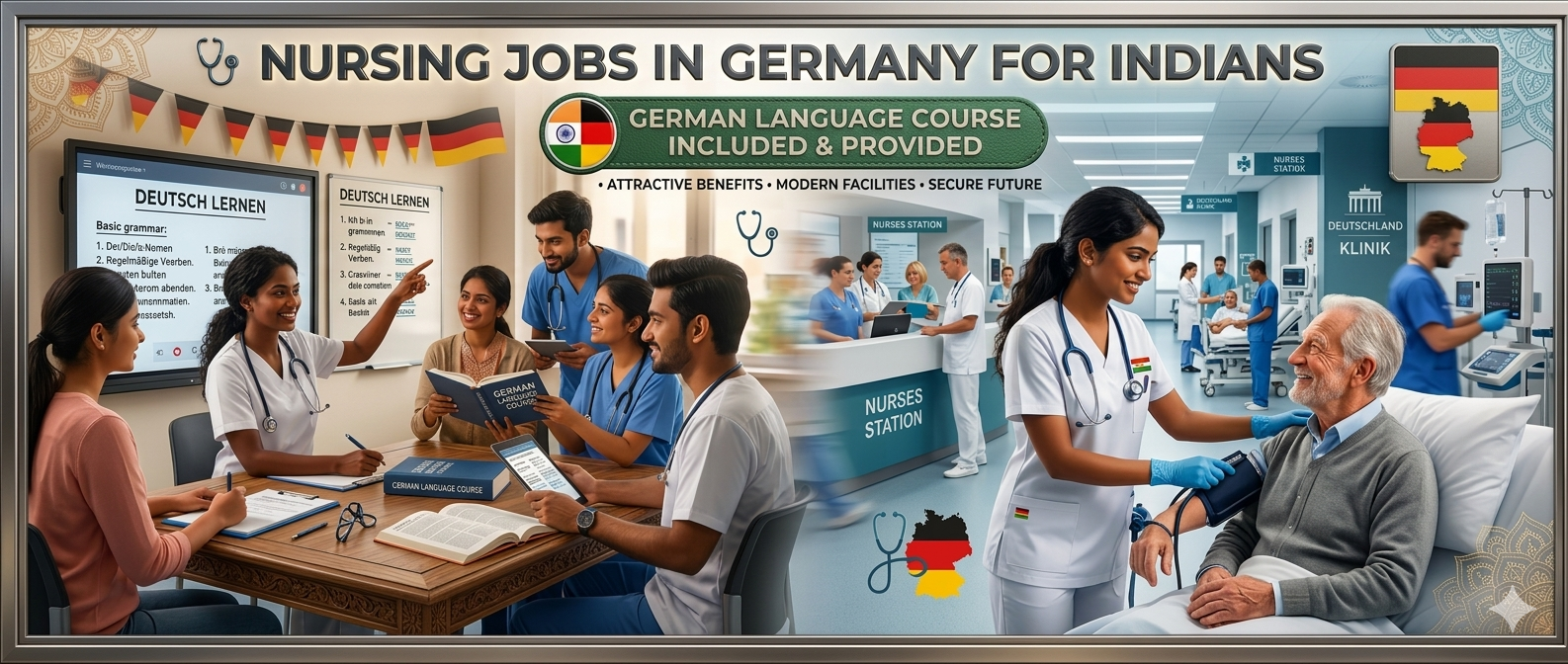
Why Nursing Jobs in Germany for Indians with German Language Course Are in High Demand

Growing Healthcare Demand in Germany
Germany is currently facing a significant shortage of healthcare professionals, especially nurses, and this gap is only widening with time. With an aging population and increasing healthcare needs, hospitals and care facilities are struggling to meet staffing demands. According to recent healthcare workforce reports, Germany requires over 200,000 additional nurses by 2030, which creates a massive opportunity for foreign-trained professionals. This is where nursing jobs in Germany for Indians with German language course come into the spotlight, offering a structured pathway for skilled candidates to enter a stable and rewarding career abroad.
Now, imagine a healthcare system that is modern, well-funded, and constantly evolving—Germany ticks all those boxes. Hospitals are equipped with advanced medical technology, and patient care standards are exceptionally high. However, none of that matters without skilled nurses to bridge the gap between technology and human care. That’s exactly why international hiring has become a necessity rather than an option. Indian nurses, known for their dedication and adaptability, are increasingly being welcomed into this system.
Language plays a central role here. German patients expect clear communication, empathy, and understanding—all of which require at least a B1 or B2 level of German proficiency. This is why many programs combine job placement with language training, ensuring candidates are job-ready upon arrival. The combination of career stability, attractive salaries, and international exposure makes Germany a top destination.
In simple terms, if you’re an Indian nurse looking for global opportunities, this is not just a trend—it’s a long-term career pathway that’s only growing stronger.
Why Indian Nurses Are Preferred
Indian nurses have built a strong global reputation for their work ethic, clinical skills, and ability to adapt quickly to different healthcare environments. German employers recognize these qualities and often prefer Indian candidates because they bring both technical expertise and compassionate patient care. When discussing apply nursing jobs Germany Indian nurses German B2 requirement, employers frequently highlight how Indian nurses excel once they meet the language criteria.
One of the key reasons Indian nurses stand out is their education system. Nursing programs in India are rigorous, combining theoretical knowledge with hands-on clinical experience. This makes Indian candidates well-prepared for real-world challenges. Additionally, many Indian nurses already have experience working in high-pressure environments, which aligns well with Germany’s fast-paced healthcare system.
Another factor is cultural adaptability. Moving to a new country isn’t just about professional adjustment—it’s about integrating into a completely different society. Indian nurses have consistently demonstrated the ability to learn new languages, adapt to cultural norms, and build strong relationships with patients and colleagues. This adaptability significantly reduces the onboarding time for employers.
However, it’s not just about skills; it’s also about communication. German hospitals prioritize nurses who can interact effectively with patients. That’s why completing a German language course for nurses to work in Germany is often a mandatory step. Once Indian nurses achieve the required language level, usually B2, their chances of employment increase dramatically.
In essence, Indian nurses are not just filling a gap—they are becoming an integral part of Germany’s healthcare future. Their combination of skill, empathy, and adaptability makes them one of the most sought-after talent pools in the global nursing workforce.
Apply Nursing Jobs Germany Indian Nurses German B2 Requirement Explained
What Is the German B2 Requirement for Nurses
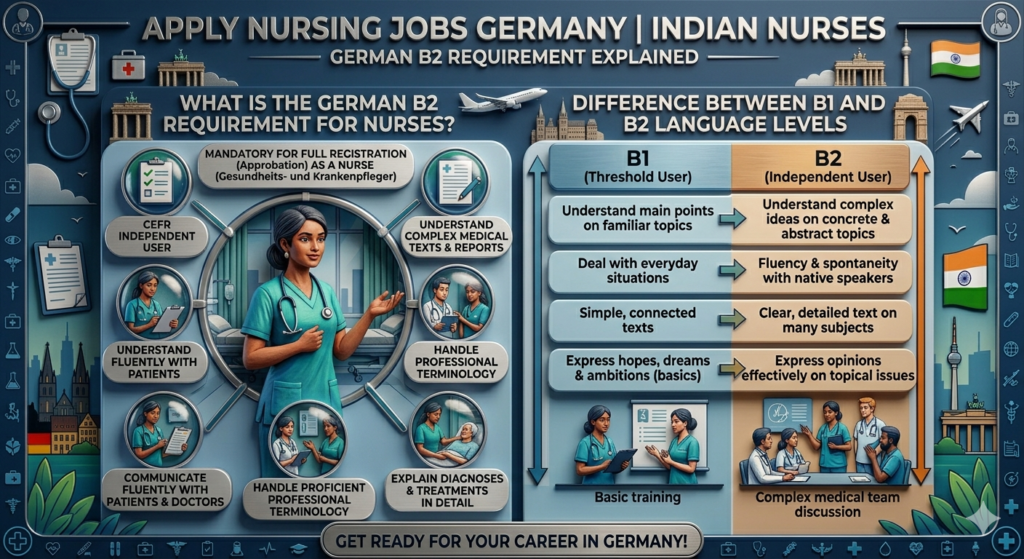
When you start exploring apply nursing jobs Germany Indian nurses German B2 requirement, one thing becomes immediately clear—language proficiency is not just a formality; it’s a core professional requirement. The German B2 level, as defined by the Common European Framework of Reference for Languages (CEFR), indicates an upper-intermediate ability to communicate effectively in everyday and professional situations. For nurses, this isn’t about passing an exam—it’s about being able to understand patients, follow medical instructions, document care accurately, and collaborate with doctors and staff.
Think about a typical day in a German hospital. A nurse must explain medication instructions to a patient, understand a doctor’s complex directives, and handle emergencies where communication must be instant and precise. Without B2-level proficiency, these tasks become risky. That’s why German authorities and employers insist on this standard before granting full recognition to foreign nurses. In many cases, nurses can enter Germany with a B1 level but must reach B2 within a specific timeframe to continue working.
What makes B2 particularly important is its focus on fluency and independence. At this level, you can engage in detailed conversations, understand technical discussions, and even handle unexpected situations confidently. This is critical in healthcare, where every word matters. Many Indian nurses initially find the requirement challenging, but with structured training and consistent practice, it becomes achievable.
Training programs offered by agencies like H.R. International are designed specifically for nurses, combining general language skills with medical terminology. This targeted approach makes it easier to transition from classroom learning to real-world application. So, while B2 may seem like a hurdle at first, it’s actually a stepping stone that ensures long-term success and professional growth in Germany’s healthcare system.
Difference Between B1 and B2 Language Levels
Understanding the difference between B1 and B2 is crucial when planning your journey toward German B1 B2 course requirement for nursing jobs in Germany. At first glance, these levels might seem similar, but in practice, they represent two very different stages of language mastery—especially in a professional setting like healthcare.
At the B1 level, you can handle basic conversations, understand simple instructions, and manage everyday situations like shopping, traveling, or casual interactions. For nurses, this might mean being able to greet patients, ask basic questions, and follow straightforward instructions. However, healthcare is rarely straightforward. Patients may describe symptoms in complex ways, doctors may use technical language, and emergencies demand quick, clear communication. This is where B1 starts to fall short.
B2, on the other hand, takes your communication skills to a much deeper level. You can understand extended speech, participate actively in discussions, and express yourself clearly even in complex situations. For example, at B2, you can explain treatment plans, discuss patient conditions with doctors, and handle emotionally sensitive conversations with confidence. This level of fluency is essential for building trust with patients and ensuring high-quality care.
Another key difference lies in professional recognition. Many German states allow nurses to begin working with B1 under supervision, but full licensure usually requires B2. This means your salary, responsibilities, and career growth are directly tied to your language level. Reaching B2 is not just about meeting a requirement—it’s about unlocking better opportunities.
From a learning perspective, moving from B1 to B2 requires consistent effort, practice, and exposure to real-life scenarios. This is why enrolling in a German language course for nurses to work in Germany is highly recommended. These courses are tailored to bridge the gap between general language skills and professional communication, making the transition smoother and more effective.
German Language Course for Nurses to Work in Germany – Complete Guide
Importance of Language Training for Nurses
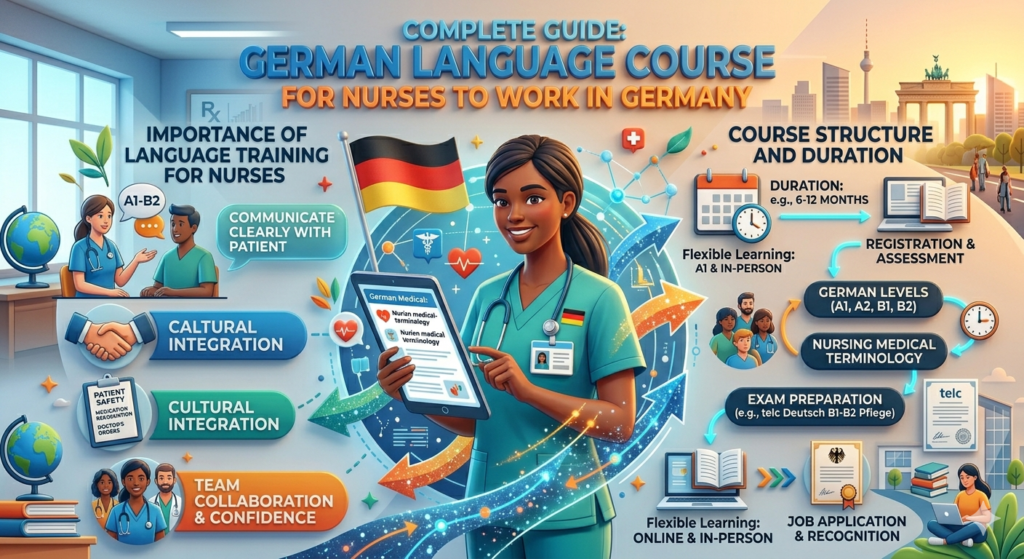
When discussing German language training for nurses going to Germany jobs, it’s impossible to overstate its importance. Language is not just a tool for communication—it’s the foundation of safe and effective patient care. In Germany, where healthcare standards are exceptionally high, even minor misunderstandings can have serious consequences. That’s why language training is treated as an integral part of the recruitment process rather than an optional add-on.
Imagine trying to comfort a patient who is in pain but cannot fully understand what they are saying. Or consider the challenge of interpreting a doctor’s instructions during a critical situation. Without strong language skills, these scenarios become stressful and potentially dangerous. This is why structured training programs focus not only on general German but also on medical vocabulary, patient interaction, and workplace communication.
Another important aspect is confidence. Many nurses hesitate to speak in a foreign language, especially in professional settings. Language training helps build this confidence by providing a safe environment to practice and make mistakes. Over time, this confidence translates into better performance at work and smoother integration into the healthcare system.
Programs offered by agencies like H.R. International go a step further by combining classroom learning with practical exposure. Role-playing exercises, simulated patient interactions, and real-life scenarios are often included to prepare candidates for the challenges they will face in Germany. This hands-on approach ensures that nurses are not just linguistically prepared but also mentally ready for their new roles.
Ultimately, investing time in a German language course for nurses to work in Germany is not just about meeting a requirement—it’s about setting yourself up for long-term success. It’s the difference between merely surviving in a foreign workplace and truly thriving in it.
Course Structure and Duration
If you’re wondering what a typical best German language course for nurses Germany jobs Indians looks like, the structure is designed to be both comprehensive and practical. These courses usually start from the basics (A1 level) and progress step by step to B2, ensuring that even beginners can follow along and build their skills gradually.
The duration of the course depends on your starting point and learning pace. On average, it takes about 6 to 8 months to reach B1 and an additional 3 to 4 months to achieve B2. Intensive programs may shorten this timeline, while part-time courses may extend it. The key is consistency and regular practice, as language learning is a cumulative process.
The curriculum typically includes grammar, vocabulary, listening, speaking, reading, and writing skills. However, what sets these courses apart is their focus on medical German. You’ll learn terms related to anatomy, diseases, treatments, and hospital procedures, as well as how to communicate effectively with patients and colleagues. This specialized training ensures that you are job-ready from day one.
Examinations are an essential part of the process. Recognized certifications such as Goethe, TELC, or ÖSD are required to prove your proficiency. These exams test all aspects of language skills and are widely accepted by German authorities and employers. Passing these exams is a crucial milestone in your journey toward securing a nursing job in Germany.
Many training programs also offer additional support, such as interview preparation, resume building, and cultural orientation. This holistic approach makes it easier for candidates to transition from training to employment. With the right course and dedication, achieving the required language level becomes not just possible but highly attainable.
Nursing Jobs in Germany with Visa Sponsorship for Indians German Language Benefits
Visa Sponsorship Explained
One of the biggest advantages of pursuing nursing jobs in Germany with visa sponsorship for Indians German language is the structured and supportive immigration process. Unlike many countries where visa procedures can feel overwhelming and uncertain, Germany offers a relatively clear pathway for qualified healthcare professionals. Visa sponsorship means that your employer or recruitment partner supports your application, making it significantly easier to relocate and start working legally.
In most cases, Indian nurses apply for a Skilled Worker Visa or Recognition Partnership Visa, depending on their qualifications and language level. The process involves submitting educational documents, proof of language proficiency, and an employment contract. Once approved, you are allowed to enter Germany and begin working, often under a provisional license until full recognition is achieved.
What makes this system attractive is the level of transparency and support. Many employers collaborate with agencies like H.R. International to handle documentation, embassy appointments, and compliance requirements. This reduces the burden on candidates and ensures that all legal procedures are followed correctly. It’s like having a guide who knows every step of the journey, helping you avoid common pitfalls.
Another benefit is the speed of processing. With proper documentation and language certification, visa approvals can take anywhere from 8 to 16 weeks, depending on the case. This is relatively fast compared to other international job markets. During this period, candidates often receive guidance on relocation, accommodation, and initial settlement.
In simple terms, visa sponsorship removes many of the barriers that might otherwise discourage candidates from pursuing international careers. It transforms a complex process into a manageable one, allowing nurses to focus on what truly matters—their professional growth and future in Germany.
Benefits of Language-Integrated Hiring
The concept of language-integrated hiring is at the heart of Indian nurses jobs Germany with German language certification. Instead of treating language learning and job placement as separate steps, this approach combines them into a single, streamlined process. The result? Faster integration, better job performance, and higher satisfaction for both employers and employees.
One of the biggest advantages is job readiness. When nurses complete their language training before or during the hiring process, they arrive in Germany prepared to communicate effectively from day one. This reduces the adjustment period and allows them to contribute immediately. Employers value this readiness, as it minimizes training costs and improves patient care quality.
Another benefit is career stability. Nurses who meet the German B2 requirement are more likely to receive permanent contracts, higher salaries, and better working conditions. Language proficiency opens doors to specialized roles, leadership positions, and further education opportunities. It’s not just about getting a job—it’s about building a long-term career.
From a personal perspective, language skills make everyday life much easier. Whether it’s renting an apartment, shopping, or interacting with locals, being able to communicate confidently enhances your overall experience. It also helps in building social connections and feeling at home in a new country.
Programs offered by H.R. International emphasize this integrated approach, ensuring that candidates are supported at every stage—from language training to job placement and beyond. This holistic model is one of the reasons why so many Indian nurses successfully transition to careers in Germany each year.
Indian Nurses Jobs Germany with German Language Certification
Recognized German Certifications
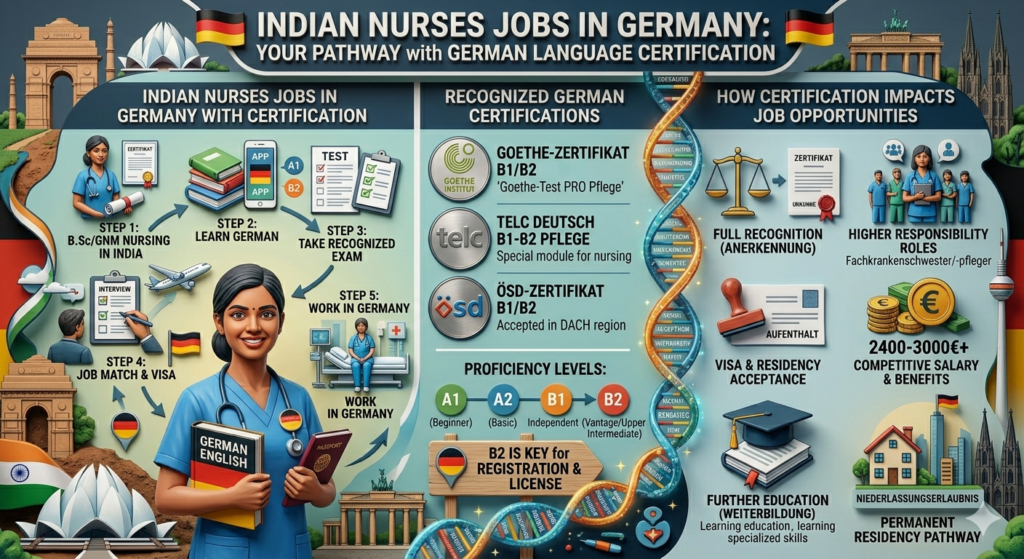
When pursuing Indian nurses jobs Germany with German language certification, one of the most critical steps is obtaining a recognized and valid language certificate. Germany does not accept just any proof of language proficiency—you must pass exams that align with internationally recognized standards. The most widely accepted certifications include Goethe-Zertifikat, TELC (The European Language Certificates), and ÖSD (Austrian German Language Diploma). These certifications are trusted by German authorities, hospitals, and licensing bodies, ensuring that your language skills meet the required professional benchmarks.
Each of these certifications evaluates your abilities in reading, writing, listening, and speaking, which are all essential for a nursing role. For example, the TELC B2 Pflege (nursing-specific exam) is particularly relevant because it focuses on medical communication, patient interaction, and healthcare scenarios. This makes it highly valuable for nurses, as it directly reflects real workplace situations. On the other hand, Goethe and ÖSD exams are more general but equally respected and widely accepted across Germany.
The process of preparing for these exams often involves structured training programs, mock tests, and continuous evaluation. Candidates are trained not only to pass the exam but also to apply their knowledge in real-life situations. This is important because passing the exam is just the beginning—the real challenge is using the language effectively in a professional environment.
Another important aspect is validity and recognition across federal states in Germany. While requirements may vary slightly depending on the region, most states accept these certifications as proof of language proficiency. This flexibility allows candidates to explore job opportunities across different cities and healthcare institutions.
In essence, obtaining a recognized certification is like holding a key that unlocks the German job market. It validates your skills, boosts your confidence, and significantly increases your chances of securing a well-paying nursing job in Germany.
How Certification Impacts Job Opportunities
The impact of language certification on job opportunities cannot be overstated when discussing nursing jobs Germany requirements Indian candidates German language. Simply put, your certification level directly influences the type of job you can get, your salary, and your long-term career prospects. Employers in Germany view language proficiency as a critical factor because it directly affects patient safety and team collaboration.
For instance, candidates with a B1 certification may be allowed to work as assistant nurses or under supervision while completing additional requirements. However, those who achieve B2 certification are eligible for full recognition as registered nurses. This means better job roles, higher salaries, and more responsibilities. It’s like moving from a trainee position to a fully qualified professional—your opportunities expand significantly.
Certification also plays a crucial role in the licensing process. German authorities require proof of language proficiency before granting professional recognition. Without this, even highly skilled nurses may face delays or restrictions in their employment. This is why completing a German language course for nurses to work in Germany is often the first and most important step in the entire process.
Employers also prefer candidates who already have certification because it reduces training time and ensures immediate productivity. In competitive job markets, having a recognized certificate can set you apart from other applicants. It demonstrates your commitment, discipline, and readiness to work in an international environment.
From a long-term perspective, language certification opens doors to specialization and career advancement. Whether you want to work in intensive care, pediatrics, or management roles, strong language skills are essential. In many ways, your certification is not just a requirement—it’s an investment in your future career.
Germany Nursing Jobs Eligibility Indian Nurses German Course Required
Basic Eligibility Criteria
Understanding Germany nursing jobs eligibility Indian nurses German course required is essential before starting your journey. While Germany offers excellent opportunities, it also maintains strict standards to ensure quality healthcare. The eligibility criteria are designed to ensure that every nurse entering the system is capable, qualified, and prepared for the challenges of the job.
First and foremost, you must have a recognized nursing qualification. This typically includes a B.Sc. Nursing, GNM (General Nursing and Midwifery), or equivalent diploma from a recognized institution. Your educational credentials will be evaluated by German authorities to determine their equivalence to German standards. In some cases, candidates may need to complete additional training or adaptation programs to meet these standards.
Work experience is another important factor, although not always mandatory. Many employers prefer candidates with at least 1–2 years of clinical experience, as it demonstrates practical skills and familiarity with patient care. However, fresh graduates can also apply if they meet other requirements and show strong potential.
Language proficiency is a non-negotiable requirement. As discussed earlier, achieving at least B1 or B2 level German proficiency is essential. This is why enrolling in a German language course for nurses to work in Germany is often the first step in the process. Without this, your application is unlikely to move forward.
Age and health requirements may also apply, depending on the employer and visa regulations. Candidates must be physically and mentally fit to perform nursing duties. Additionally, a clean background check and valid passport are necessary for visa processing.
In simple terms, meeting the eligibility criteria is like building a solid foundation for your career in Germany. Once you fulfill these requirements, the path to securing a nursing job becomes much clearer and more achievable.
Documents Required for Application
When preparing for how to apply nursing jobs Germany from India with German language, having the right documents is just as important as meeting eligibility criteria. Missing or incorrect documents can delay your application or even lead to rejection, so it’s crucial to be thorough and organized.
The most important document is your educational certificate, including transcripts and degree or diploma certificates. These documents must often be translated into German and certified to meet official requirements. This ensures that German authorities can accurately assess your qualifications.
Next comes your language certification, such as Goethe, TELC, or ÖSD. This serves as proof that you meet the required language level for nursing jobs in Germany. Without this, your application will not be considered complete.
Other essential documents include:
- A valid passport
- Updated resume (CV) in European format
- Work experience certificates (if applicable)
- Medical fitness certificate
- Police clearance certificate
Additionally, you may need to provide a motivation letter explaining why you want to work in Germany and how you plan to contribute to the healthcare system. This is your chance to showcase your passion and commitment.
Many candidates choose to work with recruitment agencies like H.R. International, which assist in document preparation and verification. This reduces the risk of errors and ensures that your application meets all requirements.
In the end, having a complete and well-organized set of documents not only speeds up the process but also creates a strong impression on employers and authorities. It shows that you are serious, professional, and ready to take the next step in your career.
How to Apply Nursing Jobs Germany from India with German Language
Step-by-Step Application Process
If you’re wondering how to apply nursing jobs Germany from India with German language, the process may seem complex at first, but it becomes manageable when broken down into clear steps. Think of it as a journey with defined milestones—each step brings you closer to your goal of working in Germany.
The first step is enrolling in a German language course for nurses to work in Germany. Starting from A1 and progressing to B2, this phase builds the foundation for your entire application. Without language proficiency, moving forward is nearly impossible.
Once you achieve at least a B1 or B2 level, the next step is preparing your documents. This includes educational certificates, language certification, resume, and other required paperwork. Ensuring that these documents are accurate and properly translated is crucial.
After that, you can start applying for jobs through recruitment agencies or directly to hospitals. Many candidates prefer agencies like H.R. International because they provide end-to-end support, including job matching, interview preparation, and visa assistance.
The interview process typically involves both technical and language assessments. Employers want to ensure that you have the necessary skills and can communicate effectively. Once you clear the interview, you receive a job offer, which is a major milestone.
The final steps include applying for a visa, attending embassy appointments, and preparing for relocation. This phase involves careful planning, but with proper guidance, it can be completed smoothly.
In essence, the application process is not as intimidating as it seems. With the right approach, dedication, and support, you can successfully secure a nursing job in Germany and begin a new chapter in your career.
Role of H.R. International in Placement
When it comes to recruitment agencies for nursing jobs Germany Indian nurses German language, H.R. International stands out as a trusted partner for many aspiring candidates. Their role goes beyond simple job placement—they act as a bridge between Indian nurses and German employers, ensuring a smooth and successful transition.
One of the key advantages of working with H.R. International is their comprehensive support system. From the moment you enroll in a German language training for nurses going to Germany jobs, they guide you through every step of the process. This includes language training, documentation, job matching, interview preparation, and visa assistance.
Another important aspect is their network of employers. H.R. International collaborates with reputed hospitals and healthcare institutions across Germany, giving candidates access to genuine and high-quality job opportunities. This reduces the risk of fraud and ensures that you are placed in a reliable work environment.
They also provide pre-departure training, which includes cultural orientation and practical guidance on living in Germany. This helps candidates adapt more quickly and confidently to their new surroundings.
Perhaps the most valuable aspect is their personalized approach. Every candidate has different needs, qualifications, and goals, and H.R. International tailors its services accordingly. This level of attention ensures that you are not just another applicant but a valued professional on a carefully planned career path.
Working with the right agency can make all the difference. It transforms a challenging process into a structured and supportive journey, allowing you to focus on building your future in Germany.
German B1 B2 Course Requirement for Nursing Jobs in Germany
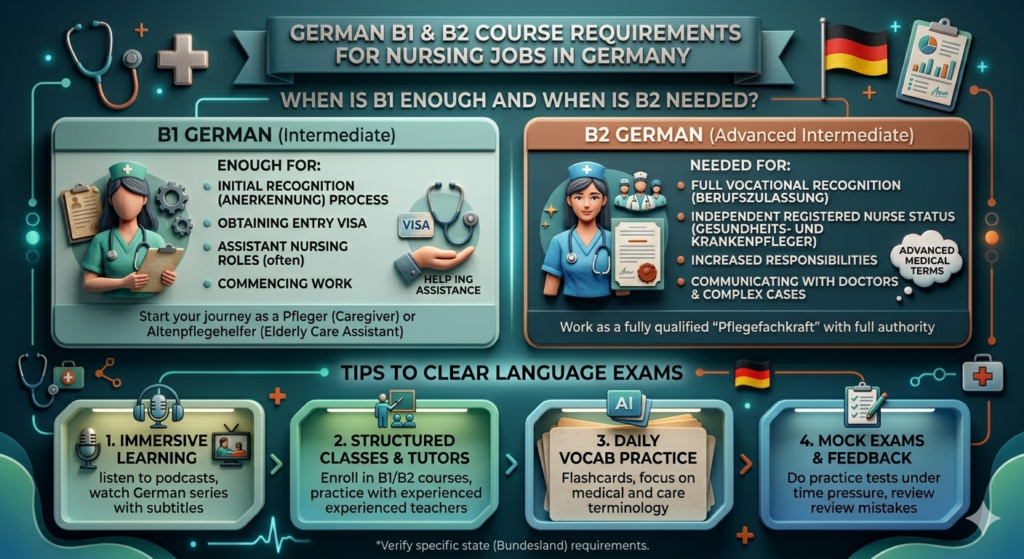
When B1 Is Enough and When B2 Is Needed
Understanding the German B1 B2 course requirement for nursing jobs in Germany is essential because it directly affects how quickly you can enter the workforce and what kind of role you’ll start with. Many candidates assume that clearing B1 is sufficient, but the reality is a bit more nuanced. While B1 may open the door, B2 is what truly allows you to walk in confidently and build a stable career.
At the B1 level, you can manage everyday communication—basic patient interactions, simple instructions, and routine conversations. Because of this, some German states allow nurses to begin working with B1 under a temporary or assistant role. This phase is often referred to as the “adaptation period,” where you gain practical experience while continuing your language training. It’s a great way to get your foot in the door, but it comes with limitations, including lower pay and restricted responsibilities.
B2, however, is where things change significantly. With B2 proficiency, you are eligible for full professional recognition as a nurse in Germany. This means you can handle complex patient interactions, understand detailed medical instructions, and work independently. Employers also trust B2-level candidates more because they can integrate quickly into the healthcare system without constant supervision.
Another key factor is licensing. Most German authorities require B2 certification before granting full recognition. Without it, your career progression may stall. This is why many training programs emphasize reaching B2 as quickly as possible. It’s not just about meeting a requirement—it’s about unlocking your full potential.
In practical terms, think of B1 as a learner’s permit and B2 as a full driver’s license. Both are important, but only one gives you complete freedom and confidence on the road. For Indian nurses aiming to build a long-term career in Germany, achieving B2 is not optional—it’s essential.
Tips to Clear Language Exams
Preparing for German language exams can feel overwhelming, especially when aiming to meet the apply nursing jobs Germany Indian nurses German B2 requirement. However, with the right strategy and mindset, clearing these exams becomes much more achievable than it initially seems.
The first and most important tip is consistency. Language learning is not something you can cram at the last minute. Daily practice—even if it’s just an hour—makes a significant difference over time. Focus on all four skills: reading, writing, listening, and speaking. Many candidates make the mistake of focusing only on grammar, but real-world communication requires a balanced approach.
Another effective strategy is immersion. Surround yourself with the German language as much as possible. Watch German videos, listen to podcasts, read simple articles, and try to think in German. This might sound challenging at first, but it gradually improves your comprehension and fluency. For nurses, it’s especially helpful to learn medical vocabulary and practice patient-related conversations.
Mock tests are also incredibly valuable. They help you understand the exam format, manage your time, and identify your weak areas. Many best German language course for nurses Germany jobs Indians include regular mock exams as part of their training, which significantly improves success rates.
Speaking practice is often the most challenging part, but it’s also the most important. Try to practice with classmates, instructors, or language partners. Role-playing real-life scenarios—like interacting with patients or discussing medical cases—can make a huge difference.
Finally, don’t underestimate the importance of confidence. Many candidates know the answers but hesitate due to fear or nervousness. Remember, examiners are not looking for perfection—they are looking for effective communication. With preparation, practice, and the right guidance, clearing B1 and B2 exams becomes a realistic and achievable goal.
Recruitment Agencies for Nursing Jobs Germany Indian Nurses German Language
Why Choose Licensed Recruitment Agencies
When exploring recruitment agencies for nursing jobs Germany Indian nurses German language, choosing a licensed and reputable agency is one of the most important decisions you’ll make. The journey to working in Germany involves multiple steps—language training, documentation, job placement, and visa processing—and a reliable agency can simplify each of these stages.
Licensed agencies operate under strict regulations, ensuring transparency and ethical practices. This significantly reduces the risk of fraud, which is unfortunately a concern in international recruitment. They provide verified job opportunities, clear contracts, and proper guidance, giving candidates peace of mind throughout the process.
Another major advantage is expertise. Recruitment agencies understand the requirements of both Indian candidates and German employers. They know what documents are needed, how to prepare for interviews, and how to navigate the visa process. This expertise can save you time, effort, and unnecessary stress.
Agencies also act as a support system. From the moment you start your German language training for nurses going to Germany jobs, they assist you with every detail, including exam preparation, document verification, and relocation planning. This level of support is especially valuable for first-time international job seekers.
In addition, agencies often have established relationships with hospitals and healthcare institutions in Germany. This means they can connect you with genuine job opportunities that match your skills and preferences. Instead of applying blindly, you get access to curated positions with a higher chance of success.
Choosing the right agency is like having a trusted guide on a complex journey. It ensures that you stay on the right path and reach your destination without unnecessary obstacles.
H.R. International Services Overview
Among the many options available, H.R. International has established itself as a leading name in facilitating hospital nursing jobs Germany for Indians German course needed. Their approach is comprehensive, focusing not just on job placement but on the overall success of the candidate.
One of their standout features is their integrated training and placement model. Candidates begin with a German language course for nurses to work in Germany, which is tailored specifically for healthcare professionals. This ensures that you are not only learning the language but also understanding how to use it in a medical context.
H.R. International also provides end-to-end assistance with documentation. From translating certificates to preparing resumes and submitting applications, they handle the technical aspects so you can focus on your preparation. This significantly reduces the chances of errors or delays.
Their placement network includes reputed hospitals across Germany, offering candidates access to high-quality job opportunities. They also assist with interview preparation, helping you build confidence and perform well during the selection process.
Another key aspect is their post-placement support. Moving to a new country can be challenging, but H.R. International provides guidance on accommodation, cultural integration, and workplace expectations. This ensures a smoother transition and helps candidates settle in quickly.
In essence, H.R. International acts as a complete career partner, supporting you from the initial stages of language learning to your successful integration into the German healthcare system.
Nursing Jobs Germany Salary for Indian Nurses with German Language
Salary Breakdown and Benefits
When discussing nursing jobs Germany salary for Indian nurses with German language, one of the biggest attractions is the competitive pay combined with excellent benefits. Germany offers a structured salary system, ensuring fairness and transparency across the healthcare sector.
On average, Indian nurses in Germany can expect a starting salary of €2,500 to €3,500 per month after achieving B2 certification and full recognition. During the initial phase (with B1), salaries may be slightly lower, typically ranging from €2,000 to €2,500 per month. However, this increases significantly once you complete the required qualifications.
Here’s a simple breakdown:
| Experience Level | Monthly Salary (€) | Notes |
| Beginner (B1) | 2000–2500 | Assistant role |
| Certified Nurse (B2) | 2500–3500 | Full recognition |
| Experienced Nurse | 3500–4500+ | Specialized roles |
In addition to salary, nurses receive various benefits such as health insurance, paid leave, overtime pay, and pension contributions. Many employers also provide accommodation support or housing allowances, which significantly reduces living expenses.
Another important aspect is job security. Germany’s healthcare sector is stable and well-regulated, ensuring consistent employment and timely salary payments. This level of security is particularly appealing for international candidates.
When you compare this to many other countries, Germany stands out not just for its salary but for its overall quality of life. The combination of financial stability, professional growth, and social benefits makes it an ideal destination for Indian nurses.
Growth Opportunities and Promotions
Beyond the initial salary, nursing jobs in Germany for Indians with German language course offer significant opportunities for career growth. Germany values continuous learning and professional development, which means nurses can advance their careers through specialization and additional training.
For example, nurses can specialize in areas like intensive care, oncology, geriatrics, or pediatric care. These specialized roles often come with higher salaries and greater responsibilities. With experience and additional qualifications, nurses can also move into supervisory or managerial positions.
Language proficiency continues to play a crucial role in career advancement. Nurses with strong German skills are more likely to take on leadership roles, as they can communicate effectively with both patients and staff. This is another reason why achieving B2 or higher is so important.
Germany also offers opportunities for further education. Many institutions provide training programs and certifications that allow nurses to enhance their skills and expand their career options. This culture of continuous improvement ensures that your career doesn’t stagnate.
In the long run, working in Germany is not just about earning a salary—it’s about building a sustainable and rewarding career. With the right skills, experience, and dedication, the possibilities are virtually endless.
German Language Training for Nurses Going to Germany Jobs
Training Methods and Practical Learning
When it comes to German language training for nurses going to Germany jobs, the approach has evolved far beyond traditional classroom teaching. Today’s training programs are designed to be immersive, practical, and highly relevant to real-world healthcare settings. Instead of just memorizing vocabulary and grammar rules, nurses are trained to think, respond, and communicate in German as they would in an actual hospital environment.
One of the most effective methods used is scenario-based learning. In this approach, candidates participate in simulated hospital situations—such as admitting a patient, explaining medication, or responding to emergencies. These exercises not only improve language skills but also build confidence and decision-making abilities. It’s like rehearsing for a real-life role, where every interaction prepares you for what lies ahead.
Another important aspect is interactive learning. Group discussions, role-plays, and peer-to-peer conversations are encouraged to create a dynamic learning environment. This helps learners overcome hesitation and develop fluency. Many programs also incorporate digital tools like language apps, video lessons, and online quizzes to make learning more engaging and flexible.
Listening skills are given special attention because understanding different accents and speaking speeds is crucial in a healthcare setting. Training often includes exposure to real German audio clips, patient conversations, and doctor instructions. This ensures that nurses are not caught off guard when they encounter real-life situations.
Writing and documentation are equally important. Nurses are trained to write patient reports, maintain records, and communicate professionally through written German. This is a critical skill, as accurate documentation is a key part of healthcare in Germany.
In essence, modern training programs focus on creating a holistic learning experience. They prepare nurses not just to pass exams but to function effectively in a demanding and dynamic work environment. This practical approach is what makes the transition from training to employment much smoother and more successful.
Cultural Integration Support
Language is only one part of the equation when pursuing nursing jobs in Germany with visa sponsorship for Indians German language—cultural integration plays an equally important role. Moving to a new country means adapting to a completely different way of life, and understanding German culture can significantly ease this transition.
Training programs often include cultural orientation sessions that cover everything from workplace etiquette to social norms. For example, punctuality is highly valued in Germany, and even a few minutes’ delay can be seen as unprofessional. Similarly, communication tends to be direct and straightforward, which may feel different from the more indirect style common in India.
Understanding the healthcare culture is also crucial. German hospitals operate with strict protocols and a high level of discipline. Nurses are expected to follow procedures meticulously and maintain clear communication with the medical team. Cultural training helps candidates understand these expectations and adapt quickly.
Another important aspect is daily life. From using public transportation to shopping and managing finances, these practical skills are essential for settling in comfortably. Many programs provide guidance on these topics, helping candidates feel more confident and independent.
Social integration is equally important. Building relationships with colleagues and patients requires not just language skills but also cultural awareness. Knowing how to greet people, engage in small talk, and respect personal boundaries can make a big difference in how quickly you feel at home.
Ultimately, cultural integration support ensures that nurses are not just professionally prepared but also personally equipped to thrive in Germany. It transforms what could be a challenging transition into a smooth and enriching experience.
Best German Language Course for Nurses Germany Jobs Indians
Features of a Good Language Program
Choosing the best German language course for nurses Germany jobs Indians is a critical decision that can shape your entire career path. Not all language courses are created equal, and selecting the right one can make the difference between struggling and succeeding.
A good language program should be structured and progressive, starting from the basics and gradually advancing to higher levels like B1 and B2. It should provide a clear roadmap, ensuring that learners understand what they need to achieve at each stage. This structured approach helps maintain focus and motivation.
Another essential feature is specialization in medical German. General language skills are important, but nurses need to learn terminology related to healthcare, patient care, and hospital procedures. A course that includes medical vocabulary and real-life scenarios is far more effective than a generic language program.
Qualified instructors are also a key factor. Experienced teachers who understand both the German language and the healthcare context can provide valuable insights and guidance. They can identify common mistakes, offer practical tips, and tailor lessons to meet the needs of nursing professionals.
Flexibility is another important consideration. Many candidates balance language learning with work or other responsibilities, so courses that offer online classes, recorded sessions, or flexible schedules can be highly beneficial.
Finally, a good program should include exam preparation and mock tests. Passing recognized exams like Goethe or TELC is a crucial step, and proper preparation significantly increases your chances of success.
In simple terms, the best course is one that goes beyond teaching a language—it prepares you for a career. It equips you with the skills, confidence, and knowledge needed to succeed in Germany’s healthcare system.
Why H.R. International Stands Out
When discussing nursing jobs in Germany for Indians with German language course, H.R. International consistently stands out as a preferred choice for many candidates. Their approach is not just about training—it’s about creating a complete pathway from learning to employment.
One of their biggest strengths is their integrated model. Instead of treating language training and job placement as separate processes, they combine them into a seamless journey. This ensures that candidates are always aligned with their end goal—securing a nursing job in Germany.
Their training programs are specifically designed for nurses, focusing on both general and medical German. This targeted approach makes learning more relevant and effective. Candidates are not just preparing for exams—they are preparing for real-life situations in hospitals.
H.R. International also provides personalized support. Each candidate receives guidance based on their individual needs, whether it’s improving language skills, preparing for interviews, or completing documentation. This personalized attention ensures that no one is left behind.
Another key advantage is their strong network of employers. By collaborating with reputed hospitals in Germany, they offer candidates access to genuine and high-quality job opportunities. This reduces uncertainty and increases the chances of successful placement.
Their commitment doesn’t end with placement. They continue to support candidates even after they arrive in Germany, helping them adjust to their new environment and overcome initial challenges.
In essence, H.R. International stands out because they focus on the complete journey. They don’t just help you reach Germany—they help you succeed there.
Nursing Jobs Germany Requirements Indian Candidates German Language
Professional Qualification Requirements
Understanding nursing jobs Germany requirements Indian candidates German language involves more than just language proficiency—it requires meeting strict professional standards. Germany places a strong emphasis on quality healthcare, which means every nurse must demonstrate the necessary qualifications and skills.
The first requirement is a recognized nursing degree or diploma, such as B.Sc. Nursing or GNM. These qualifications must be evaluated by German authorities to ensure they meet local standards. This process, known as recognition (Anerkennung), determines whether your education is equivalent to German training.
In some cases, there may be gaps between your qualifications and German requirements. When this happens, candidates may need to complete an adaptation program or pass a knowledge test. These steps are designed to bridge the gap and ensure that all nurses meet the same professional standards.
Clinical experience is another important factor. While not always mandatory, having practical experience can significantly improve your chances of employment. It demonstrates your ability to handle real-world situations and adds value to your application.
Language proficiency, of course, remains a central requirement. Without at least B1 or B2 level German, even highly qualified candidates may struggle to secure a job. This is why combining professional qualifications with language training is essential.
In simple terms, meeting these requirements ensures that you are fully prepared to work in Germany’s healthcare system. It’s about proving that you have both the knowledge and the skills to deliver high-quality patient care.
Licensing and Recognition Process
The licensing process is a crucial step in securing hospital nursing jobs Germany for Indians German course needed. Without proper recognition, you cannot work as a fully qualified nurse in Germany, regardless of your experience or qualifications.
The process begins with submitting your educational documents to the relevant German authority. These documents are carefully evaluated to determine their equivalence. This step can take several weeks or even months, depending on the complexity of your case.
If your qualifications are fully recognized, you can proceed directly to employment. However, if there are gaps, you may be required to complete additional steps, such as an adaptation course or a knowledge exam. These requirements ensure that all nurses meet the same standards of care.
Language certification is also a key part of the licensing process. Most authorities require proof of B2-level proficiency before granting full recognition. This ensures that you can communicate effectively in a professional setting.
Once you complete all requirements, you receive your license to practice as a nurse in Germany. This is a significant milestone, as it opens the door to better job opportunities, higher salaries, and long-term career growth.
The process may seem complex, but with proper guidance and preparation, it becomes manageable. It’s a necessary step that ensures quality and consistency in Germany’s healthcare system.
Hospital Nursing Jobs Germany for Indians German Course Needed
Types of Hospitals Hiring
When exploring hospital nursing jobs Germany for Indians German course needed, it’s important to understand the variety of healthcare institutions actively recruiting international nurses. Germany’s healthcare system is vast and well-organized, offering opportunities across multiple types of facilities, each with its own working environment, expectations, and benefits.
The most prominent employers are public hospitals (Krankenhäuser), which are government-funded and provide a wide range of medical services. These hospitals often have the highest demand for nurses due to large patient volumes and diverse departments such as emergency care, surgery, and internal medicine. For Indian nurses who have completed a German language course for nurses to work in Germany, these institutions offer excellent exposure and structured career growth.
Private hospitals also play a significant role. They tend to have more modern infrastructure and may offer slightly better working conditions or specialized departments. These hospitals often look for nurses who already meet the German B2 requirement, as they prioritize immediate integration into their systems.
Another major employer is elderly care homes (Altenpflegeheime). With Germany’s aging population, these facilities are in constant need of skilled nurses. While the work may differ from hospital settings, it provides stable employment and a chance to build strong patient relationships. Many Indian nurses start their careers here, especially during the adaptation phase.
Rehabilitation centers and specialized clinics are also worth mentioning. These institutions focus on long-term recovery and specific medical conditions, offering a different pace and work style compared to general hospitals.
In essence, the opportunities are diverse. Whether you prefer a fast-paced hospital environment or a more personal caregiving role, Germany’s healthcare system has something for everyone. The key is meeting the nursing jobs in Germany requirements Indian candidates German language, which opens the door to all these possibilities.
Work Environment and Responsibilities
Understanding the work environment is crucial when considering nursing jobs in Germany for Indians with German language course. German healthcare settings are known for their professionalism, structure, and high standards of patient care. For Indian nurses, this can feel both exciting and challenging at the same time.
A typical workday involves a mix of clinical and administrative tasks. Nurses are responsible for patient care, administering medication, monitoring vital signs, and assisting doctors during procedures. Communication is a big part of the job, which is why completing a German B1 B2 course requirement for nursing jobs in Germany is essential. You’ll need to interact with patients, explain treatments, and coordinate with the medical team—all in German.
The work environment is highly organized. Tasks are scheduled, documented, and monitored carefully to ensure efficiency and accuracy. This level of structure helps maintain high standards but also requires discipline and attention to detail. For nurses coming from different systems, this may take some adjustment, but it ultimately leads to a more streamlined workflow.
Teamwork is another key aspect. Nurses work closely with doctors, therapists, and other healthcare professionals. Collaboration is encouraged, and everyone’s role is clearly defined. This creates a supportive environment where responsibilities are shared, and patient care is prioritized.
Shift work is common, including night shifts and weekends. However, German labor laws ensure fair working hours, overtime compensation, and adequate rest periods. This balance helps maintain both productivity and well-being.
In simple terms, working as a nurse in Germany is both demanding and rewarding. It challenges you to grow professionally while providing a stable and supportive environment.
Challenges and Solutions for Indian Nurses in Germany
Moving to Germany for work is a life-changing decision, and while nursing jobs in Germany with visa sponsorship for Indians German language offer incredible opportunities, they also come with challenges. Being aware of these challenges—and how to overcome them—can make your transition much smoother.
One of the biggest challenges is the language barrier. Even after completing a German language course for nurses to work in Germany, real-life conversations can feel different from classroom learning. Accents, speed, and medical terminology can be overwhelming at first. The solution lies in continuous practice, patience, and active communication. Over time, your confidence and fluency will improve.
Cultural differences can also be challenging. German workplaces value punctuality, direct communication, and strict adherence to rules. For Indian nurses, this may require some adjustment. Attending cultural orientation programs and observing workplace behavior can help you adapt quickly.
Another common issue is homesickness. Being away from family and familiar surroundings can be emotionally challenging. Staying connected with loved ones, building a social circle, and engaging in local activities can help ease this transition.
Professional challenges may include adapting to new systems, technologies, and protocols. However, Germany provides structured training and support during the initial phase, making it easier to learn and adjust.
The key is to approach these challenges with an open mind and a willingness to learn. Every difficulty is an opportunity for growth, and with time, most nurses find themselves fully integrated and thriving in their new environment.
Relocation Package and Lifestyle in Germany
One of the attractive aspects of nursing jobs in Germany with visa sponsorship for Indians German language is the relocation support provided by employers and agencies. Moving to a new country can be expensive and complex, but many organizations offer packages that make the transition easier.
Relocation packages often include flight tickets, initial accommodation, and financial assistance for settling in. Some employers also provide free or subsidized housing for the first few months, allowing you to focus on your job without worrying about immediate expenses. Agencies like H.R. International also assist with documentation, visa processing, and travel arrangements.
Germany offers a high standard of living. Cities are clean, safe, and well-connected, with excellent public transportation systems. Healthcare, education, and social security systems are among the best in the world. For Indian nurses, this means not just a better career but also an improved quality of life.
The cost of living varies depending on the city, but with a stable income from nursing jobs Germany salary for Indian nurses with German language, most professionals find it manageable. Proper budgeting and employer support further ease the transition.
Work-life balance is another major advantage. German labor laws ensure reasonable working hours, paid leave, and job security. This allows you to enjoy your personal life while building a successful career.
In essence, relocating to Germany is not just about work—it’s about building a new life in a country that values stability, growth, and well-being.
Career Growth and Long-Term Opportunities
Choosing nursing jobs in Germany for Indians with German language course is not just a short-term decision—it’s a long-term investment in your career. Germany offers numerous opportunities for professional growth, making it an ideal destination for ambitious nurses.
With experience and additional training, nurses can specialize in various fields such as critical care, oncology, or geriatrics. These specializations often come with higher salaries and increased responsibilities. Language proficiency continues to play a key role, as advanced roles require strong communication skills.
Germany also encourages continuous learning. Many hospitals offer training programs, workshops, and certifications to help nurses upgrade their skills. This culture of learning ensures that your career keeps evolving.
Another important aspect is the possibility of permanent residency and long-term settlement. After a few years of working and meeting certain criteria, nurses can apply for permanent residency, providing stability and security for the future.
Leadership roles are also within reach. Experienced nurses can move into supervisory or managerial positions, contributing to decision-making and team management.
In simple terms, Germany doesn’t just offer jobs—it offers careers. With dedication and the right skills, you can build a fulfilling and prosperous future.
Common Mistakes to Avoid While Applying
When applying for how to apply nursing jobs Germany from India with German language, avoiding common mistakes can save you time, money, and frustration. One of the biggest mistakes is underestimating the importance of language proficiency. Many candidates rush through their German B1 B2 course requirement for nursing jobs in Germany, only to struggle later. Taking the time to build strong language skills is essential.
Another mistake is incomplete documentation. Missing or incorrect documents can delay your application or lead to rejection. Double-checking all paperwork and working with reliable agencies can help avoid this issue.
Choosing the wrong recruitment agency is another common problem. Not all agencies are trustworthy, so it’s important to select licensed and reputable ones like H.R. International.
Lack of preparation for interviews is also a concern. Employers assess both technical and language skills, so practicing beforehand is crucial.
Finally, unrealistic expectations can lead to disappointment. Understanding the process, timeline, and requirements helps set realistic goals and ensures a smoother journey.
Future Scope of Nursing Jobs in Germany for Indians
The future of nursing jobs in Germany for Indians with German language course looks incredibly promising. With a growing aging population and increasing healthcare demands, Germany’s need for skilled nurses is expected to rise significantly in the coming years.
Government policies are also becoming more supportive of international recruitment. Simplified visa processes, recognition programs, and language training initiatives are making it easier for Indian nurses to enter the German workforce.
Technological advancements in healthcare are creating new roles and opportunities. Nurses with specialized skills and strong language proficiency will be in high demand.
For Indian nurses, this means not just job security but also the chance to be part of a dynamic and evolving healthcare system. The combination of demand, support, and growth opportunities makes Germany one of the best destinations for nursing professionals.
Conclusion
Nursing jobs in Germany for Indians with German language course represent a powerful opportunity to build a stable, rewarding, and globally recognized career. From structured language training and visa sponsorship to competitive salaries and long-term growth, every aspect of this journey is designed to support success. With the right preparation, guidance from trusted agencies like H.R. International, and a commitment to learning, Indian nurses can seamlessly transition into Germany’s healthcare system and thrive both professionally and personally.
FAQs
1. What is the minimum German level required for nursing jobs in Germany?
Most employers require at least B1 to start, but B2 is mandatory for full recognition and better job opportunities.
2. Can Indian nurses get visa sponsorship in Germany?
Yes, many employers offer visa sponsorship along with relocation support for qualified nurses.
3. How long does it take to complete a German language course?
It usually takes 6–12 months to reach B2 level, depending on the intensity of the course.
4. What is the average salary for nurses in Germany?
Indian nurses can earn between €2,500 and €3,500 per month after achieving B2 certification.
5. Is H.R. International reliable for nursing jobs in Germany?
Yes, H.R. International is a well-known recruitment agency offering training, placement, and relocation support.


Leave a Reply